What does a good R&D tax incentive claim look like in Australia?

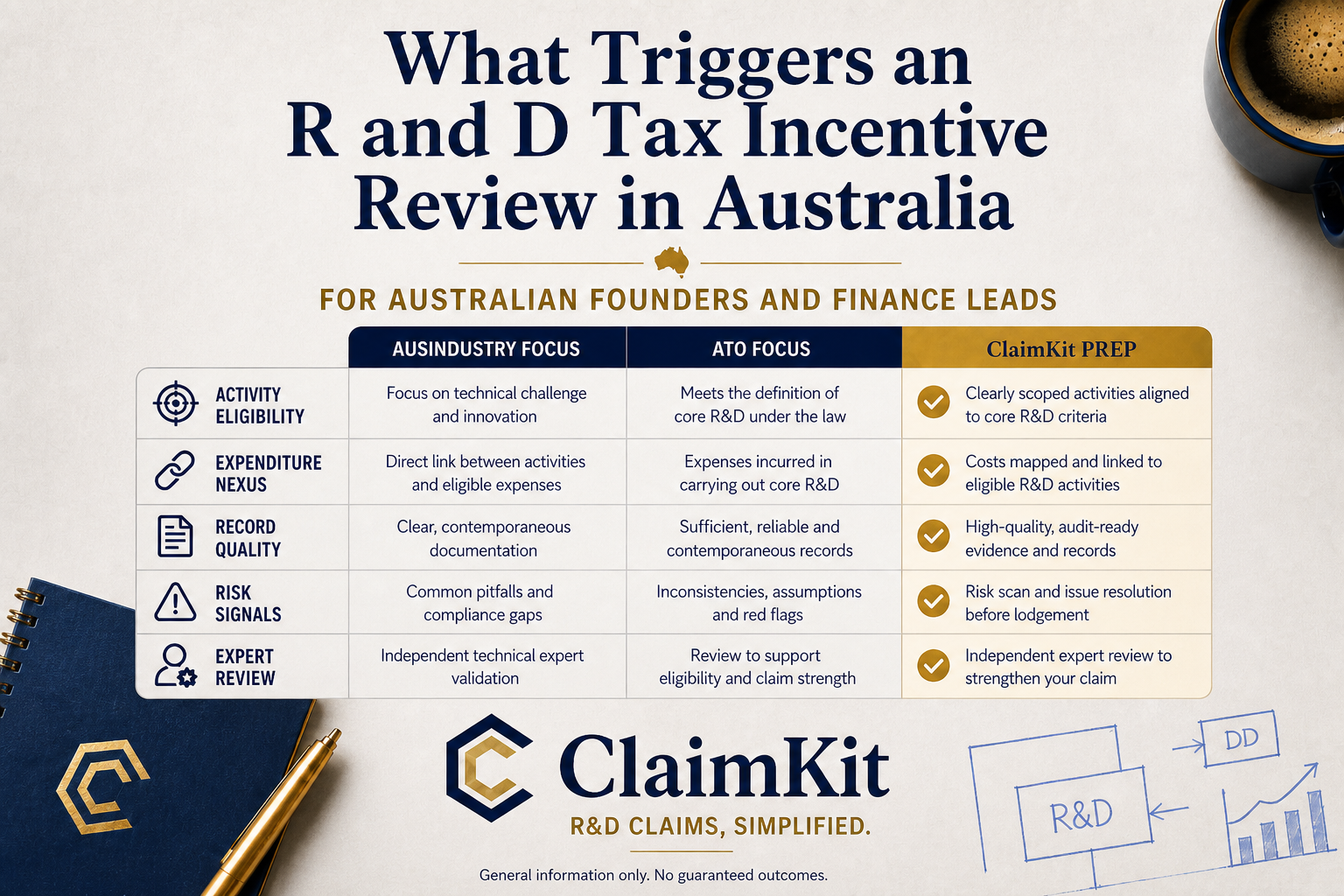
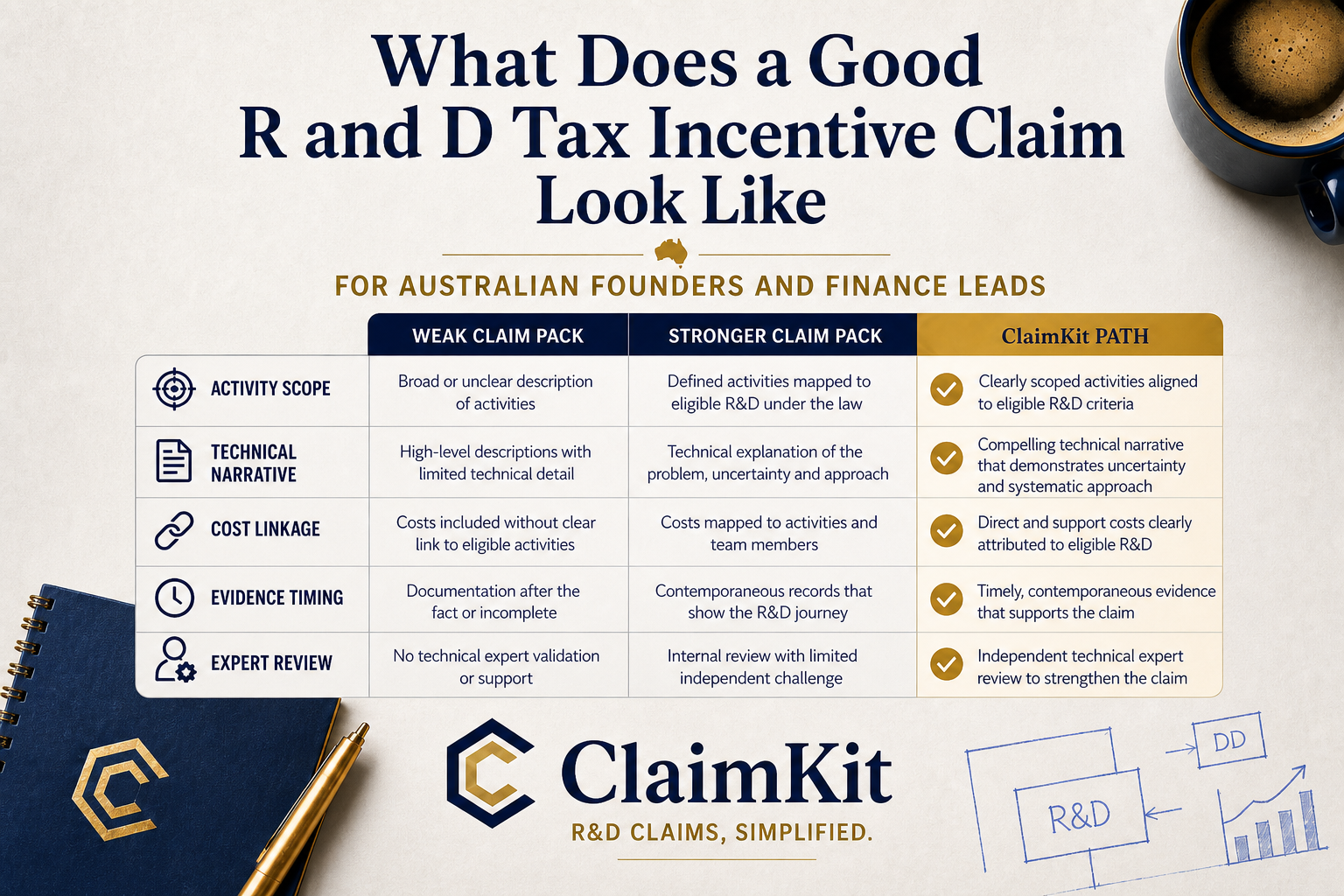 What does a good r&d tax incentive claim look like in Australia? For many eligible companies, a stronger claim reads like a complete evidence chain: clear core and supporting activities, technical narratives that explain uncertainty and experimentation, contemporaneous records, and expenditure that maps cleanly to those activities. A large offset amount alone does not make a claim good. Reviewers usually care whether the story, evidence, and numbers fit together. This is general information, not personal tax advice.
Eligible companies generally register activities with AusIndustry, then claim the offset through the company tax return. ClaimKit can help many stack-ready startups draft claim materials from tools they already use, then run expert review before lodgement. It does not guarantee approval or refunds. (business.gov.au R&D Tax Incentive)
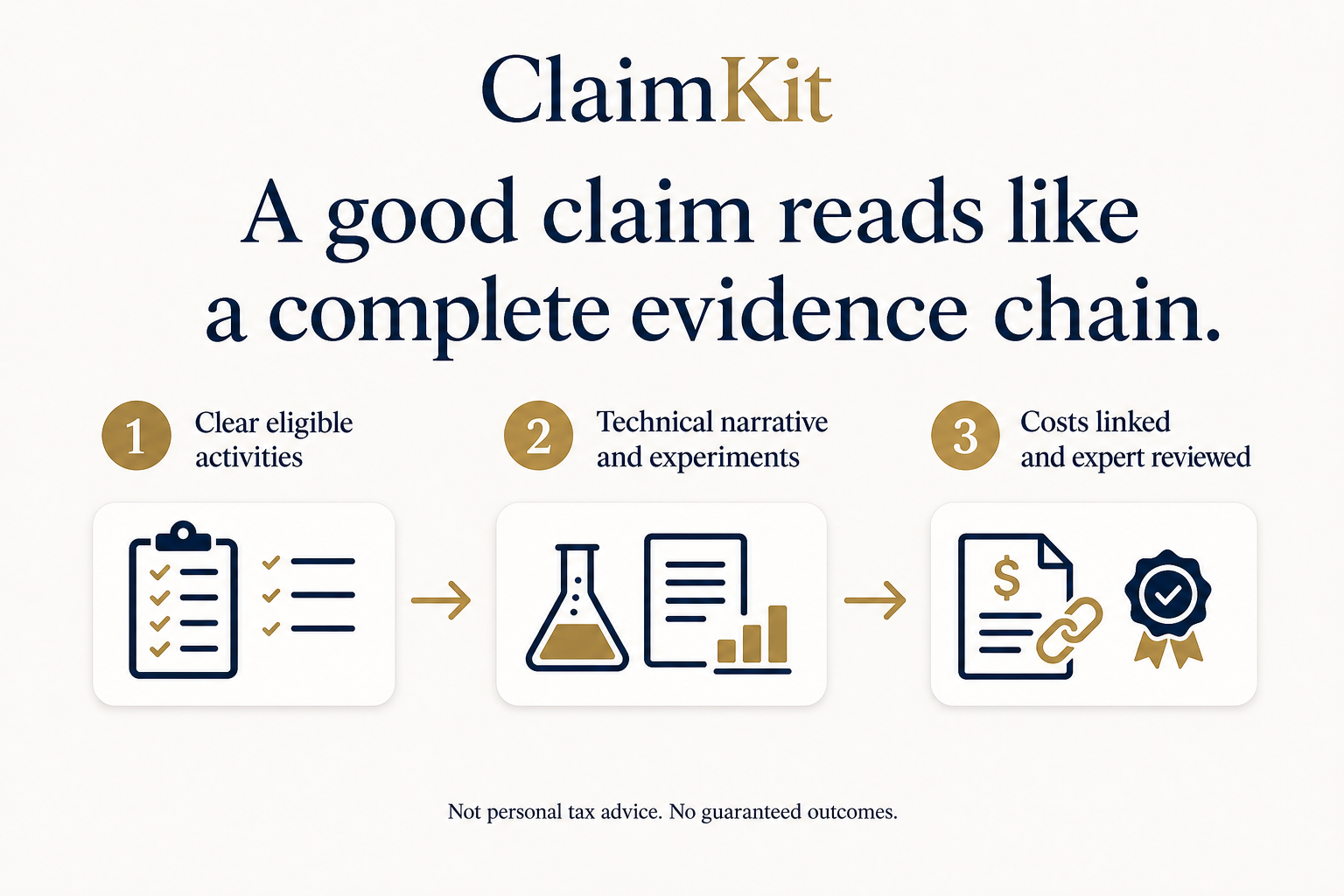
What does "good" mean for an R&D claim pack?
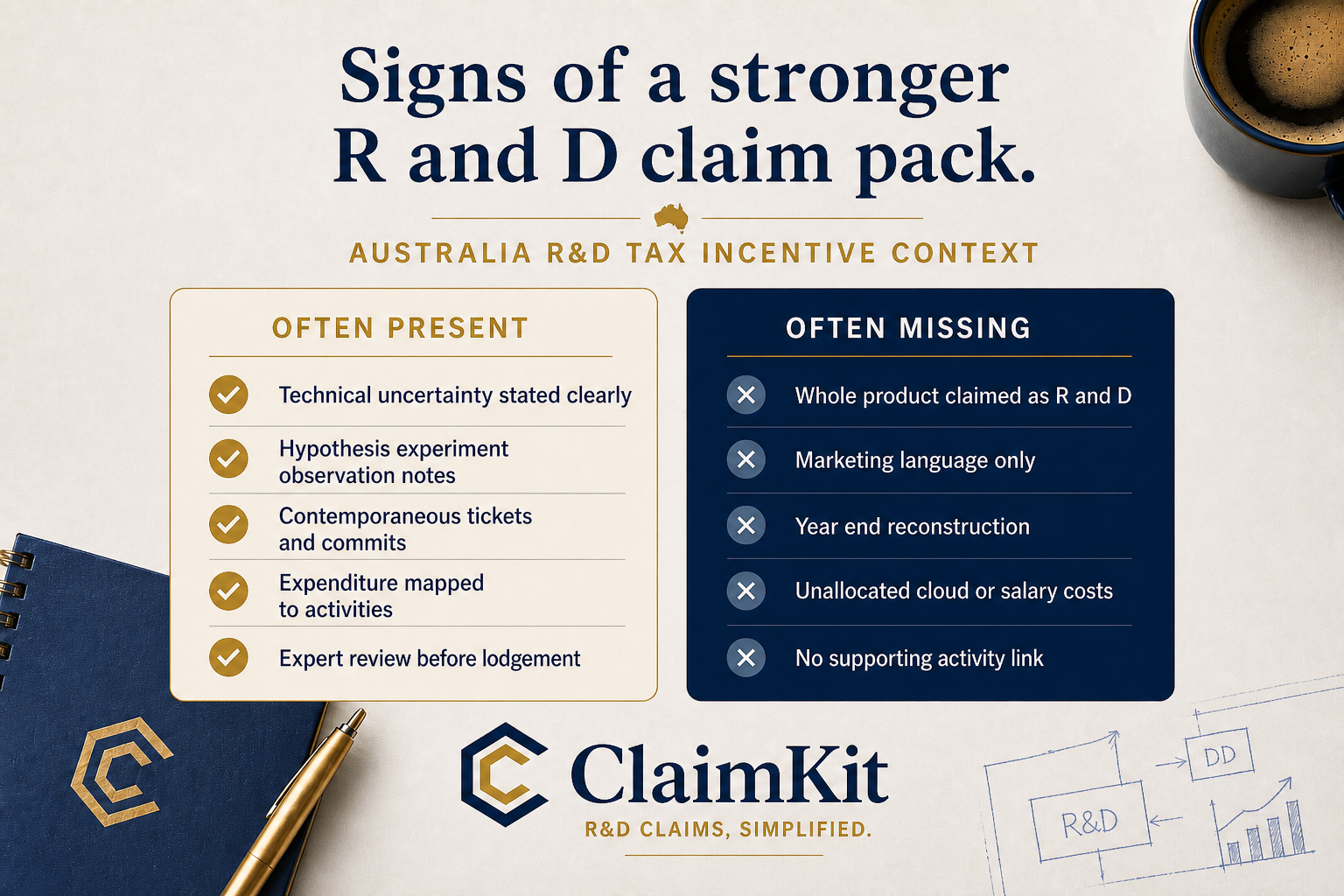
Good usually means defensible and coherent, not maximal. A stronger pack can show which work was experimental, why technical uncertainty existed, how the team tested it, what evidence was kept as work happened, and how costs were attributed. Weak packs often claim the whole product roadmap in marketing language with reconstructed records at year end.
Screen activity fit first with ClaimKit's R&D tax incentive eligibility guide, then build the pack around evidence quality rather than headline refund size.
What should the activity description look like?
Stronger activity descriptions usually isolate genuine experiments from routine delivery. They name the technical unknown, the approach tested, and the boundary between core R&D and ordinary product work. Claiming every feature as R&D often makes the pack look thin, even when some work may qualify.
For software and SaaS teams, that often means separating novel algorithms, uncertain architecture, or experimental pipelines from standard CRUD, UI polish, and known integrations. See Does my SaaS startup qualify for R&D tax incentive?.
What evidence usually sits inside a stronger claim?
Contemporaneous engineering and finance records usually beat year-end storytelling. Stronger packs often include experiment tickets, commits and PR discussion, design notes, failed-run logs, timesheets or people-cost mapping, and tagged invoices for contractors or cloud compute.
A practical evidence stack many teams use:
- Project case: what uncertainty existed and who worked on it
- Experiment case: hypothesis, method, observations, conclusions
- Cost case: salaries, contractors, and other spend mapped to activities
- Timing case: evidence created during the income year, not only after EOFY
- Review case: expert review before registration and lodgement
For the documentation habit, see How to document for R&D tax incentive compliance.
How should costs link to the activities?
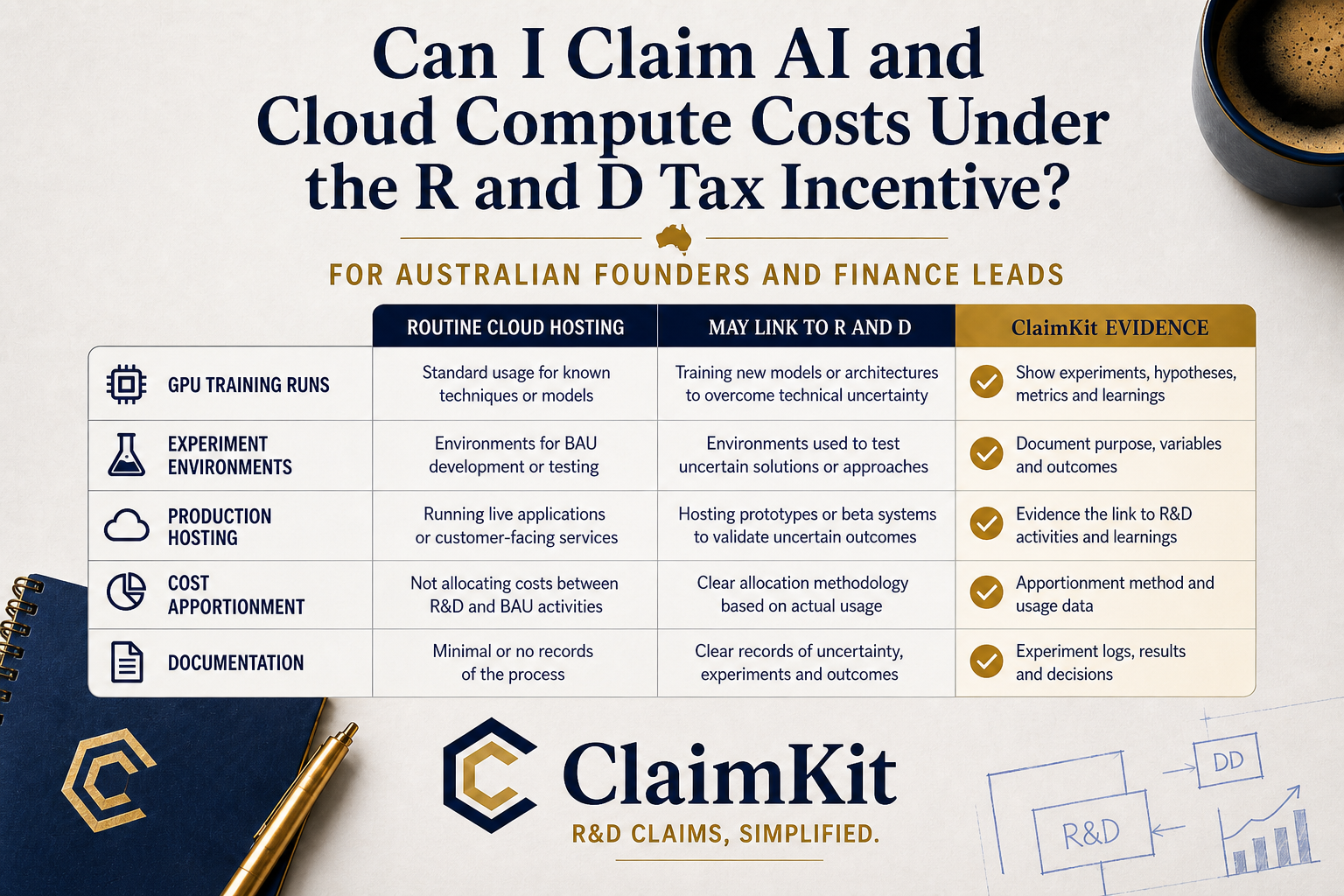
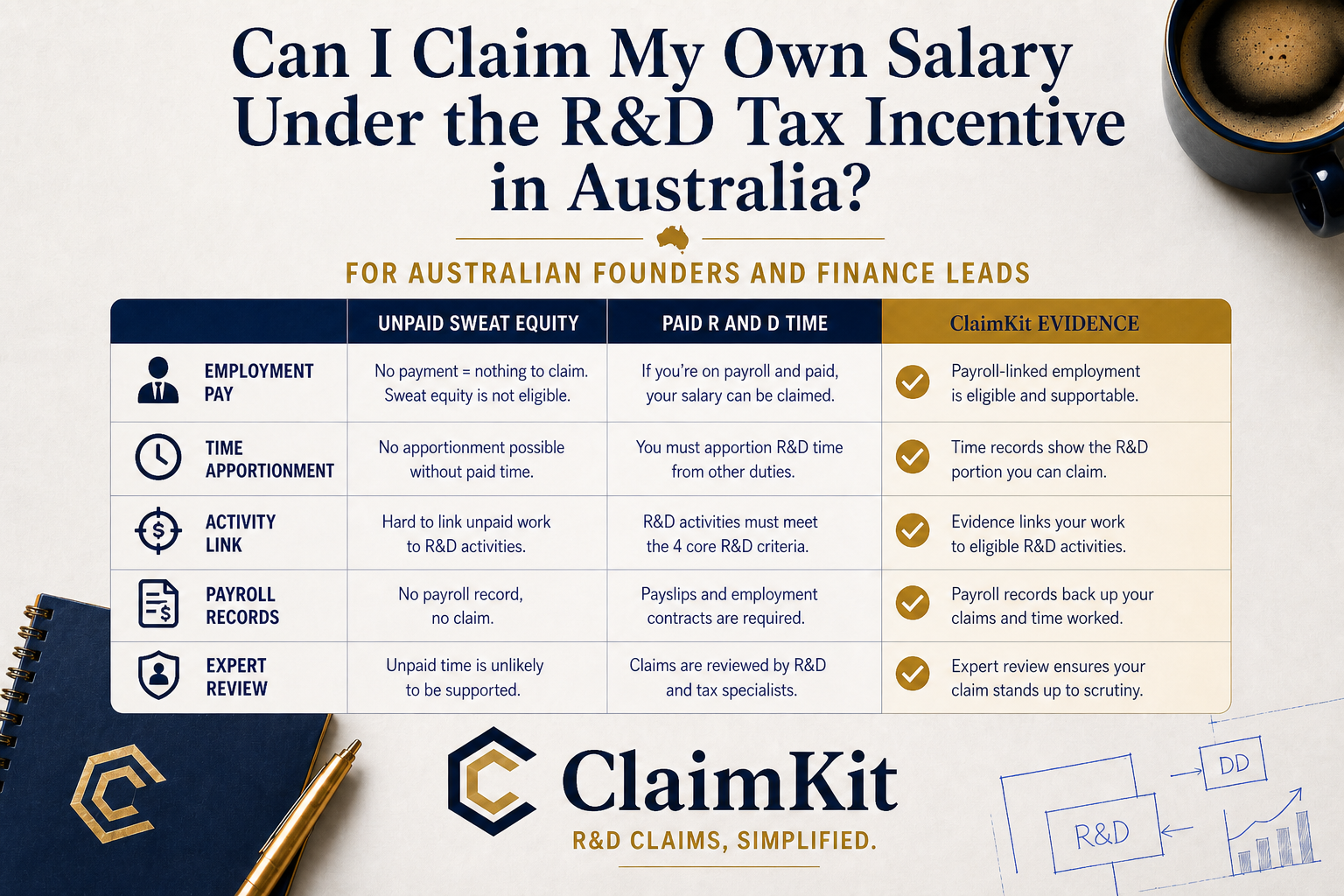
In a stronger claim, expenditure is explainable. People time, contractors, and cloud or GPU costs usually need a method that connects spend to registered activities. Unallocated company-wide bills and vague salary percentages often create review risk.
If AI or cloud compute is material, treat production hosting differently from experiment environments. Guide: Can I claim AI and cloud compute costs under the R&D tax incentive in Australia?.
How can ClaimKit help prepare a stronger claim pack?
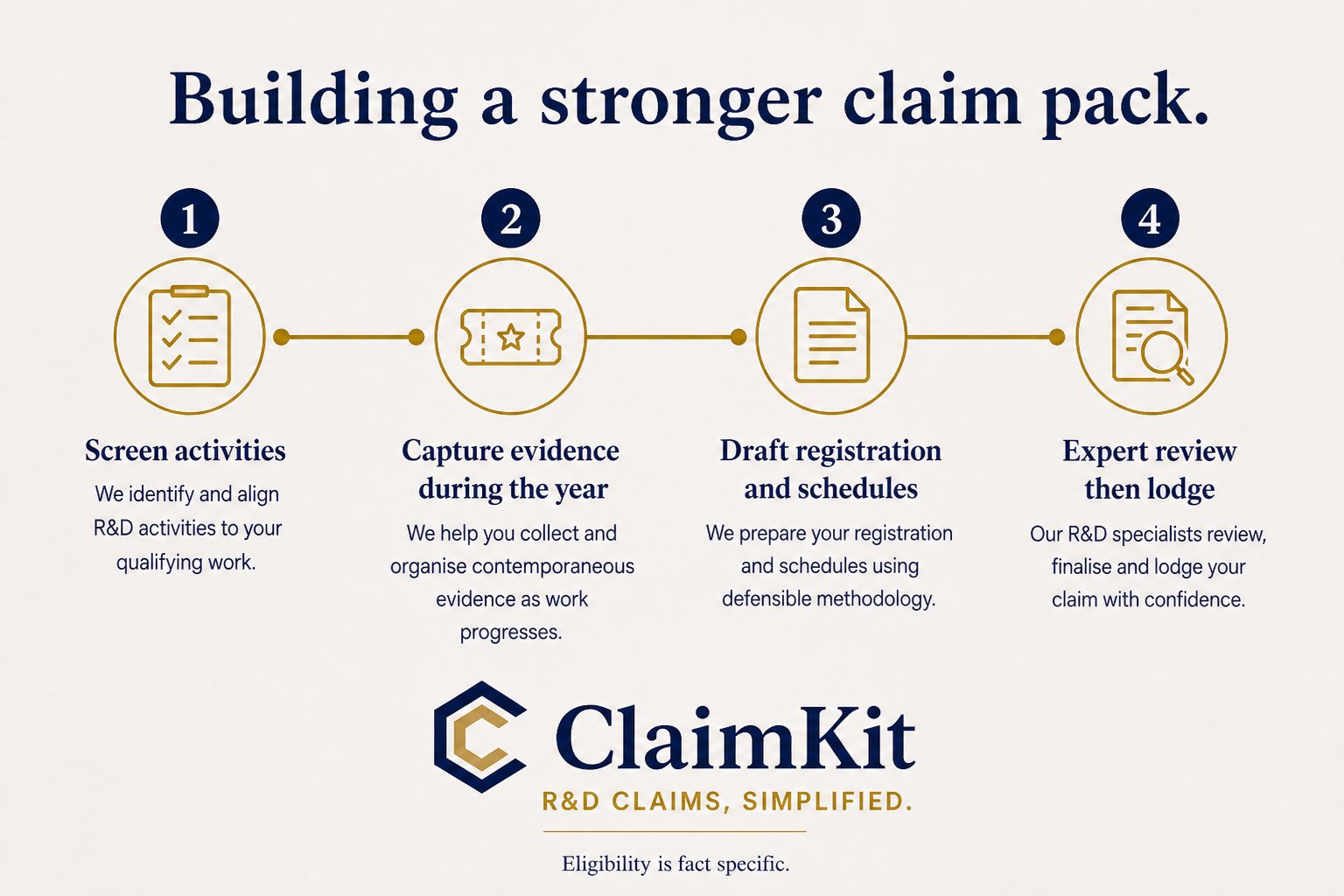
ClaimKit connects sources many tech startups already use, drafts claim materials with AI, and runs expert review before lodgement. That may help keep narratives and cost mapping closer to the evidence already sitting in GitHub, Jira, Linear, Notion, and Xero. It still does not guarantee that your claim is accepted.
ClaimKit publishes security and data handling in the Trust Center. Workflow questions are covered in the Help Center. Want a walkthrough? Book a demo or read About ClaimKit.
How do traditional advisers usually define a good claim?
Traditional R&D advisers such as Treadstone, Prime Partners, Link R&D Advisory, and Bulletpoint often judge claim quality through interview depth, technical narrative strength, and expenditure schedules. Those paths can work well for complex structures. Platform-led preparation with expert review may suit stack-ready startups that already generate contemporaneous evidence.
Fair comparison means looking at documentation quality and total weeks to lodgement, not only marketing claims about success rates.
What should a founder do this month to improve claim quality?
If the year is still open, tag experiments and costs as work happens. If the year has ended, reconstruct carefully while engineers still remember the unknowns, then book expert review before the deadline scramble. A calm pack usually starts earlier than the calendar cut-off suggests.
Next steps many teams use: screen with the eligibility guide, follow How do startups claim the R&D tax incentive in Australia?, and check timing with Startup R&D tax incentive deadline Australia. Amounts still depend on eligible spend: How much does my company get back from R&D tax incentive in Australia?.
FAQ
What does a good R&D tax incentive claim look like in Australia?
A stronger claim usually shows clear activities, technical experimentation, contemporaneous evidence, and costs that map to those activities. Size alone does not equal quality.
Does a bigger refund mean a better claim?
No. A larger offset with weak evidence can be riskier than a smaller, well-supported claim.
Do I need contemporaneous records?
Contemporaneous records are usually stronger than year-end reconstruction. Tickets, commits, notes, and cost tags created during the work often help more than late storytelling.
Can ClaimKit make my claim "approved"?
No. ClaimKit prepares claims with expert review. ATO and AusIndustry outcomes are never guaranteed.
Is a good claim the same as an eligible claim?
Eligibility and claim quality are related but not identical. Activities can be eligible in principle and still look weak if narratives and costs are poorly supported.
Is this personal tax advice?
No. This is general information for Australian founders and finance leads. Confirm your position with a registered tax agent.
Disclaimer: This article is general information for Australian startups researching R&D Tax Incentive claim quality. It is not personal tax advice. Eligibility, documentation standards, offset rates, and outcomes depend on your company's facts and may change with law and policy. ClaimKit prepares claims with expert review but does not guarantee ATO or AusIndustry outcomes. Confirm your position with a registered tax agent before registering or lodging.
Related reading: How to document for R&D tax incentive compliance · R&D tax incentive eligibility guide · How do startups claim the R&D tax incentive in Australia?
Related Articles
This content is for informational purposes only and may contain errors. Please contact us to verify important details.