Can I claim AI and cloud compute costs under the R&D tax incentive in Australia?

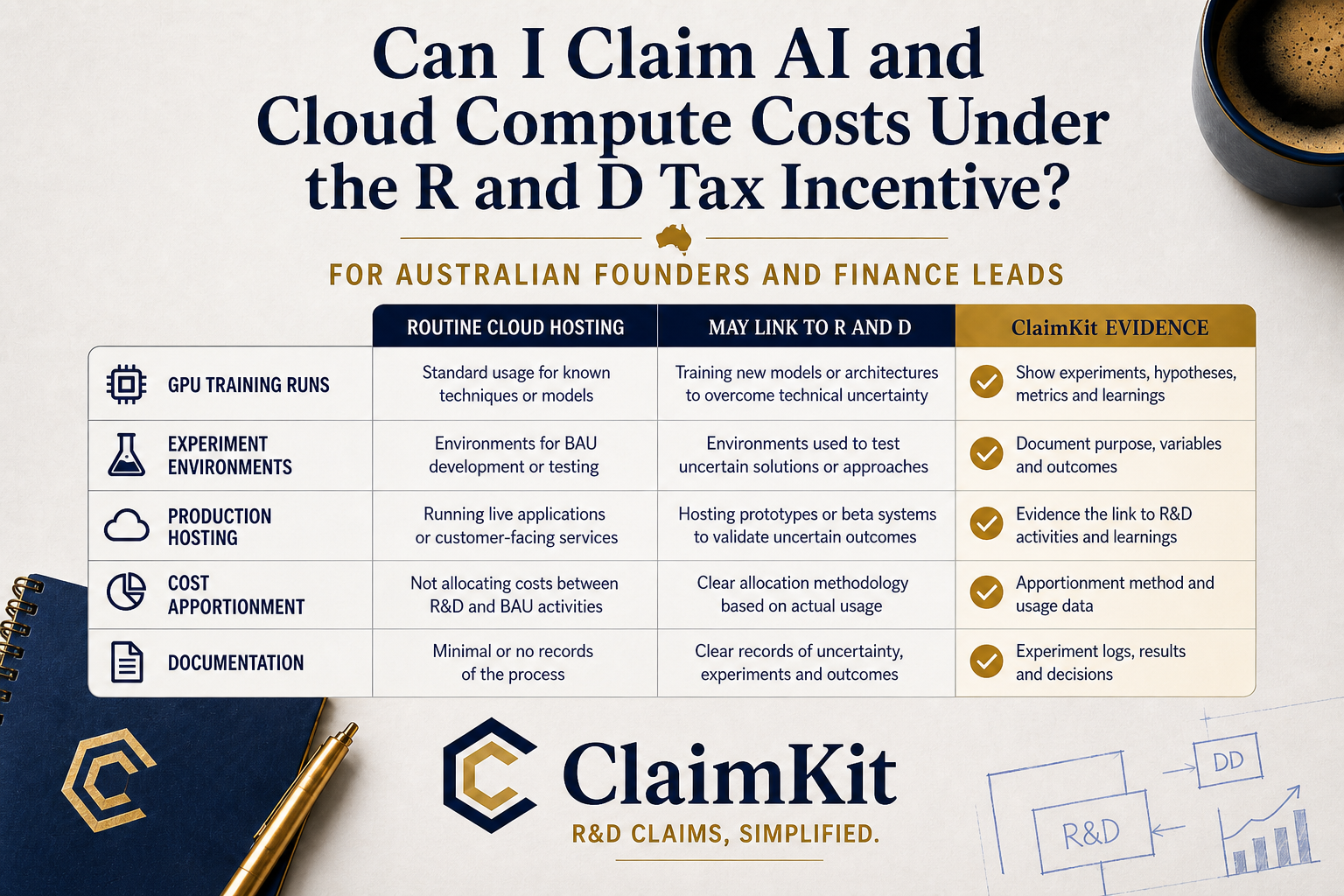 Can I claim AI and cloud compute costs under the R&D tax incentive in Australia? Often yes in part, when the spend is reasonably attributable to eligible R&D activities, not to routine production hosting. For many Australian tech startups, GPU training runs, experiment environments, and failed test jobs may be worth assessing. Always-on app hosting and unallocated company-wide cloud bills usually need careful apportionment or sit outside the claim. This is general information, not personal tax advice.
Eligible companies generally register activities with AusIndustry, then claim qualifying expenditure through the company tax return. ClaimKit can help many stack-ready teams connect engineering and finance evidence, draft claim materials, and run expert review before lodgement. It does not guarantee that your AI or cloud costs qualify or that a refund will issue. (business.gov.au R&D Tax Incentive)
What does "claimable" mean for AI and cloud spend?
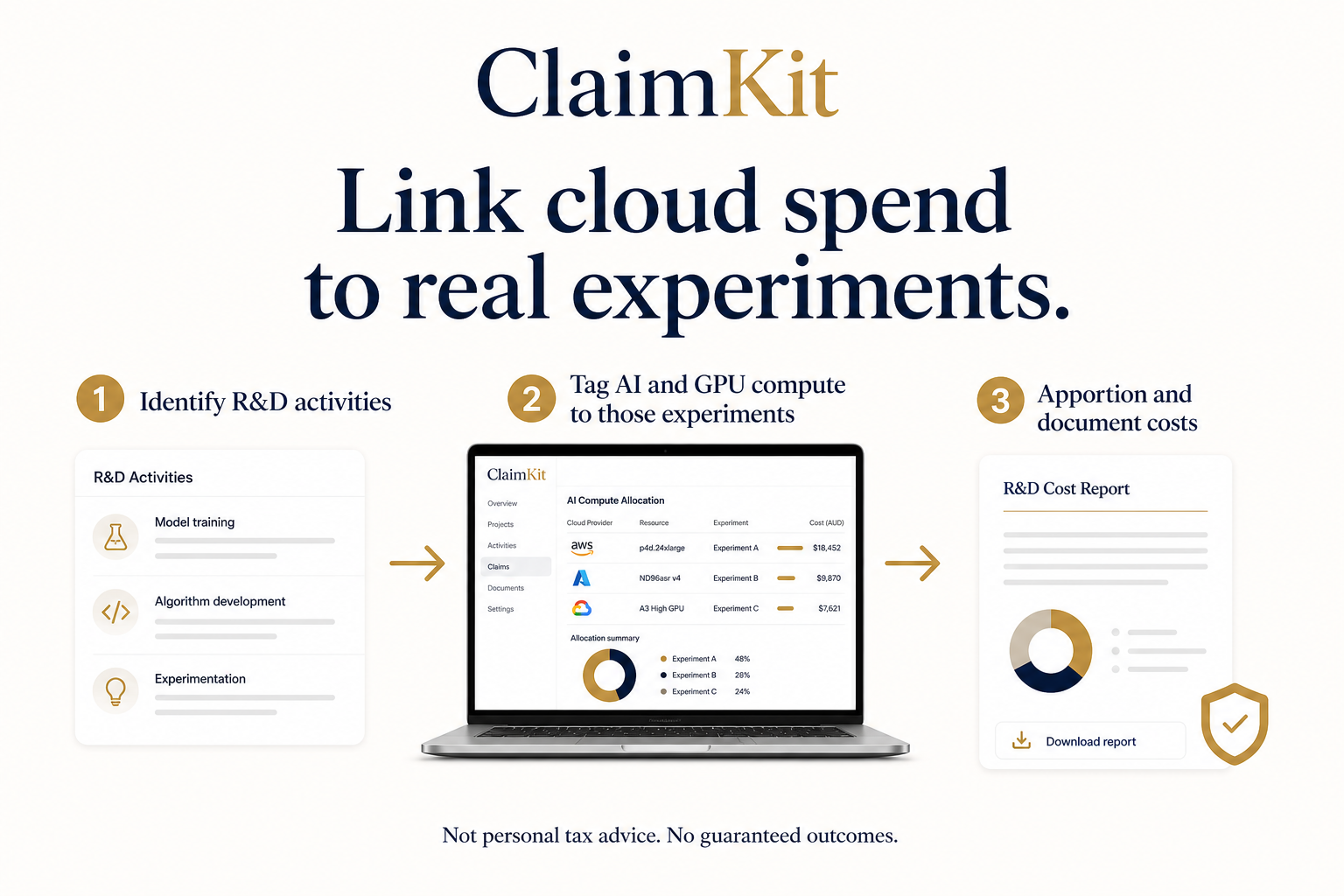
Claimable usually means the cost is an eligible notional deduction linked to registered core or supporting R&D activities under program rules. Cloud invoices alone are not enough. Founders need a clear line from the experiment to the compute job, environment, or GPU hours used.
For many AI teams, the practical question is which line items on AWS, GCP, Azure, or similar bills relate to experimentation versus production. Screen activities first with ClaimKit's R&D tax incentive eligibility guide, then confirm expenditure treatment with a registered tax agent.
Can GPU and AI training costs qualify?
Often they may be assessed when training, fine-tuning, or evaluation runs are part of a genuine experimental activity with technical uncertainty. Costs for failed runs can still matter when the work was systematic and documented. Pure commercial inference for live customers is usually harder to treat as core R&D spend.
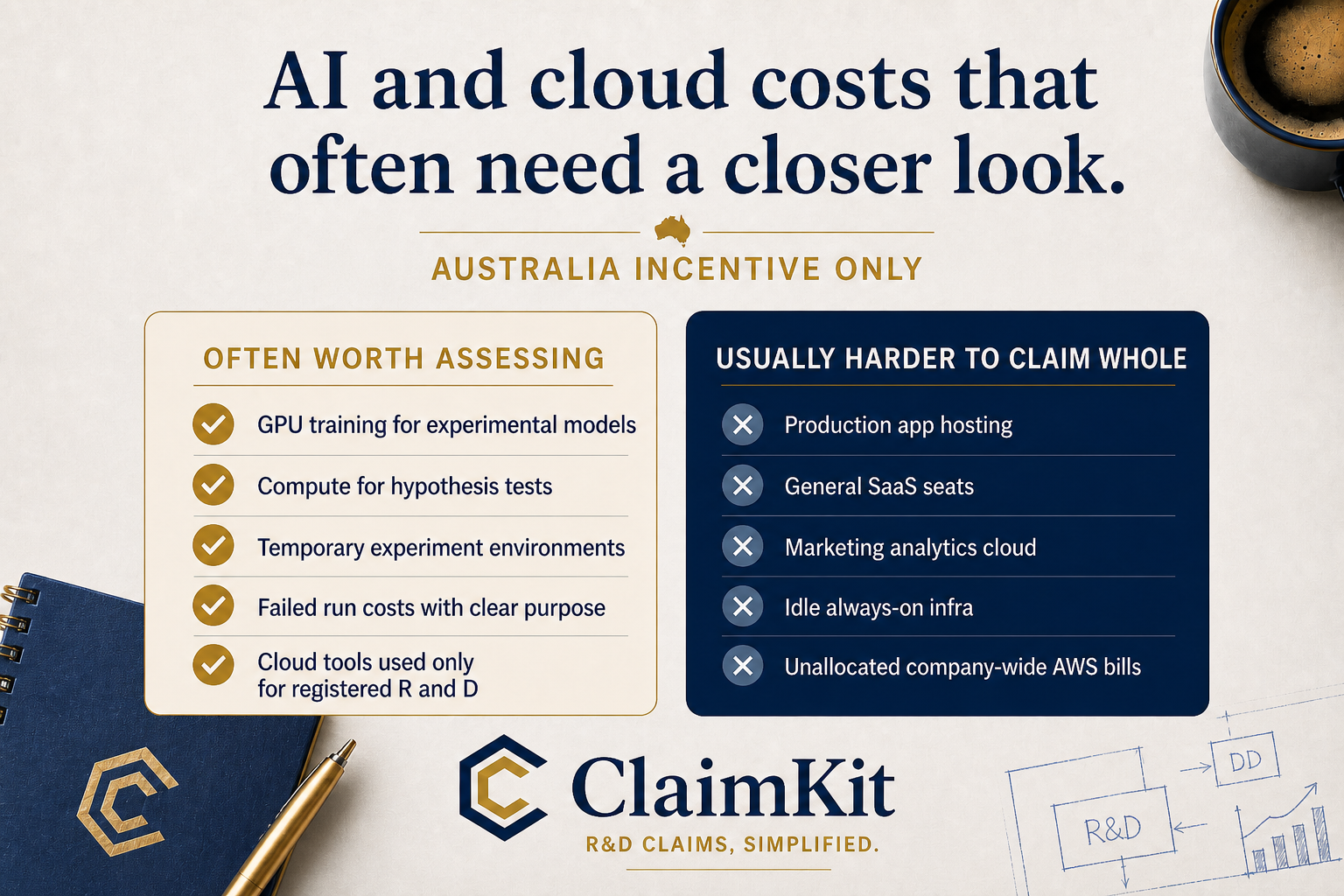
What often needs a closer look:
- GPU jobs tied to model experiments and hypotheses
- Temporary environments spun up for tests
- Benchmarking and ablation runs recorded in tickets or notebooks
- Contractor or platform fees used only for those experiments
What usually needs caution:
-
Production inference and customer-facing hosting
-
Always-on infra with no experiment tag
-
Marketing analytics cloud tools
-
Company-wide seats with no R&D apportionment method
Does production cloud hosting usually qualify?
Usually not in full. Hosting a live SaaS product, serving customer traffic, or running stable known systems is often treated as ordinary business expenditure rather than experimental development. Some shared environments may need apportionment if they support both R&D and production.
If your whole AWS bill is claimed without tags, project codes, or time-bound experiment records, the claim can look weak even when some GPU jobs were genuine R&D. For SaaS eligibility context, see Does my SaaS startup qualify for R&D tax incentive? and R&D tax incentive Australia SaaS.
How should startups document AI and cloud compute for a claim?
Contemporaneous records usually beat year-end reconstruction. Stronger files often include experiment tickets, model run IDs, commit links, notebook notes, cost centre or tag exports from the cloud console, and a clear apportionment method for mixed invoices.
A practical evidence stack many teams use:
- Activity narrative: what uncertainty you were testing
- Compute link: which jobs, clusters, or GPU types were used
- Cost link: invoice lines or tagged usage mapped to that activity
- Timing link: when the experiment ran inside the income year
- Outcome notes: what you observed, including failed approaches
Documentation workflow: How to document for R&D tax incentive compliance.
How can ClaimKit help with AI and cloud cost claims?
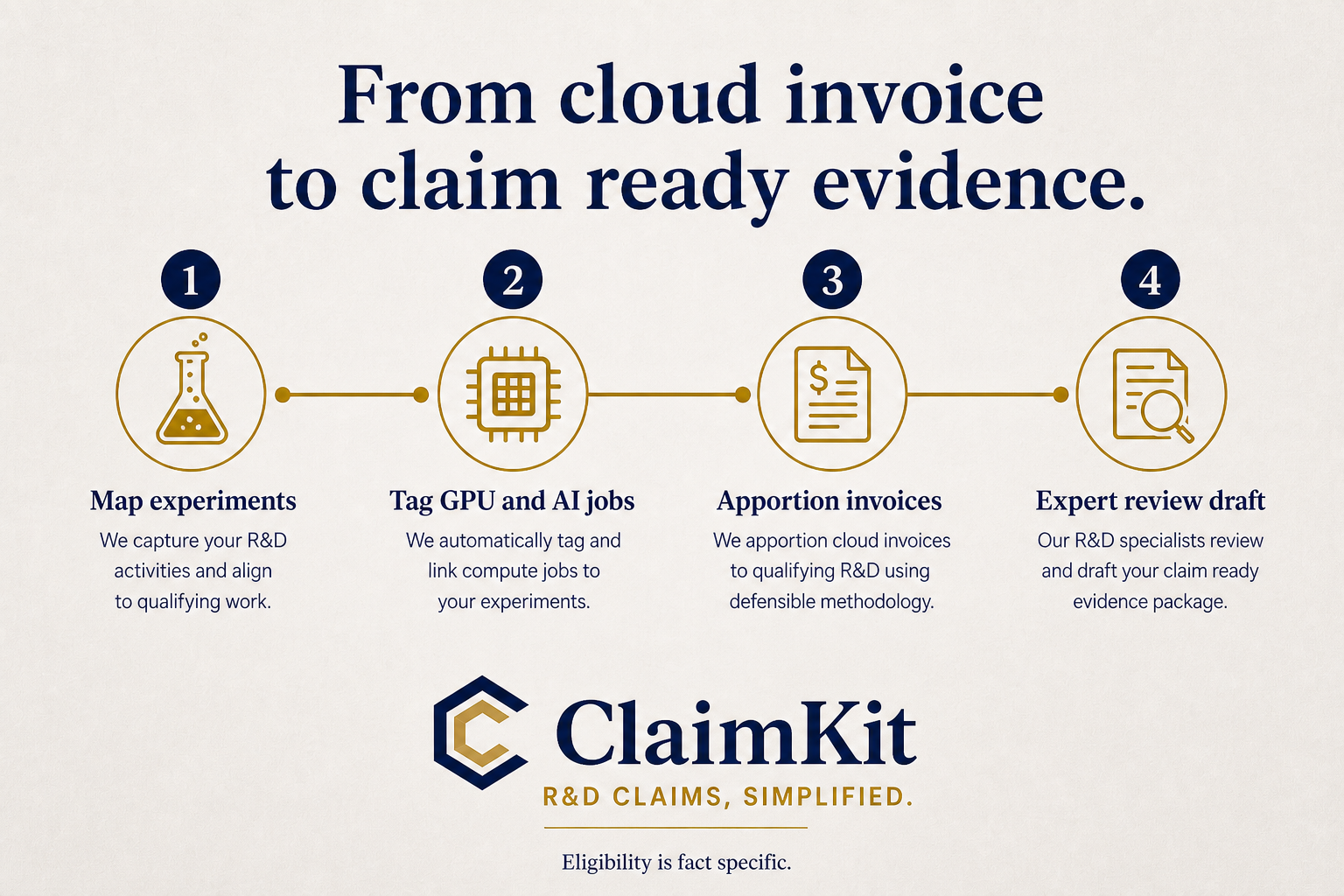
ClaimKit connects sources many tech startups already use, drafts claim materials with AI, and runs expert review before lodgement. That may help finance and engineering keep experiment tags, narratives, and cost mapping closer together than a year-end scramble. It still does not decide eligibility for you or guarantee ATO outcomes.
ClaimKit is built for Australian teams using tools such as GitHub, Jira, Linear, Notion, and Xero. Security and data handling are in the Trust Center. Workflow questions are covered in the Help Center. Want a walkthrough? Book a demo or read About ClaimKit.
How do traditional advisers usually treat cloud and GPU costs?
Traditional R&D advisers such as Treadstone, Prime Partners, Link R&D Advisory, and Bulletpoint often review cloud schedules through interviews and spreadsheet rebuilds. Those paths can work well for complex groups, but mixed AI bills can take longer when tags are missing. Platform-led preparation with expert review may move faster when usage data already sits in your stack.
Fair comparison means looking at apportionment quality and total weeks to lodgement, not only marketing claims about AI eligibility.
What should a founder do this month?
List AI experiments that had real technical unknowns, export tagged GPU or compute usage, and separate production hosting from experiment environments. If your income year has ended, lock the mapping while engineers still remember the runs. If the year is still open, start tagging jobs now.
Next steps many teams use: screen activities with the eligibility guide, follow How do startups claim the R&D tax incentive in Australia?, and estimate value with How much does my company get back from R&D tax incentive in Australia?.
FAQ
Can I claim AI and cloud compute costs under the R&D tax incentive in Australia?
Often yes in part, when costs are reasonably linked to eligible R&D activities and supported by records. Routine production hosting is usually harder to claim in full.
Are GPU training costs automatically eligible?
No. GPU spend may be assessed when it supports genuine experimentation. Automatic eligibility does not apply just because the workload uses AI.
Can I claim my whole AWS or GCP bill?
Usually not without apportionment. Mixed production and R&D usage generally needs a defensible split method and evidence.
Do failed model runs count?
Failed experimental runs may still be relevant when they were systematic, documented, and tied to registered activities. Confirm treatment with a registered tax agent.
Does ClaimKit guarantee my cloud costs will be accepted?
No. ClaimKit prepares claims with expert review. Approval and eligible amounts are never guaranteed.
Is this personal tax advice?
No. This is general information for Australian founders and finance leads. Confirm your position with a registered tax agent.
Disclaimer: This article is general information for Australian startups researching AI, cloud compute, and the R&D Tax Incentive. It is not personal tax advice. Eligibility, apportionment, offset rates, and outcomes depend on your company's facts and may change with law and policy. ClaimKit prepares claims with expert review but does not guarantee ATO or AusIndustry outcomes. Confirm your position with a registered tax agent before registering or lodging.
Related reading: R&D tax incentive eligibility guide · How to document for R&D tax incentive compliance · Does my SaaS startup qualify for R&D tax incentive?
Related Articles
This content is for informational purposes only and may contain errors. Please contact us to verify important details.