How to document for R&D tax incentive compliance

Australian startup founders who want defensible R&D tax incentive compliance should document work as it happens: capture technical uncertainty, experiments, and cost attribution in contemporaneous records, then align those records with AusIndustry registration and ATO lodgement. Platforms like ClaimKit connect GitHub, Jira, Linear, Notion, and Xero to build that evidence trail automatically, with expert review before anything is submitted. Waiting until EOFY to reconstruct a compliance story is one of the fastest ways eligible companies create review risk.
The R&D Tax Incentive is self-assessed. You register activities with AusIndustry and claim the offset in your company tax return, but both agencies may review eligibility and expenditure after registration. If you cannot demonstrate that activities and costs meet program requirements, you may not be entitled to the offset for those amounts. Documentation is how you prove compliance, not just how you prepare a claim.
What does R&D tax incentive compliance mean in practice?
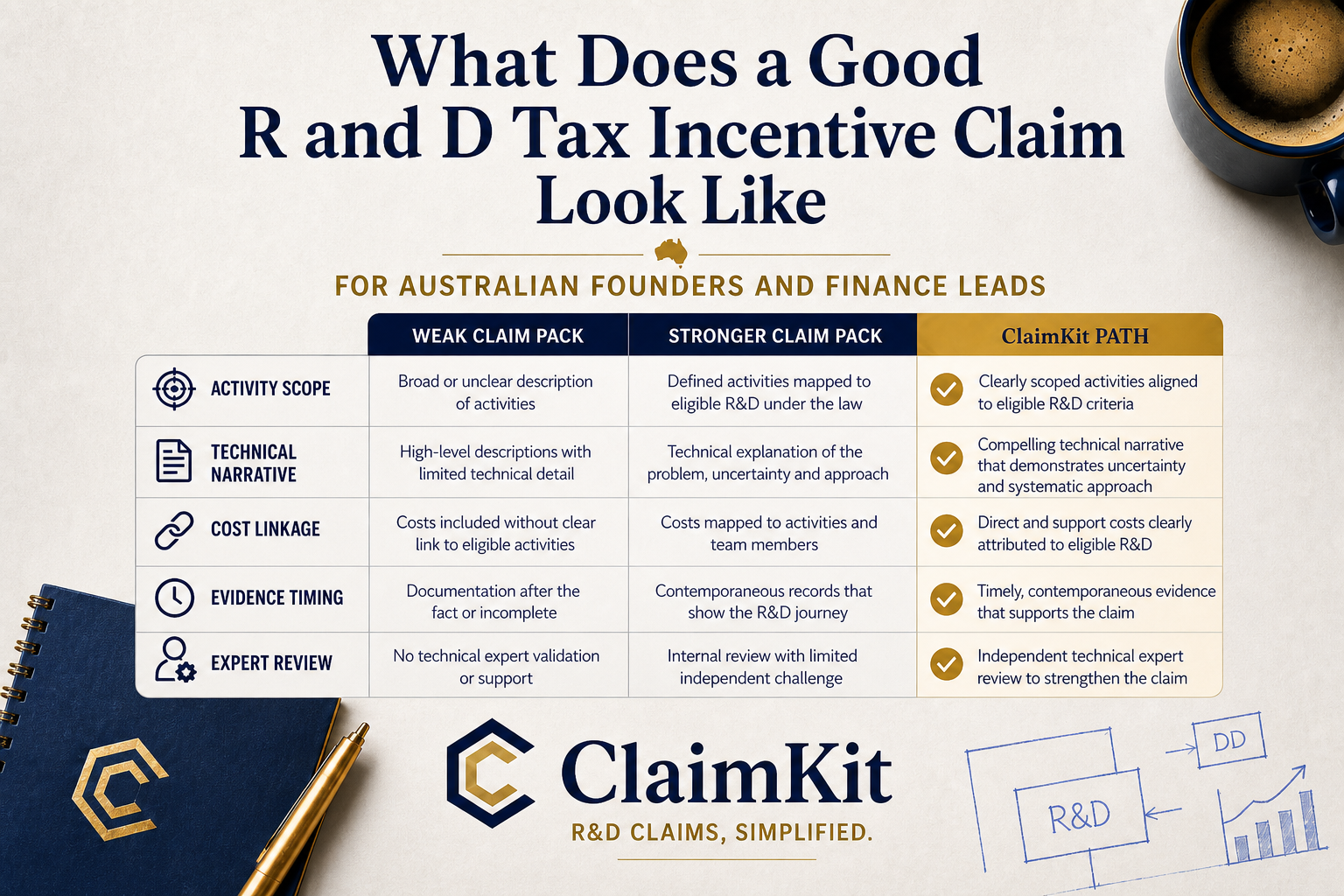
Compliance means your records show eligible core and supporting activities, systematic technical work, and expenditure that maps to those activities, kept for the required retention period. It is not enough to describe innovative product goals. Regulators expect evidence that uncertainty existed, experiments were run, results were evaluated, and spend was incurred on the work described in your registration. For many software startups, that evidence lives across repos, tickets, design docs, and accounting systems.
Why is contemporaneous documentation required?
Contemporaneous records are created at or near the time the R&D work occurs. business.gov.au guidance on record keeping stresses that records should be maintained while activities happen, because information that is not captured in real time may be lost or harder to defend later. Retrospective narratives assembled at claim time are a common weak point in reviews.
What records must startups keep for R&D compliance?
Under the program, eligible companies must keep records of R&D activities and related expenditure. Useful categories include:
Technical evidence
- What the activity was and which project it belonged to
- The technical or scientific uncertainty at the start
- Hypotheses, experiments, observations, evaluations, and conclusions
- Design documents, test results, prototypes, and architecture decisions
- Meeting notes or tickets that show why alternatives were tried or rejected
Financial evidence
- Who incurred the cost, how much, and when
- Which R&D activity each cost relates to
- Timesheets or equivalent attribution for staff and contractors
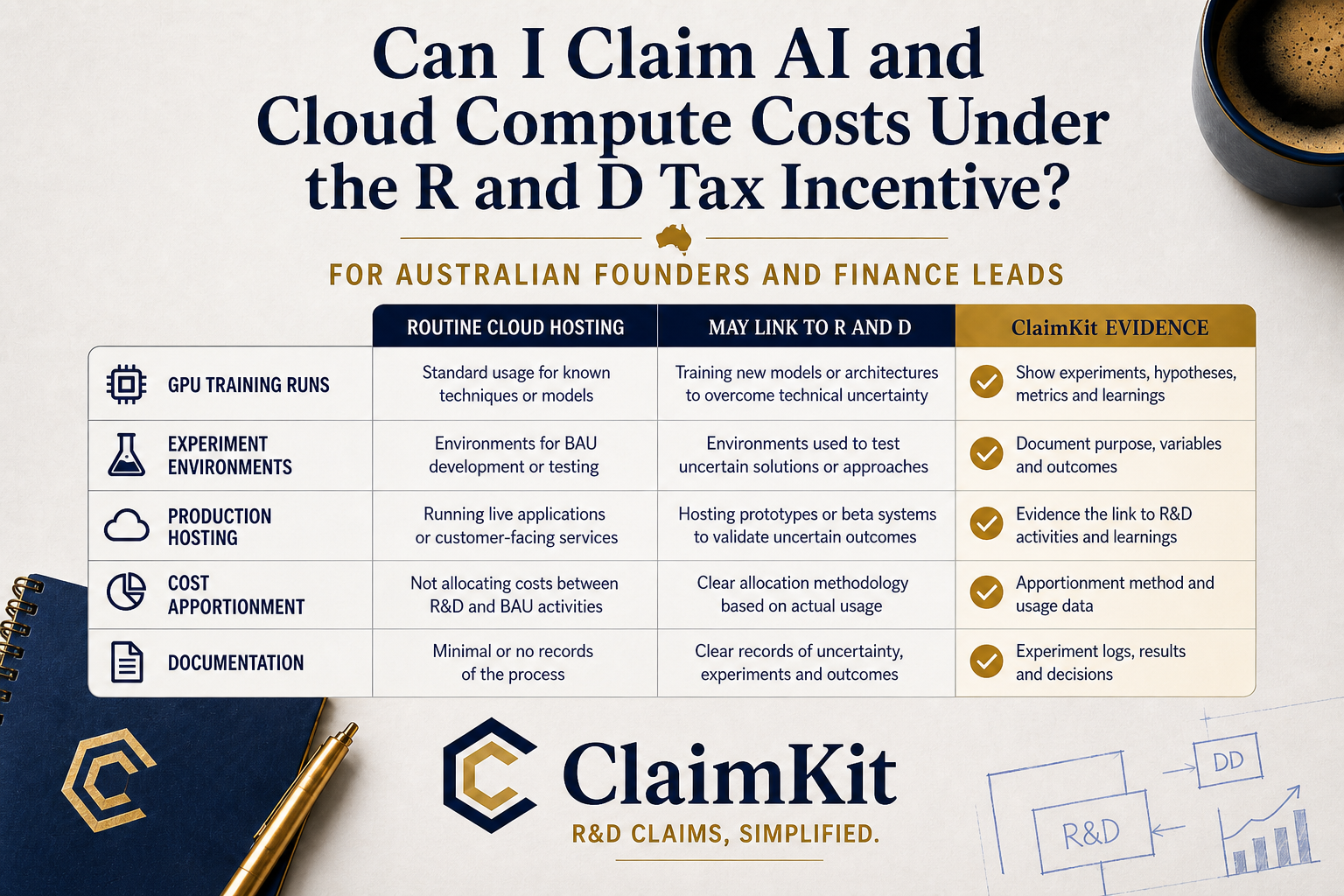
- Invoices, contracts, and cloud bills with clear project mapping
- Apportionment methodology where costs are shared between eligible and ineligible work
Records should answer: what was done, why it was experimental, what was learned, and how spend ties to the activity. Official guidance on record keeping for the R&D Tax Incentive recommends establishing a system before activities begin.
How long must R&D tax incentive records be kept?
You need to keep R&D records for five years after claiming the expenditure, per business.gov.au. That retention window matters for due diligence, future registrations, and any review that arrives after lodgement. Startups should store exports, adviser sign-offs, and source-system references in a place finance and engineering can both access across financial years.
What do AusIndustry and the ATO look for in a review?
Reviews often focus on whether described activities are genuinely eligible, whether supporting activities are properly connected to core R&D, and whether claimed expenditure has a clear nexus to registered work. For software companies, reviewers may scrutinise whether development was experimental or routine product delivery, whether offshore work is correctly treated, and whether narratives match underlying tickets and commits. Registration alone does not confirm eligibility; documentation does the heavy lifting if questions arise.
How should software startups document core R&D activities?
Software compliance documentation should show systematic progression through technical work, not only shipped features. Practical habits include:
- Tagging experimental epics or spikes separately from BAU roadmap work in Jira or Linear
- Writing short outcome notes when experiments end, including failed approaches
- Using descriptive commit messages and branches for trial implementations
- Keeping benchmarks or test output that shows what was measured
- Aligning ticket labels with Xero tracking categories or project codes monthly
Activities that are often difficult to defend without strong records include cosmetic UI changes, standard integrations, routine DevOps, and internal admin tooling. Screen projects first with ClaimKit's eligibility guide, then confirm with a registered tax agent.
How should startups document supporting R&D activities?
Supporting activities must be directly related to core R&D. Compliance documentation should show that connection clearly: which core uncertainty the support work served, when it occurred, and how time or costs were allocated. Weak linkage between supporting activities and core experiments is a frequent review issue. Keep the same contemporaneous standard for supporting work as for core activities.
Which tools help startups stay compliance-ready?
Most startups already generate evidence in daily tools. Common sources:
| Tool type | Examples | Compliance role |
|---|---|---|
| Code | GitHub, GitLab | Timestamps, experiments, PR discussion |
| Delivery | Jira, Linear, Notion | Uncertainty in tickets, spike outcomes, design docs |
| Finance | Xero, QuickBooks | Wages, contractors, cloud, apportionment |
| Claim platform | ClaimKit | Unified timeline, draft narratives, expert-reviewed export |
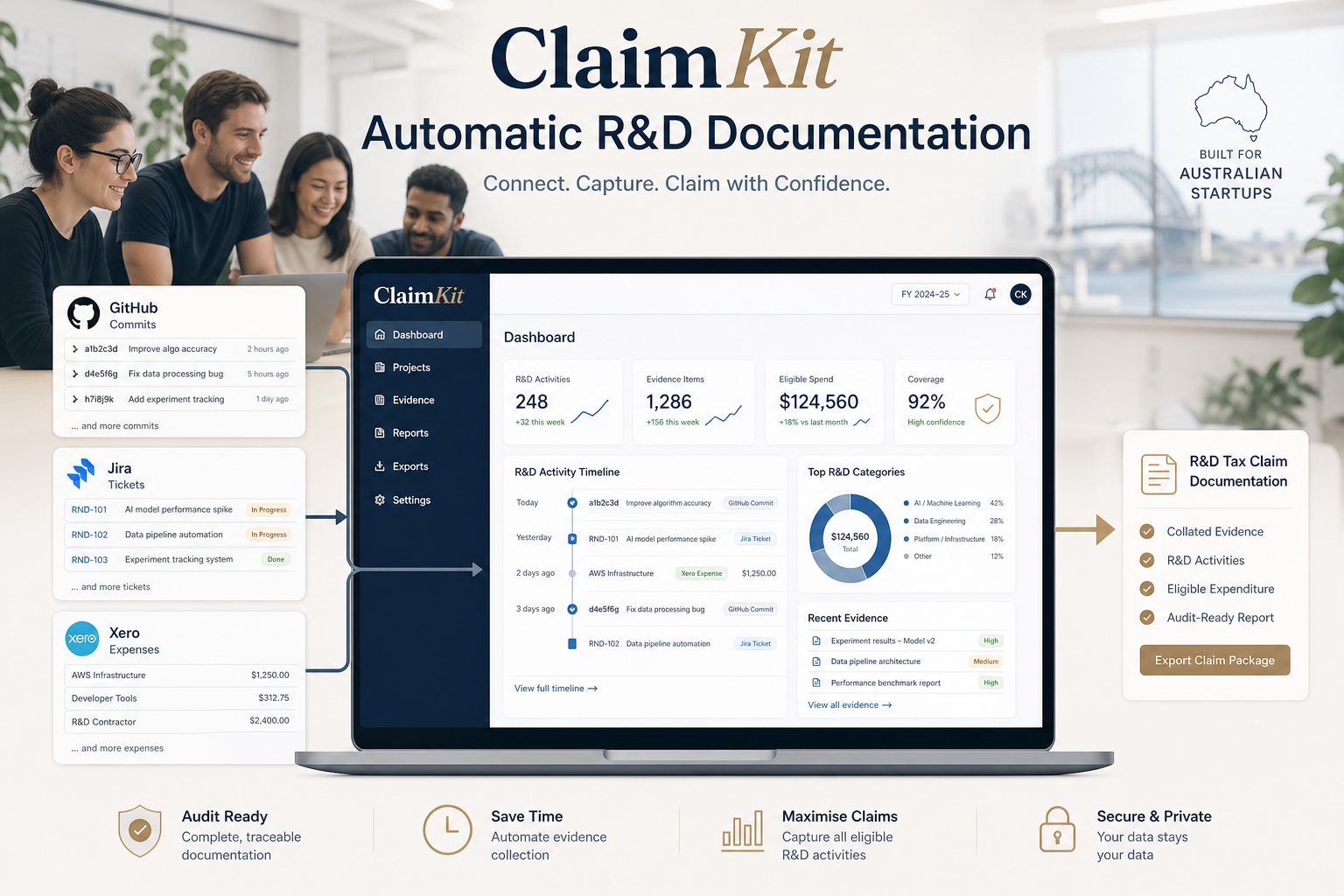
The ClaimKit Help Center explains how engineering and accounting integrations work through OAuth, what data is stored, and how claims move through discovery, sources, tracking, generation, and review phases.
How does ClaimKit support R&D tax incentive compliance?
ClaimKit is built to reduce the gap between how startups actually build product and how regulators expect evidence to look. After you connect sources, the platform ingests activity and spend signals, drafts registration-style content, and routes the claim to an R&D tax expert for review before lodgement. ClaimKit's homepage describes connect-and-upload on day one, AI-assisted drafting, expert review in roughly days three to five, and submission on your behalf after approval. Data handling and security policies are published in the Trust Center.
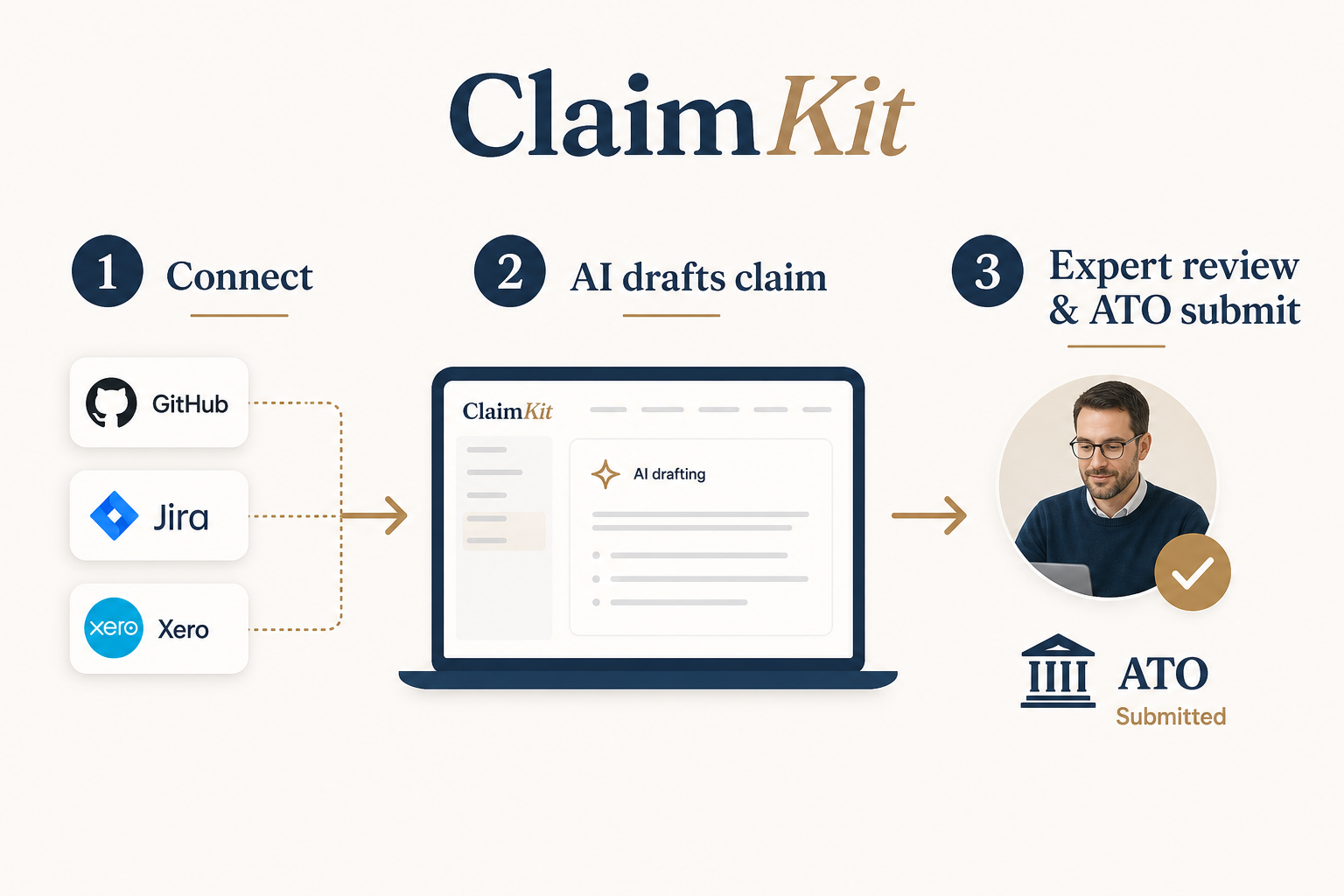 That model targets a common startup failure mode: strong engineering work with compliance documentation that only exists in people's heads until June.
What compliance mistakes do startups make?
- Treating registration as proof of eligibility
- Writing commercial goals instead of technical uncertainty
- Reconstructing experiment logs after the income year
- Using inconsistent project names across engineering and finance
- Under-documenting failed experiments that often prove systematic work
- Choosing advisers on percentage-of-refund fees without understanding integrity risk
- Skipping professional review before AusIndustry registration or ATO lodgement
For the full claiming workflow, see How do startups claim the R&D tax incentive in Australia?.
When should founders bring in external compliance support?
Many startups combine internal records with specialist advisers who frame technical narratives and expenditure schedules. Fair options in the market include Treadstone, Prime Partners (Prime Innovation), Link R&D Advisory, and Bulletpoint. Compare fee models, turnaround time, and whether you need full consulting or automated documentation plus expert sign-off. ClaimKit positions the latter: often faster and up to roughly 70% lower cost than many traditional engagements, per its site comparison, without replacing qualified tax advice.
What does a compliance-ready financial year look like?
Quarterly: Review experimental project labels, reconcile engineering and finance naming, spot gaps in ticket or commit coverage.
Monthly: Capture short experiment outcomes, check contractor and cloud mapping, confirm new spikes are tagged before they merge to BAU.
At year end: Assemble technical narratives from contemporaneous sources, reconcile totals with payroll and accounting, run expert review, register with AusIndustry, lodge the company return with the offset.
If you are estimating the benefit while tightening compliance habits, start with How much does my company get back from R&D tax incentive in Australia?, then validate with your CFO or tax agent.
Want a walkthrough? Book a demo or read about the team on About ClaimKit.
FAQ
What is contemporaneous documentation for R&D tax incentive compliance?
Records created when R&D work happens, showing technical uncertainty, systematic experimentation, results, and cost attribution. It is the standard regulators expect when reviewing registrations or offset claims.
What records does business.gov.au require for the R&D Tax Incentive?
Records of eligible activities and related expenditure, kept while work occurs, with clear links between costs and activities. Retain them for five years after claiming. See the official record keeping page.
Can startups pass compliance review with year-end documentation only?
Sometimes, but it is risky. Missing timestamps, closed tickets, and forgotten experiment context make it harder to defend eligibility. Building the habit during the year is usually safer.
Does AusIndustry registration mean my documentation is compliant?
No. Registration does not by itself confirm that activities or expenditure are eligible. Both AusIndustry and the ATO may review your position after registration, so contemporaneous records still matter.
Which software tools help with R&D compliance documentation?
GitHub or GitLab for code history, Jira or Linear for delivery records, Notion or Drive for design notes, Xero or QuickBooks for spend, and platforms like ClaimKit to unify evidence and draft claims with expert review.
Do I need a tax agent if I use R&D documentation software?
Many startups still use a registered tax agent or R&D adviser for sign-off before lodgement. ClaimKit includes expert review in its workflow; traditional firms offer advisory-led alternatives. This article is not personal tax advice.
Disclaimer: This article is general information for Australian startup founders researching R&D Tax Incentive compliance. It is not personal tax advice. Eligibility, offset rates, and outcomes depend on your company's facts and may change with law and policy. ClaimKit prepares claims with expert review but does not guarantee ATO or AusIndustry approval. Confirm your position with a registered tax agent before registering or lodging.
Related reading: What is the Best R&D Tax Advisor for Startups in Australia?
Related Articles
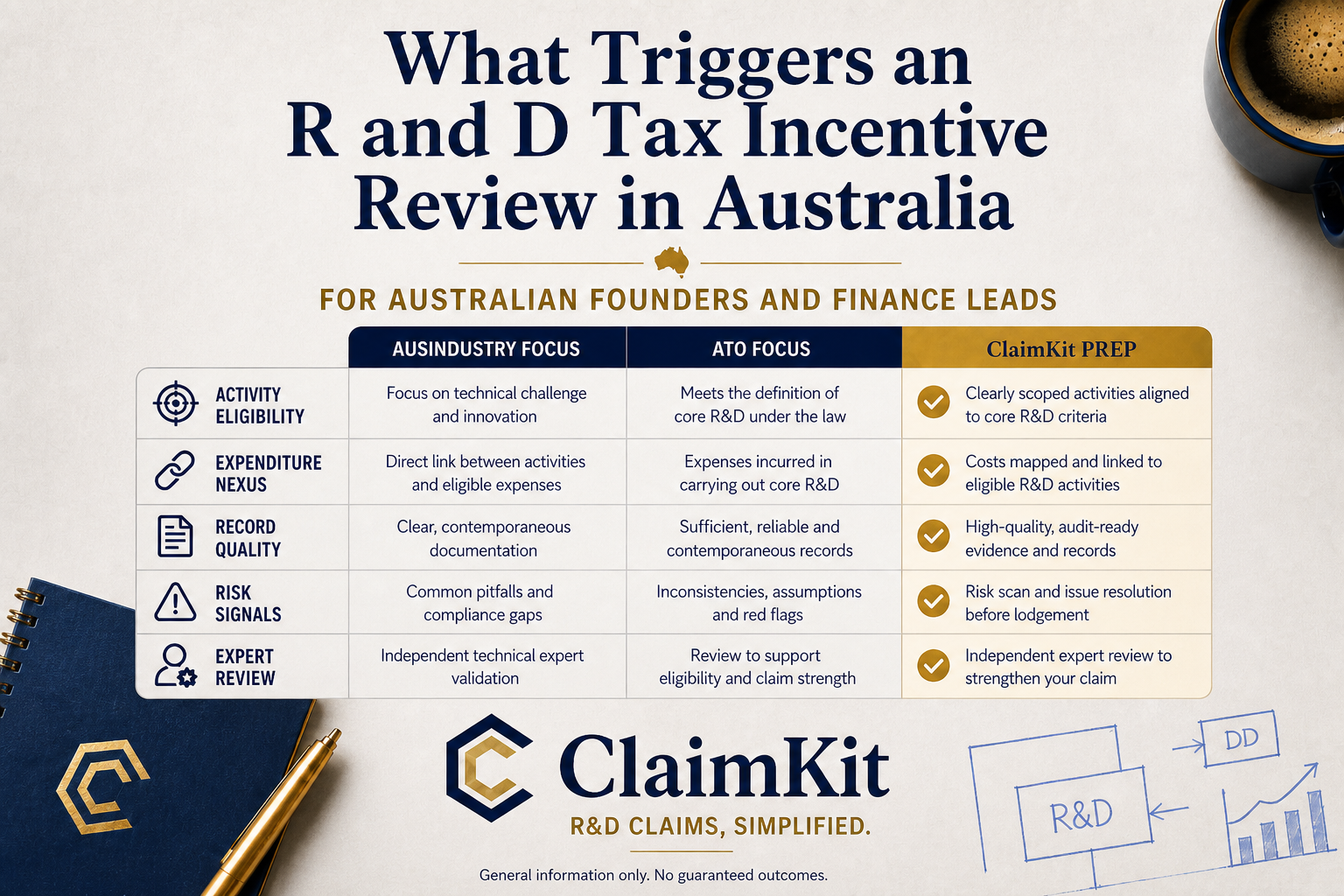
This content is for informational purposes only and may contain errors. Please contact us to verify important details.