Does my SaaS startup qualify for R&D tax incentive?

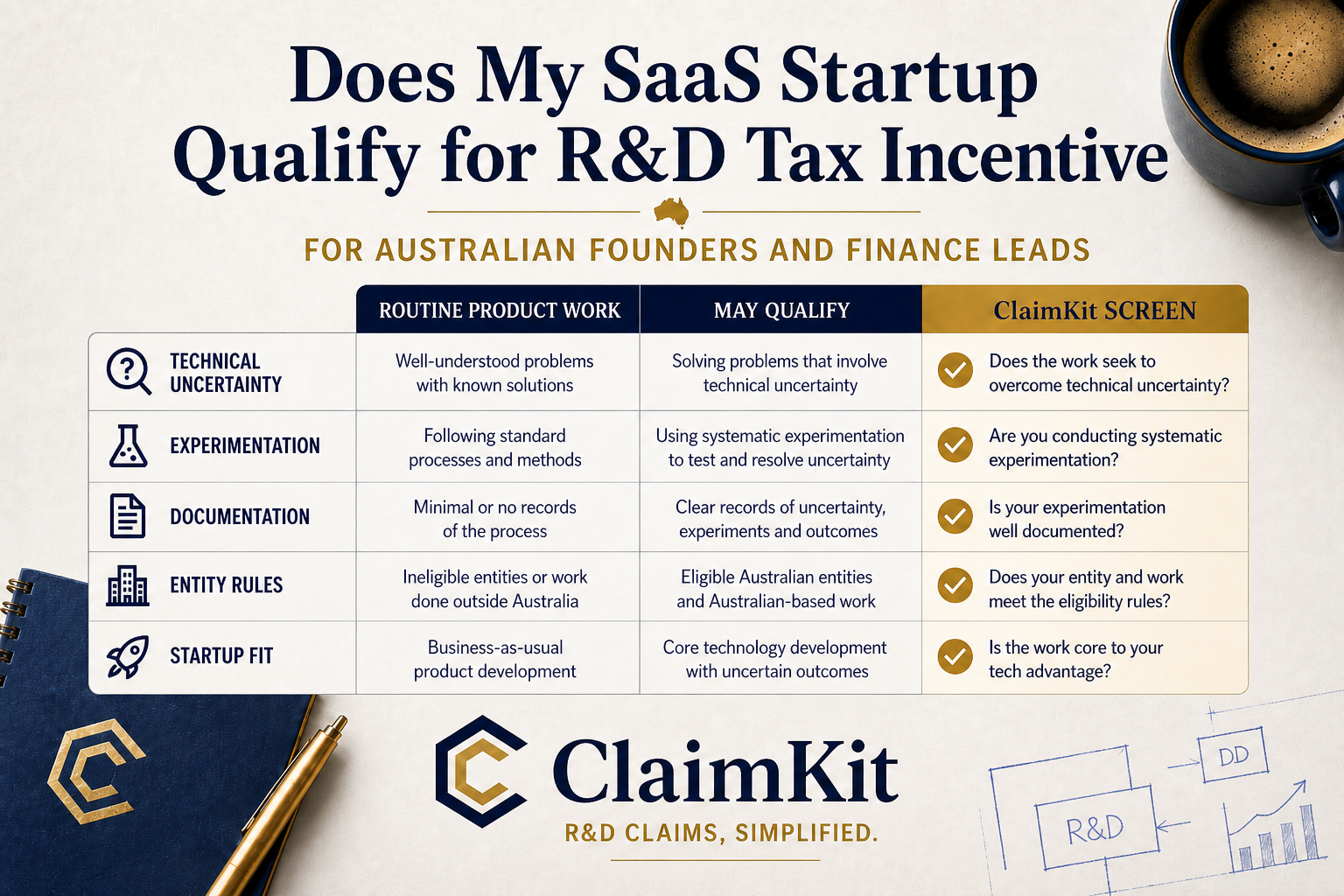 Does my SaaS startup qualify for r&d tax incentive support in Australia? Often yes in part, but building a SaaS product does not automatically qualify. For many eligible Australian companies, some experimental software work may fit the R&D Tax Incentive when there is genuine technical uncertainty, systematic experimentation, and contemporaneous records. Routine feature shipping usually does not. This guide covers Australia's Incentive, not the US R&D Tax Credit.
Eligible companies generally register activities with AusIndustry, then claim the offset through the company tax return. ClaimKit can help many stack-ready SaaS teams screen activities, draft claim materials from tools they already use, and run expert review before lodgement. It does not provide personal tax advice and does not guarantee approval or refunds. (business.gov.au R&D Tax Incentive)
What does "qualify" mean for a SaaS startup?
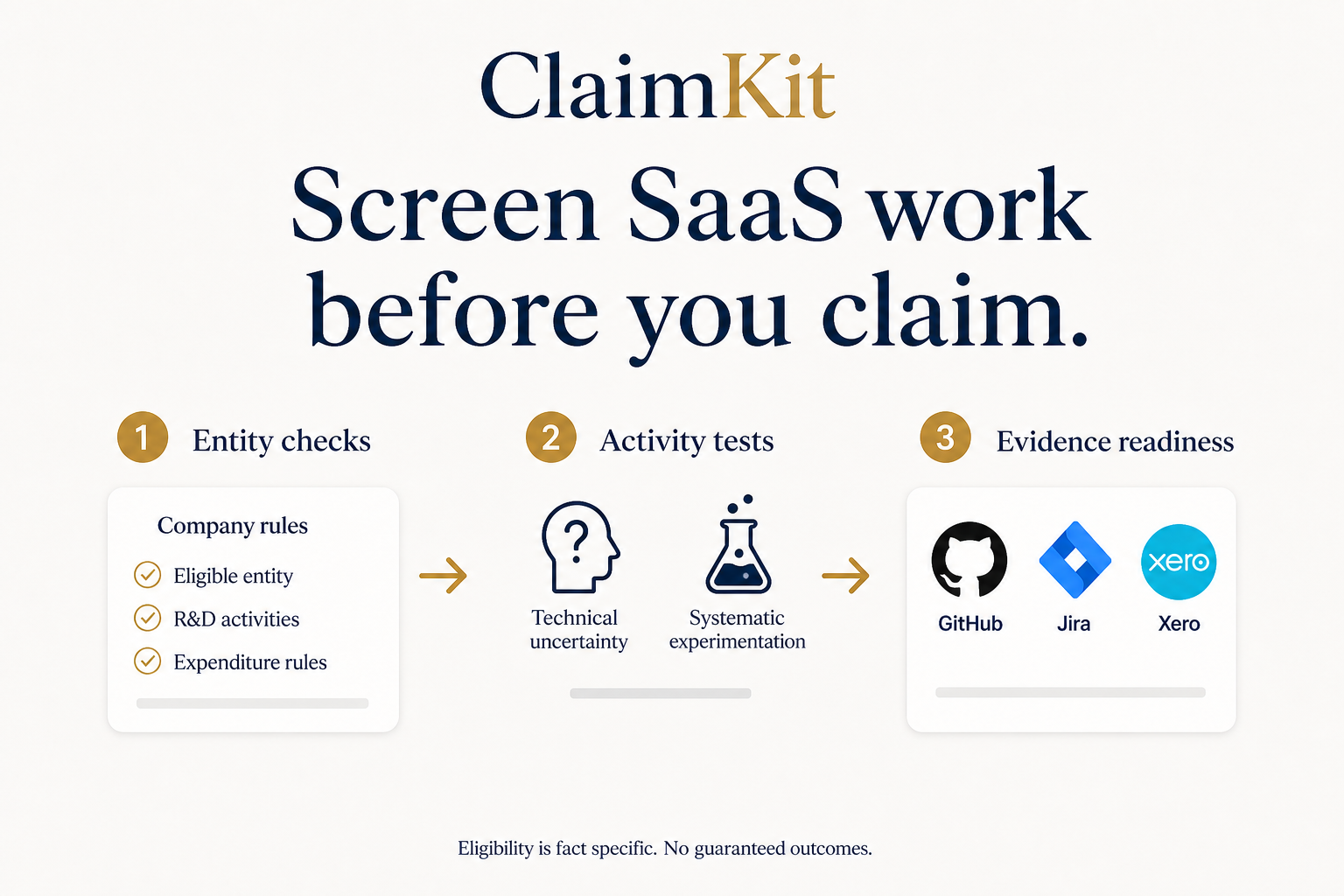
Qualify usually means two layers: your company is an eligible R&D entity, and specific activities meet core or supporting R&D tests. Founders who ask only "are we a SaaS company?" miss the activity layer. Panels and reviewers look at technical uncertainty and evidence, not your business model label.
For many startups, the useful question is which tickets, spikes, and experiments may qualify, not whether the whole product roadmap qualifies. Screen first with ClaimKit's R&D tax incentive eligibility guide, then confirm with a registered tax agent.
Does building SaaS software automatically qualify?
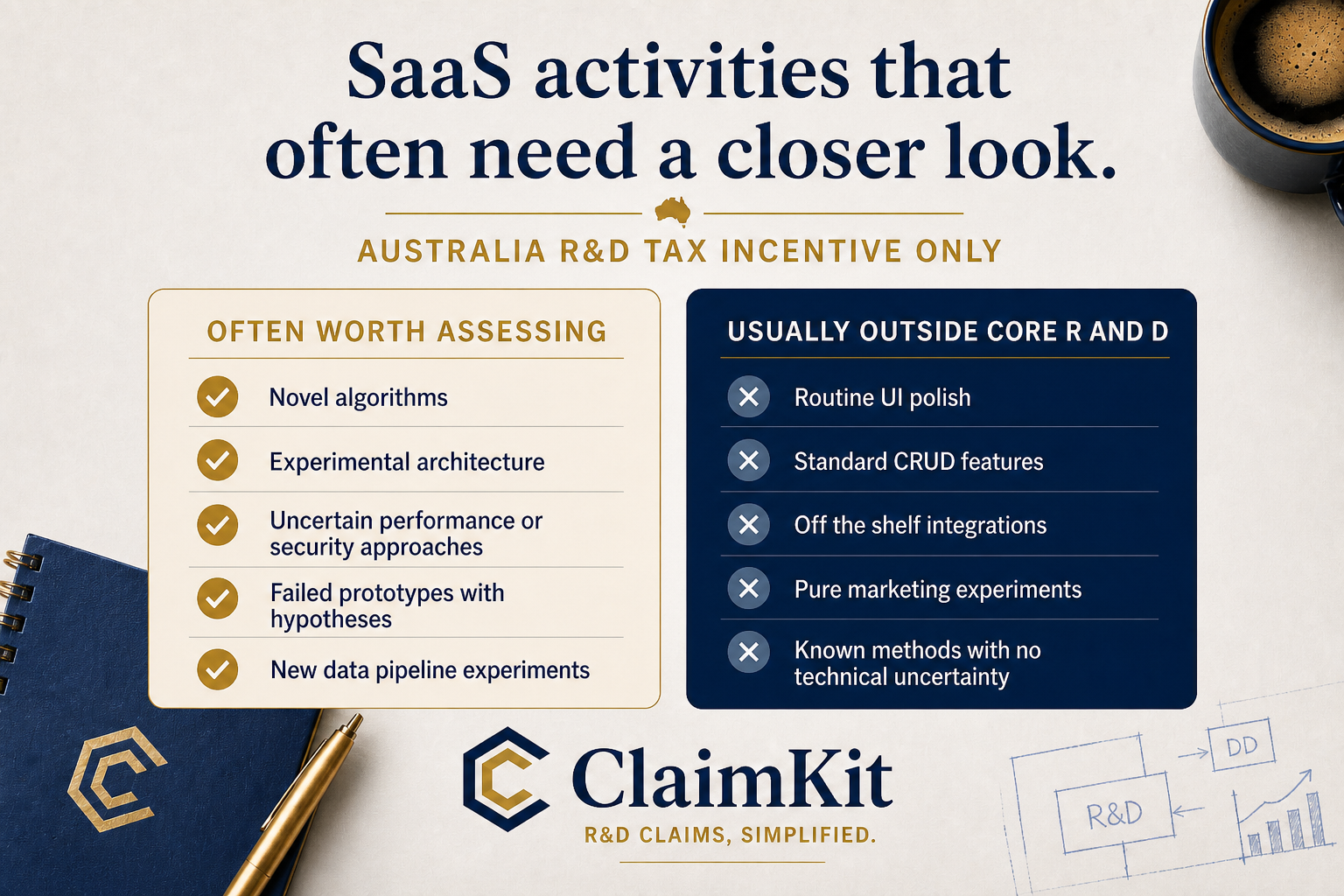
No. Shipping known methods, standard CRUD, UI polish, and off-the-shelf integrations usually sit outside core R&D. Work that may warrant assessment often involves novel algorithms, uncertain architecture, experimental performance or security approaches, new data pipeline experiments, or failed prototypes with clear hypotheses.
Australia's program is about generating new knowledge through experimentation. Marketing experiments, growth hacks, and pure commercial pivots are not the same as technical R&D. For a broader SaaS claiming overview, see R&D tax incentive Australia SaaS.
What company rules do SaaS founders usually need to clear?
Your company generally needs to be an eligible R&D entity under program rules, with registration and claim steps completed for the income year. Many early-stage SaaS companies also watch turnover and tax-loss position because that can affect whether an offset is refundable. Exact thresholds and outcomes depend on your facts and current law.
Entity fit does not equal activity fit. A correctly structured Australian company can still fail if the claimed work is routine product delivery. Confirm entity position against business.gov.au and your tax agent before you invest heavy claim prep time.
What evidence makes a SaaS eligibility screen stronger?
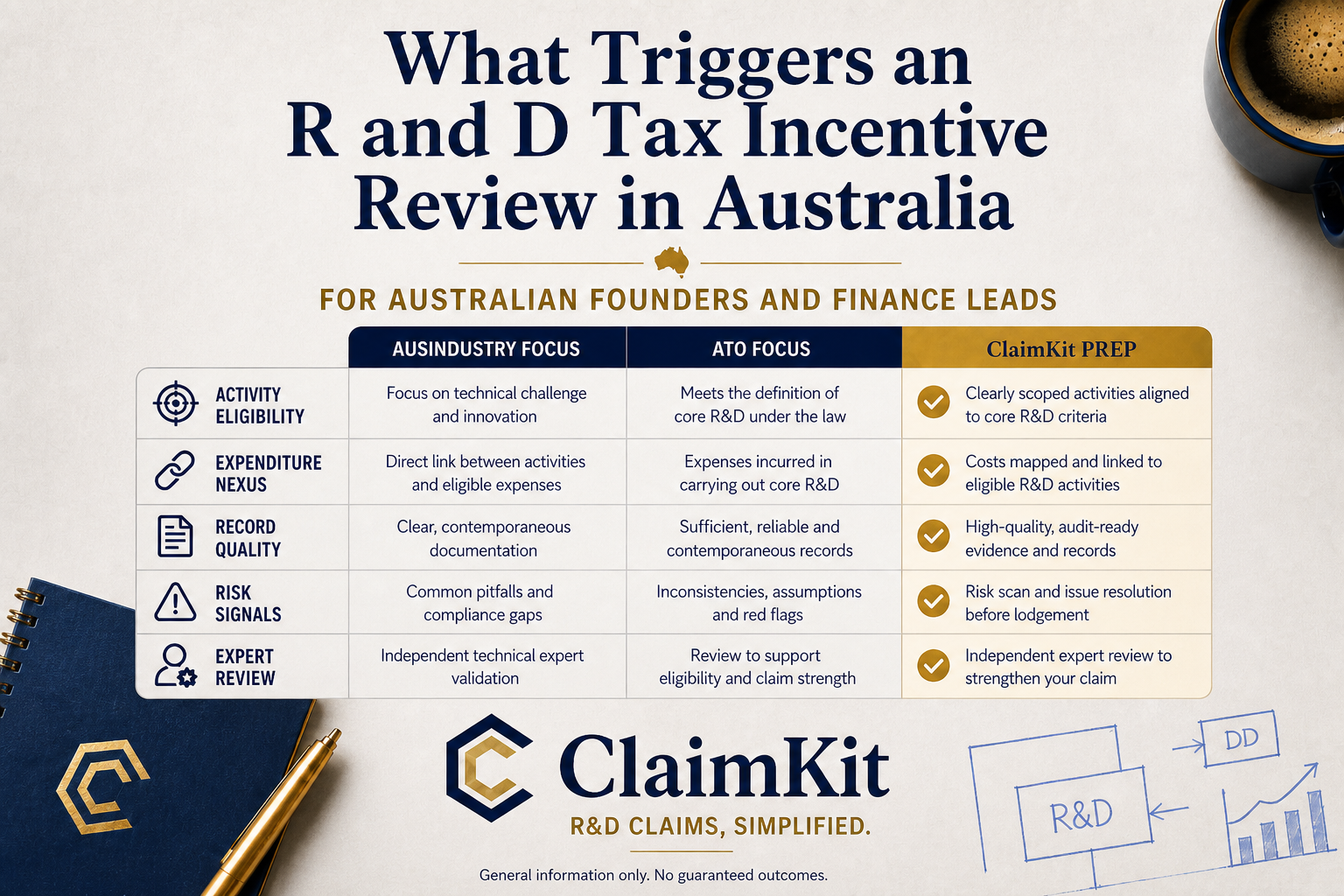
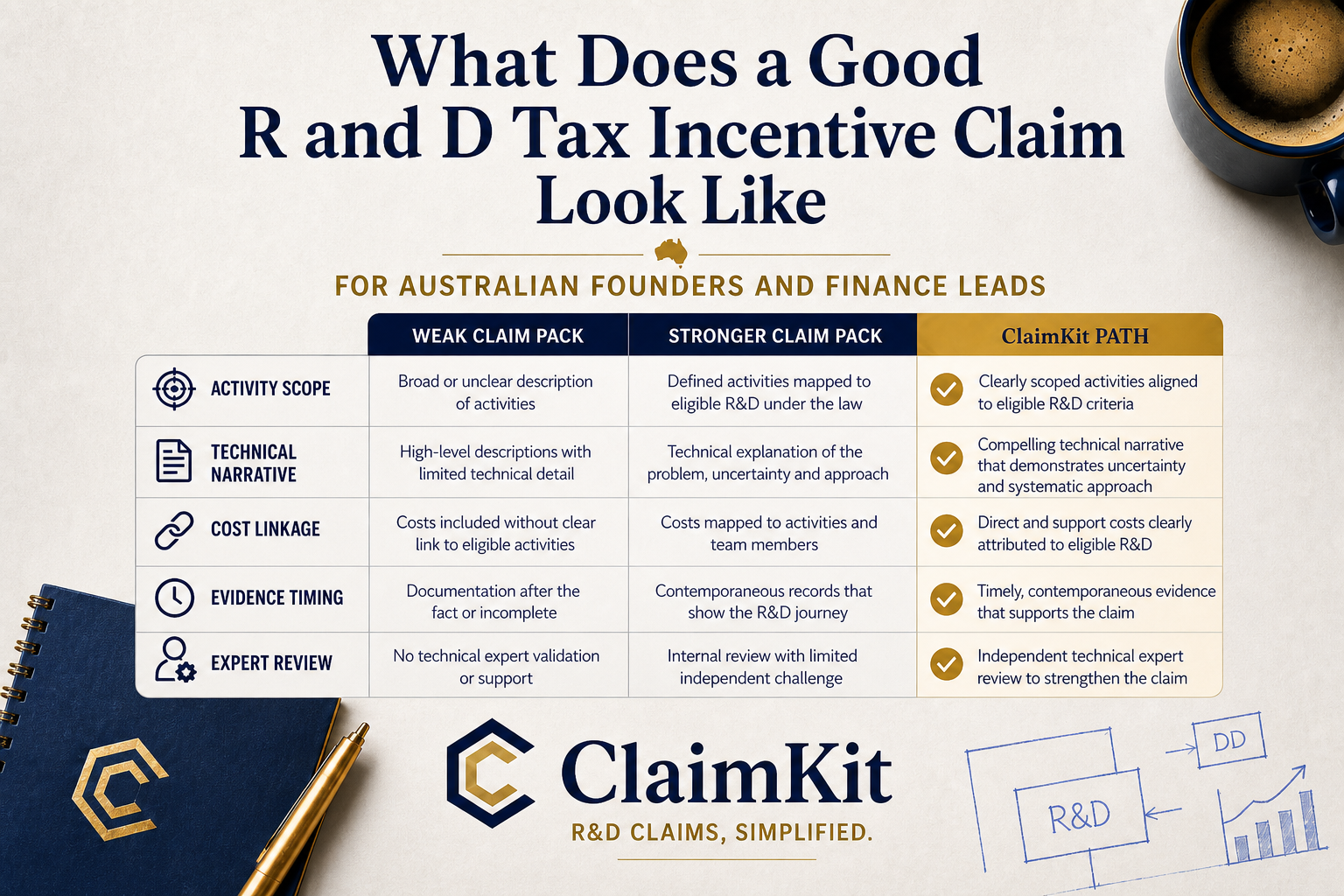
Contemporaneous engineering and finance records usually beat year-end storytelling. Stronger screens often include experiment tickets in Jira or Linear, commits and PR discussion in GitHub, design notes in Notion, benchmarks and failed runs, and cost mapping in Xero. Weak screens rely on marketing language and reconstructed timelines.
Documentation quality affects both eligibility confidence and claim speed later. For the practical evidence workflow, see How to document for R&D tax incentive compliance.
How can ClaimKit help you screen and prepare?
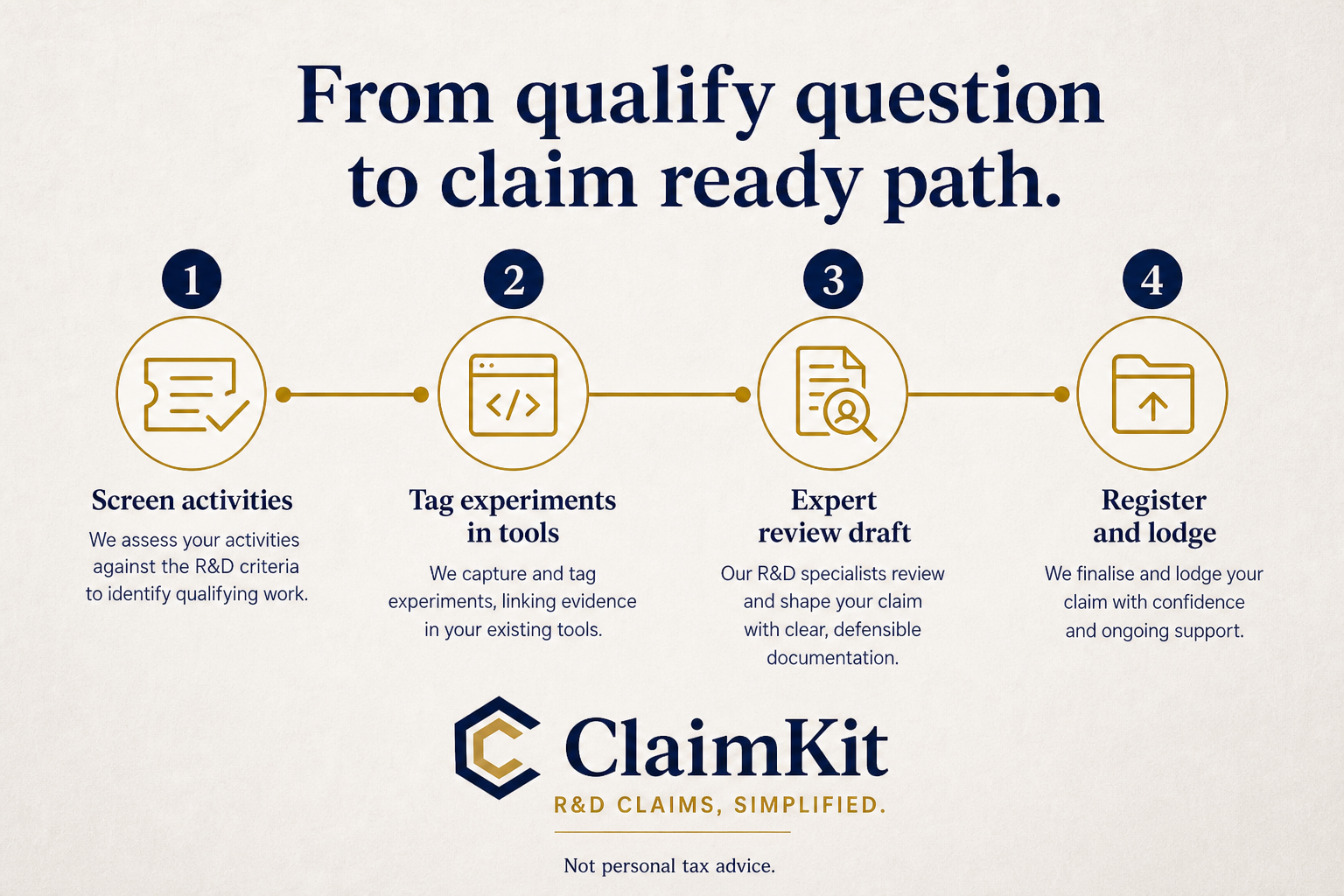
ClaimKit connects sources many SaaS startups already use, drafts claim materials with AI, and runs expert review before lodgement. That may help you separate experimental work from routine shipping earlier, then prepare a cleaner registration package after EOFY. It still does not guarantee that your activities qualify or that a refund will issue.
ClaimKit is built for Australian tech teams using GitHub, Jira, Linear, Notion, and Xero. Security and data handling are in the Trust Center. Workflow questions are covered in the Help Center. Want a walkthrough? Book a demo or read About ClaimKit.
How do traditional advisers usually approach SaaS eligibility?
Traditional R&D advisers such as Treadstone, Prime Partners, Link R&D Advisory, and Bulletpoint often run interview-led eligibility and narrative workflows. Those paths can work well for complex structures, but preparation may take longer when records are scattered. Platform-led screening with expert review may move faster for stack-ready SaaS teams.
Fair comparison means looking at documentation quality and total weeks to lodgement, not only marketing claims. Some founders use a traditional adviser for group complexity and a software-led path when the engineering stack already holds contemporaneous evidence.
What should a SaaS founder do this month?
List workstreams that had real technical unknowns, tag them in your tools, and separate them from known-method delivery. If your income year has ended, start drafting while engineers still remember the experiments. If the year is still open, set a monthly documentation cadence now.
Next steps many teams use: screen with the eligibility guide, map the claim path in How do startups claim the R&D tax incentive in Australia?, and check timing with Startup R&D tax incentive deadline Australia. Amounts still depend on eligible spend and tax position: How much does my company get back from R&D tax incentive in Australia?.
FAQ
Does my SaaS startup qualify for the R&D tax incentive automatically?
No. SaaS is not an automatic qualifier. Eligibility depends on entity rules and whether specific activities meet R&D tests with supporting evidence.
Is this the same as the US R&D Tax Credit?
No. This guide covers Australia's R&D Tax Incentive. US credit rules and qualified research tests are different.
Can pre-revenue SaaS startups still qualify?
Often they can be assessed like other early-stage companies if entity and activity tests are met. Loss-making companies under relevant turnover rules may access a refundable offset. Confirm with a registered tax agent.
What SaaS work usually does not qualify?
Routine UI polish, standard CRUD, off-the-shelf integrations, and known methods with no technical uncertainty usually sit outside core R&D.
Does ClaimKit decide eligibility for me?
No. ClaimKit can help you organise evidence and prepare claims with expert review. Eligibility remains fact-specific and is never guaranteed.
Is this personal tax advice?
No. This is general information for Australian SaaS founders and finance leads. Confirm your position with a registered tax agent.
Disclaimer: This article is general information for Australian SaaS startup founders researching the R&D Tax Incentive. It is not personal tax advice. Eligibility, deadlines, offset rates, and outcomes depend on your company's facts and may change with law and policy. ClaimKit prepares claims with expert review but does not guarantee ATO or AusIndustry outcomes. Confirm your position with a registered tax agent before registering or lodging.
Related reading: R&D tax incentive Australia SaaS · R&D tax incentive eligibility guide · How do startups claim the R&D tax incentive in Australia?
Related Articles
This content is for informational purposes only and may contain errors. Please contact us to verify important details.