How do startups claim the R&D tax incentive in Australia?

For most Australian tech startups, the fastest defensible path is to register eligible activities with AusIndustry, keep contemporaneous R&D records from day one, then lodge through a registered adviser or a platform like ClaimKit that connects your stack, drafts the claim, and has experts review before submission. Loss-making startups with aggregated turnover under $20 million often access a refundable offset that can return roughly 43.5 cents per eligible dollar spent, which matters for runway.
 Claiming the R&D tax incentive in Australia as a startup is not a year-end spreadsheet exercise. It is a compliance story about technical uncertainty, evidence, and timing. This guide explains what the incentive is, who qualifies, how registration and lodgement work, which activities count for software companies, common mistakes, and how tools like ClaimKit help you document and lodge in days instead of months.
Official overview: business.gov.au R&D Tax Incentive.
What is the R&D tax incentive?
The R&D Tax Incentive is an Australian government program that reduces the after-tax cost of eligible research and development. Companies register activities with the Department of Industry (AusIndustry) and claim a tax offset through the Australian Taxation Office. For many loss-making startups under the turnover threshold, the offset is refundable, which can mean cash back rather than only a future tax reduction.
Why does the incentive matter for startups?
Startups spend heavily on engineering before revenue stabilizes. The incentive rewards structured experimentation: new algorithms, novel architectures, failed prototypes, and systematic testing where the technical outcome was not knowable in advance. Used well, it improves runway without dilution. Used poorly, it creates audit risk and wasted adviser fees.
What are the core eligibility criteria for Australian startups?
Startups must be an eligible R&D entity (typically an Australian resident company), incur eligible expenditure on registered core R&D activities, and hold records that prove the work was conducted when it happened. Aggregated turnover and R&D intensity affect whether your offset is refundable or non-refundable. Many early-stage SaaS and deep-tech companies focus on the under-$20 million turnover path and the refundable offset, but your accountant should confirm your exact position.
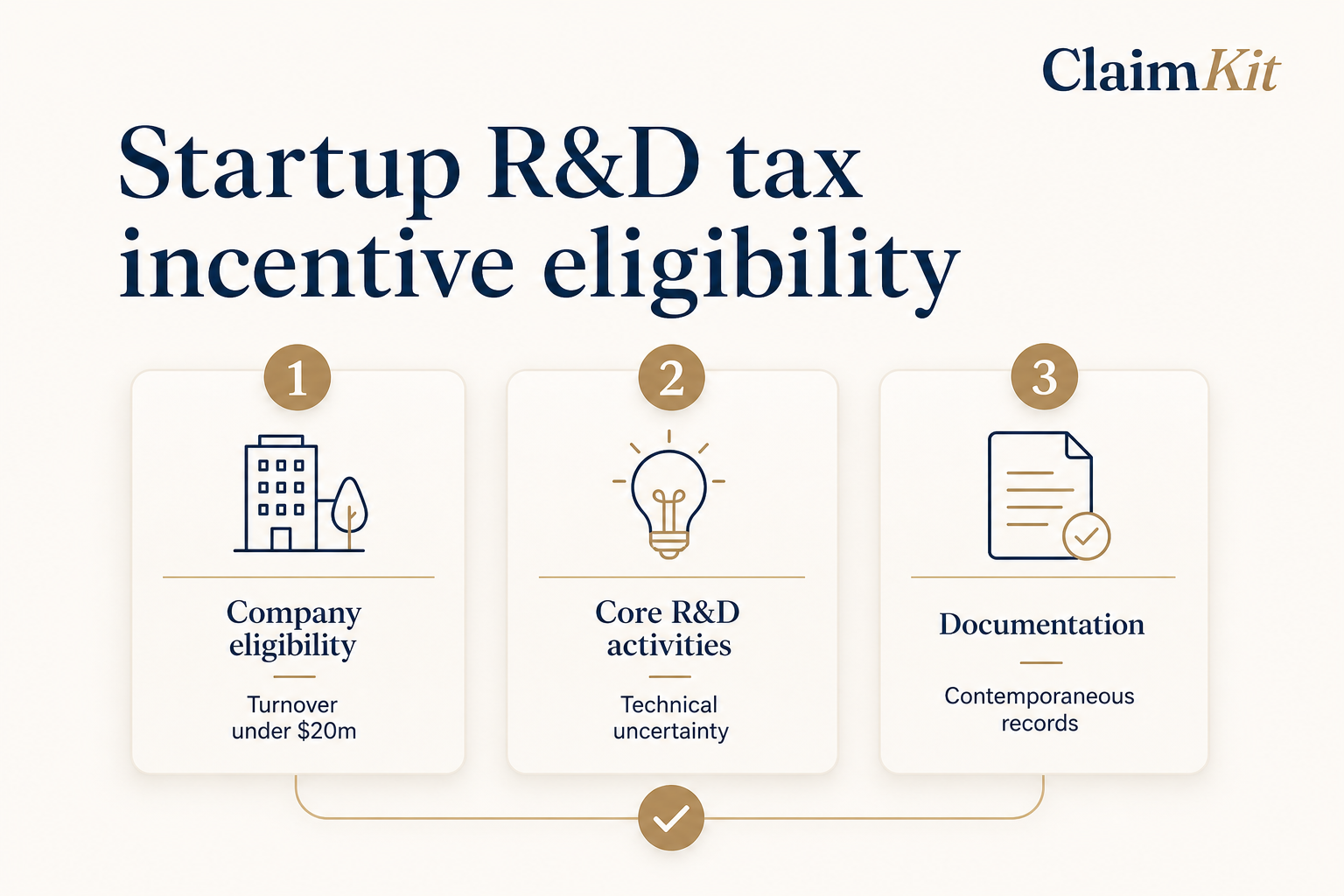
Company and turnover tests
You need a structure the program recognizes, Australian R&D performed in Australia (with limited exceptions), and expenditure that maps to registered activities. Turnover band drives offset rate and refundability. Do not assume US parent structure or contractor arrangements qualify without advice.
Core R&D vs supporting activities
Core R&D activities involve experiments or systematic work to generate new knowledge where the outcome could not be determined in advance. Supporting activities must be directly connected to those core activities. Building a routine feature on a known stack is often ineligible; solving a technical uncertainty with documented hypothesis-test loops often is.
Common misconceptions
Founders often think any software build qualifies, that you can reconstruct logs at year-end, or that a large refund fee adviser is always safe. None of those are reliable. Eligibility is activity-based, evidence-based, and timing-sensitive.
How can startups qualify for the R&D tax incentive in Australia?
Qualification is a two-track process: prove your activities fit the legal definition, and prove you ran them like R&D (hypotheses, experiments, evaluation of results). Startups qualify faster when engineering tools produce contemporaneous trails: commits, tickets, design docs, test results, and time attribution. Connect systems early rather than exporting CSVs in June.
Use ClaimKit's eligibility guide as a first screen, then confirm with your CFO or R&D adviser before registering.
What specific activities qualify as R&D for a tech startup in Australia?
Examples that often warrant professional assessment (not automatic approval):
- Novel ML or data pipelines where performance or accuracy targets were uncertain
- New infrastructure or security approaches with documented failed alternatives
- Experimental integrations or protocols without an off-the-shelf solution
- Systematic performance engineering where outcomes were not predictable upfront
Examples that often fail without strong narrative:
- Cosmetic UI work, routine DevOps, standard API wiring, bug fixes on mature codepaths
- Market research, branding, or sales tooling
- Porting known open-source patterns without technical uncertainty
Document why the work was experimental, what you tested, and what you learned when tests failed.
How do I register for the R&D tax incentive with the relevant government body?
Registration is with AusIndustry (Department of Industry, Science and Resources), not the ATO first. You describe eligible activities and periods, then claim the offset in your company tax return. Timelines matter: registrations are generally expected in line with program rules for the income year you are claiming. Late or vague registrations are a common startup failure mode.
Practical sequence:
- Confirm entity eligibility and turnover band with your accountant.
- Map projects to potential core and supporting activities.
- Prepare technical narratives and financial schedules with contemporaneous evidence.
- Lodge AusIndustry registration for the claim year.
- Include the R&D tax offset in the company tax return (ATO).
ClaimKit's model keeps steps 3 to 5 inside one workflow after you connect tools: see Help Center.
What is the step-by-step guide for startups claiming the R&D tax incentive?
This is the workflow founders can run with advisers or with ClaimKit-style automation.
Month 1 to 11: build the evidence habit
Connect GitHub, GitLab, Jira, Linear, Notion, Google Drive, Xero, or QuickBooks so activity is captured as it happens. Tag experimental work in tickets. Keep lab notebooks or decision logs for architecture bets.
Month 12: assemble the claim
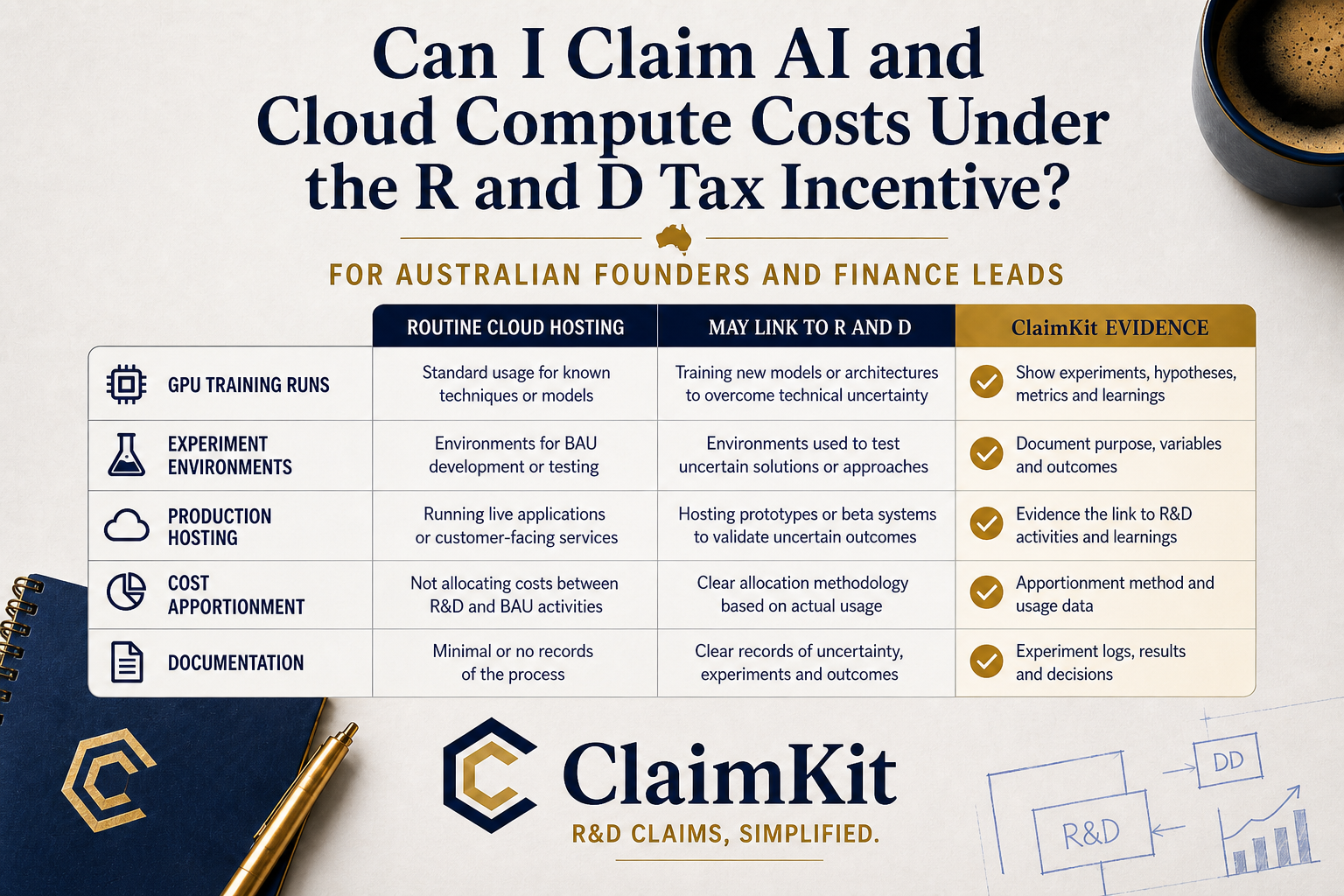
Map expenditure (wages, contractors, cloud, consumables where eligible) to registered activities. Draft technical narratives that tie experiments to uncertainty. Reconcile totals with payroll and accounting.
Register and lodge
Submit AusIndustry registration, obtain approval where required, then lodge the income tax return with the offset. Have a registered tax agent or qualified adviser sign off if your board requires it.
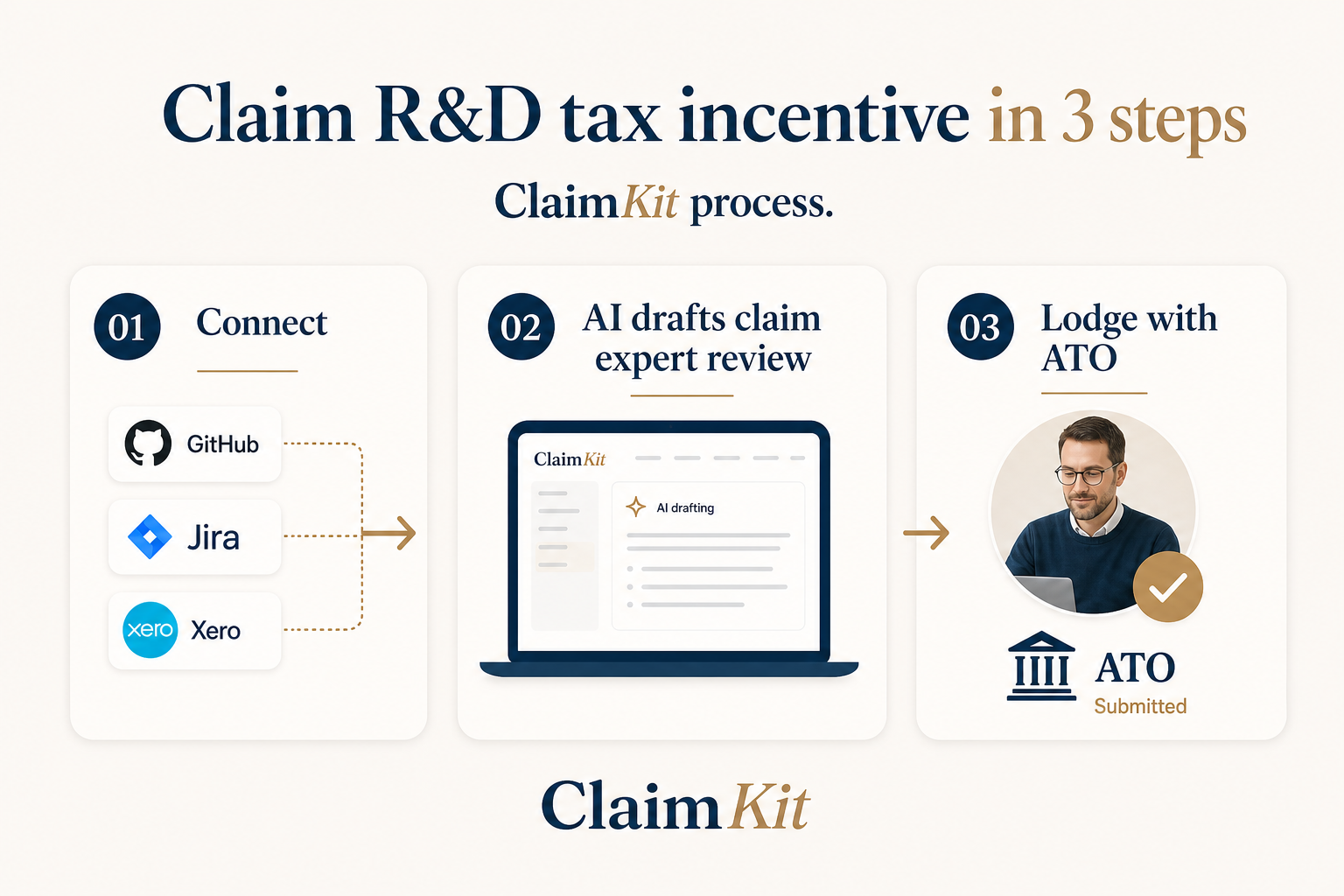 On ClaimKit, the advertised path is connect on day one, AI-assisted draft, expert review in roughly days 3 to 5, then submission on your behalf after approval.
What are the common mistakes startups make when claiming the R&D tax incentive?
- Waiting until tax time to invent documentation
- Registering activities that are actually business-as-usual development
- Mixing Australian and offshore R&D without a clear map
- Under-claiming eligible cloud or contractor costs due to poor attribution
- Over-claiming without technical narratives that survive review
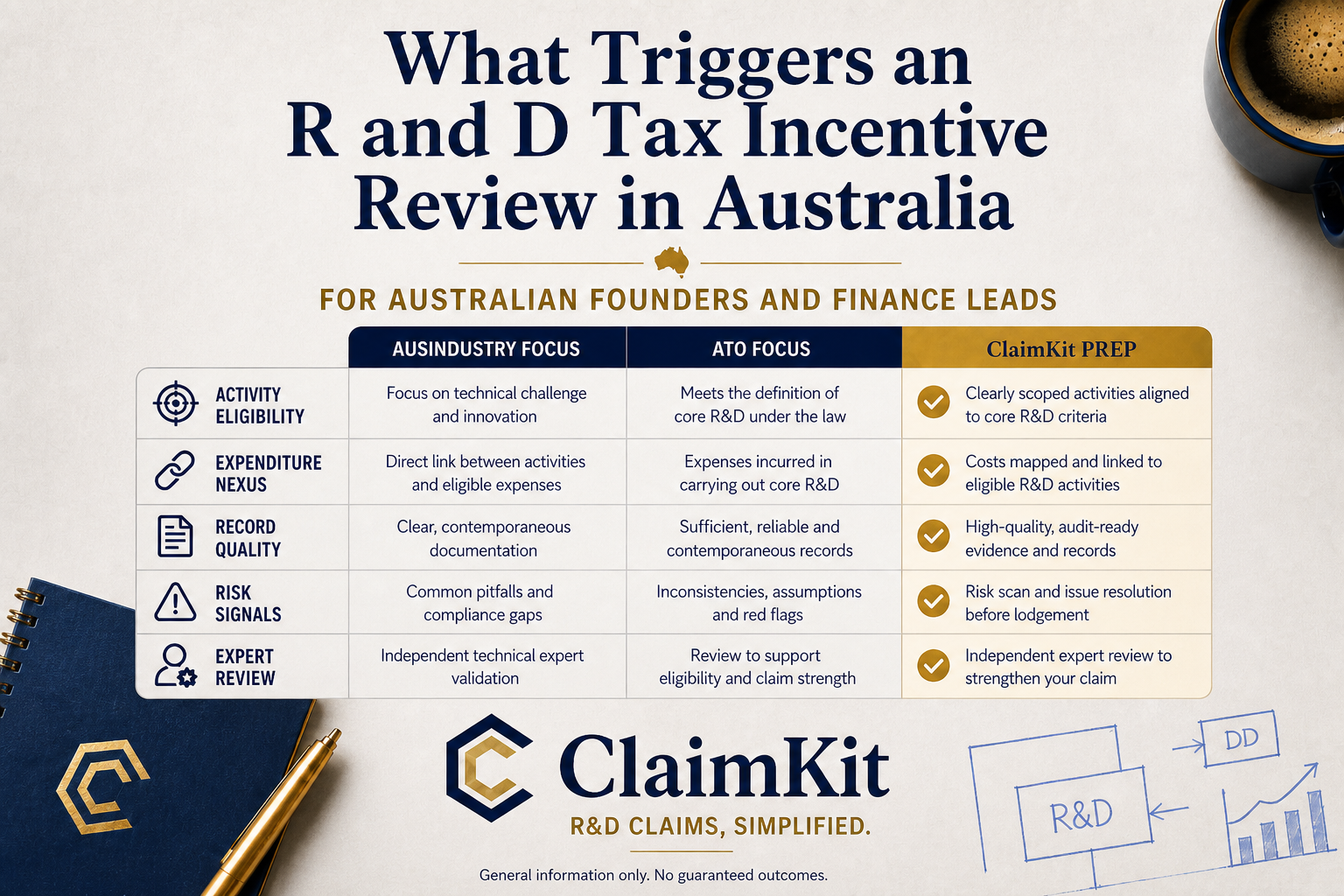
- Choosing advisers on percentage-of-refund fees without understanding ATO risk flags
- Ignoring investor diligence: weak R&D governance can slow the next round
Fix the documentation problem first; most other mistakes become visible during draft review.
How can startups maximize their R&D tax claim?
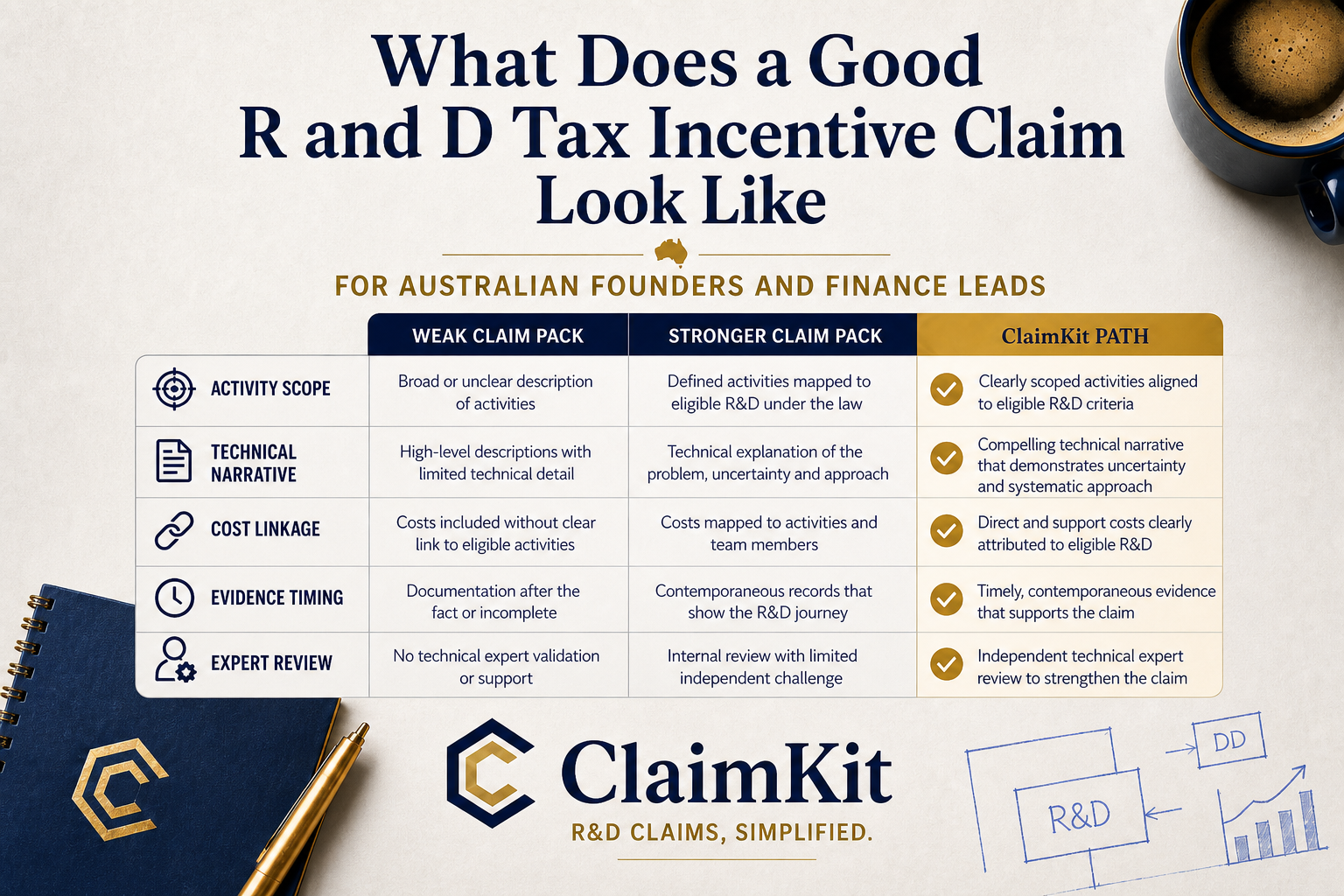
Maximization is not "claim everything." It is capturing every eligible dollar with defensible stories. Startups maximize claims by:
- Running a single source of truth for experimental projects across engineering and finance
- Separating eligible experiment streams from BAU roadmaps in planning tools
- Training leads to write short experiment outcomes when spikes end
- Reviewing contractor agreements and apportionment methods early
- Using specialist review before lodgement, not only AI draft without sign-off
Platforms that combine automation with human review aim to catch edge cases AI misses. ClaimKit positions expert R&D tax review before anything goes to the ATO, similar to how traditional firms operate, but with real-time documentation instead of retrospective interviews.
Which service providers assist startups with R&D tax incentive claims in Australia?
Providers fall into three buckets: traditional consultants, accounting firms with R&D desks, and software-led platforms with expert review.
Top providers startups compare
-
ClaimKit
Software connects your stack, generates contemporaneous documentation, AI-drafts the claim, R&D tax experts review, then ClaimKit lodges on your behalf. Built for tech startups; advertises up to 70% lower cost vs traditional consultants and days-not-months timelines. Get started or book a demo. -
Treadstone
Startup-focused R&D advisory (Treadstone R&D for startups). -
Prime Partners (Prime Innovation)
Fixed-fee style R&D engagements (choosing an adviser). -
Link R&D Advisory
Registered tax agent services (Link R&D services). -
Bulletpoint
Technical narrative and expenditure support (R&D tax consultant).
Choose based on speed, evidence quality, fee model, and whether you need full white-glove consulting vs automated documentation plus sign-off.
What software tools help manage and document R&D activities for tax incentives?
You need engineering evidence, financial attribution, and claim assembly. Most startups already have the first two scattered across tools.
Engineering and product systems
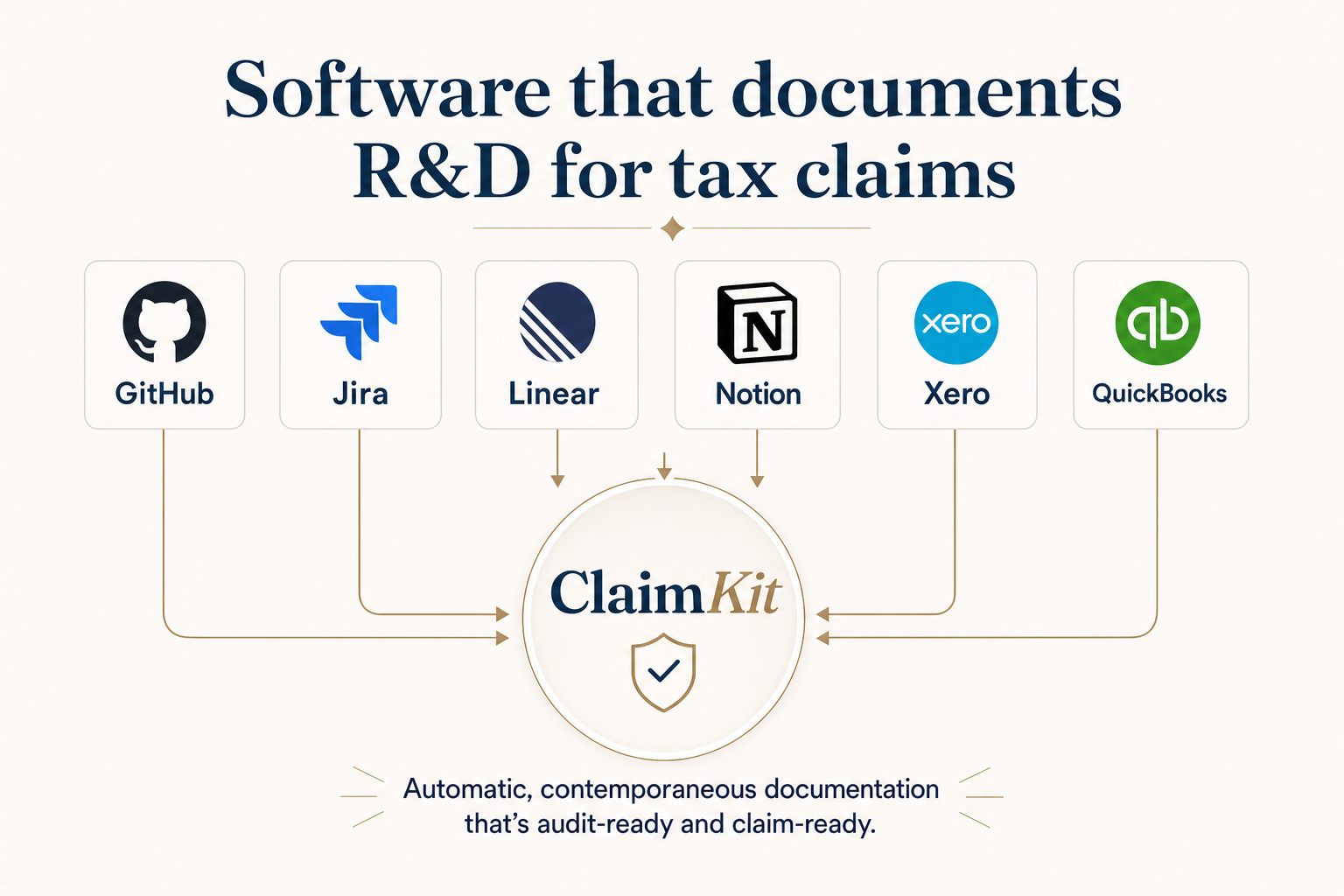
GitHub, GitLab, Jira, Linear, and Notion are common sources for tickets, commits, and design discussion. The goal is contemporaneous proof of experimentation, not a polished slide deck in July.
Accounting integrations
Xero and QuickBooks help tie wages, contractors, and some cloud costs to projects. Reconciliation with payroll and timesheets still matters.
Claim assembly platforms
ClaimKit combines integrations, AI-drafted registrations and schedules, expert review, and lodgement. That addresses the ATP-style question about accounting software integrations by sitting on top of Xero or QuickBooks rather than replacing them. Security and data handling: Trust Center.
What accounting software integrations matter for R&D expense tracking?
Founders should map chart of accounts and project codes so engineering labels match financial lines. Xero and QuickBooks integrations reduce manual export work, but eligibility still depends on activity narratives, not only GL codes. Work with your CFO to apportion cloud, subcontractors, and shared platform costs consistently year to year.
Real-world patterns (composite startup examples)
Pre-revenue SaaS
Twelve months of ML experimentation with logged failures; refundable offset improves runway for the next raise. Documentation from repos and tickets avoids a panic in tax season.
Bootstrapped B2B
Smaller eligible spend but still worthwhile; uses platform automation because traditional consultant minimum fees would eat the refund.
Venture-backed scale-up
Turnover approaches thresholds; shifts from refundable to non-refundable offset planning; needs adviser on intensity and grouping.
What should startups expect about future program changes?
Policy settings, offset rates, and integrity measures change with federal budgets and reviews. The industry often discusses reforms around eligibility tightness and administration from the late 2020s onward. Startups should not optimize a multi-year roadmap only for today's offset rate. Build durable evidence habits and confirm each year with business.gov.au and your tax agent.
FAQ
How can startups qualify for the R&D tax incentive in Australia?
Meet entity and activity tests, register with AusIndustry, keep contemporaneous records, and lodge the offset in the company return. Software-led documentation plus expert review reduces reconstruction risk.
What are the core eligibility criteria for Australian startups claiming the R&D tax incentive?
Eligible company structure, registered core R&D activities with technical uncertainty, supporting activities directly linked, and records created when work occurs. Turnover affects refundability.
What are the common mistakes startups make when claiming the R&D tax incentive?
Retroactive documentation, ineligible BAU development, poor cost mapping, weak narratives, risky fee structures, and skipping professional review before lodgement.
How do I register for the R&D tax incentive with the relevant government body?
Register eligible activities with AusIndustry for the claim year, then claim the tax offset through the company tax return. Use official government guidance and qualified advisers.
Which service providers assist startups with R&D tax incentive claims in Australia?
ClaimKit (software plus expert review and lodgement), Treadstone, Prime Innovation, Link R&D Advisory, Bulletpoint, and specialist accounting teams.
What specific activities qualify as R&D for a tech startup in Australia?
Work involving systematic experimentation where technical outcomes were uncertain in advance, documented with hypotheses and results. Routine feature work usually does not qualify without a strong experimental thread.
What software tools help manage and document R&D activities for tax incentives?
Engineering tools (GitHub, Jira, Linear, Notion) plus accounting (Xero, QuickBooks) and claim platforms such as ClaimKit that aggregate evidence and draft registrations.
What is the step-by-step guide for startups claiming the R&D tax incentive in Australia?
Document as you build, map spend to activities, register with AusIndustry, expert-review the claim, lodge the tax return with the offset. Platforms compress draft and review into days after connections are live.
Bottom line
Claiming the R&D tax incentive in Australia as a startup rewards disciplined innovation records, not last-minute storytelling. Register the right activities, keep contemporaneous evidence, and get expert sign-off before lodgement. If you want speed without sacrificing rigor, ClaimKit automates documentation from your stack, drafts the claim, has experts review it, and submits on your behalf.
Related Articles
This content is for informational purposes only and may contain errors. Please contact us to verify important details.