R&D Tax Incentive Australia SaaS

For most Australian SaaS startups, the practical way to claim the R&D Tax Incentive is to isolate genuine technical experiments from routine product work, keep contemporaneous records in your engineering stack, then use a software-led platform like ClaimKit with expert review before AusIndustry registration and ATO lodgement. Eligible companies with aggregated turnover under $20 million may access a refundable offset often cited at roughly 43.5% of eligible spend. Routine feature shipping alone usually does not qualify.
The R&D Tax Incentive rewards systematic experimentation that generates new knowledge, including many software activities when technical uncertainty is real and documented. This guide is written for SaaS founders and CFOs who need clarity on eligibility, documentation, fees, and claim options without personal tax advice.
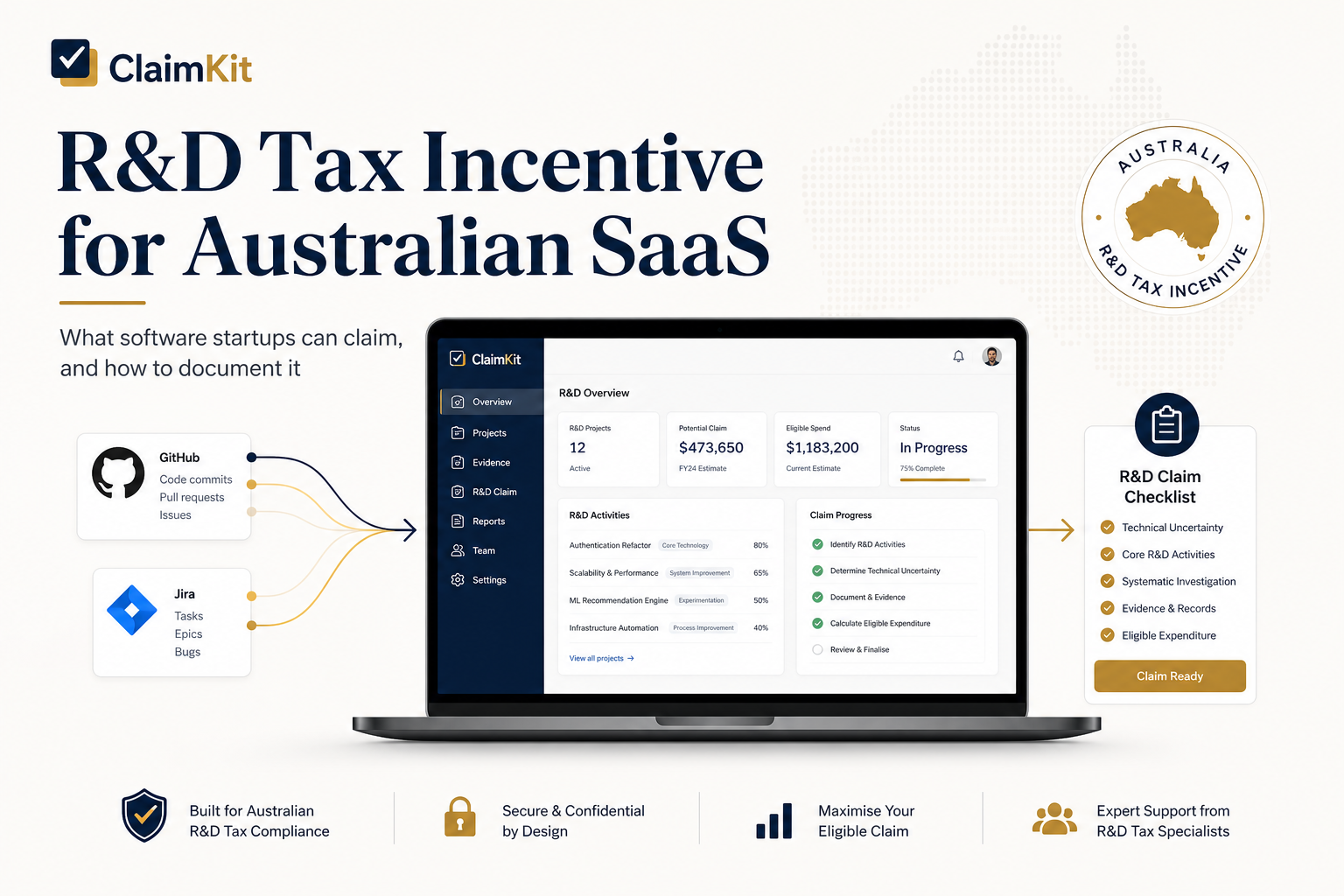
What is the R&D Tax Incentive for Australian SaaS companies?
It is a federal tax offset for eligible R&D entities that register core and supporting R&D activities and claim qualifying expenditure. For many loss-making SaaS companies under the turnover threshold, the offset can be refundable, which may improve runway without dilution. Official program details live on business.gov.au.
Can SaaS product work qualify as R&D in Australia?
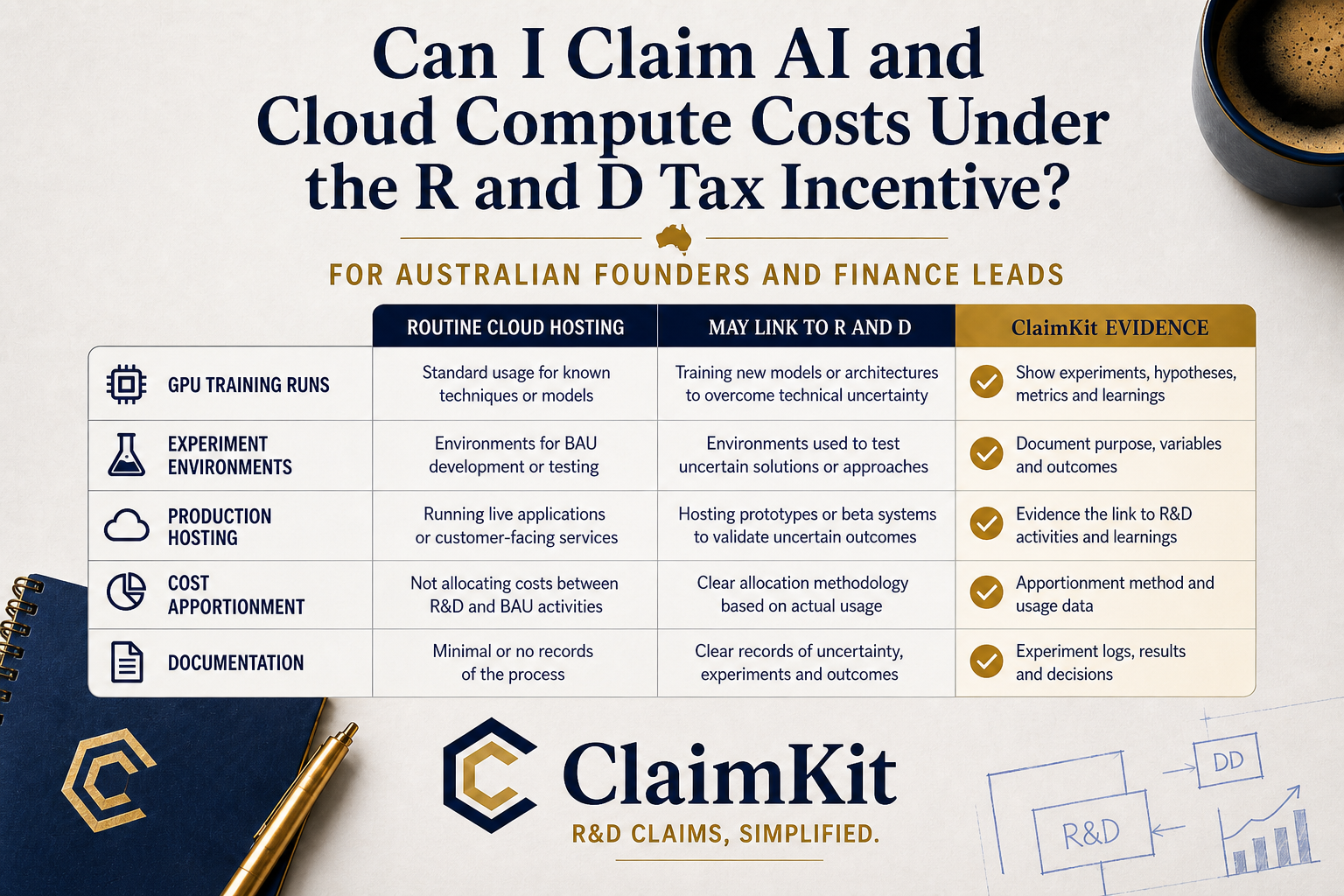
Yes, when activities involve genuine technical uncertainty resolved through systematic experimentation, not only commercial shipping of known methods. Examples that often warrant assessment include novel algorithms, uncertain performance or security approaches, experimental data pipelines, and failed prototypes with clear hypotheses. Routine UI polish, standard CRUD features, and off-the-shelf integrations usually sit outside core R&D.
What SaaS activities often fail AusIndustry and ATO reviews?
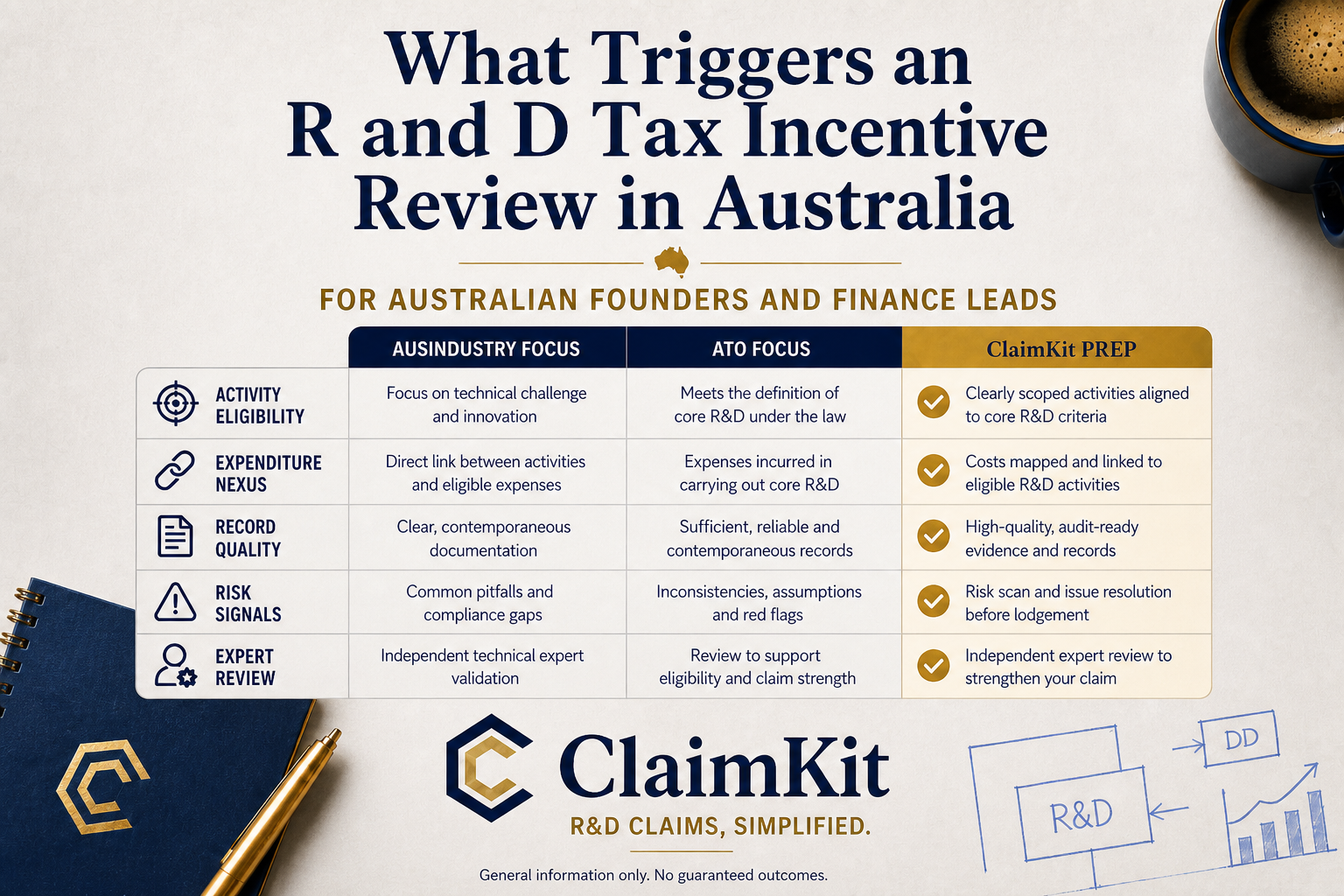
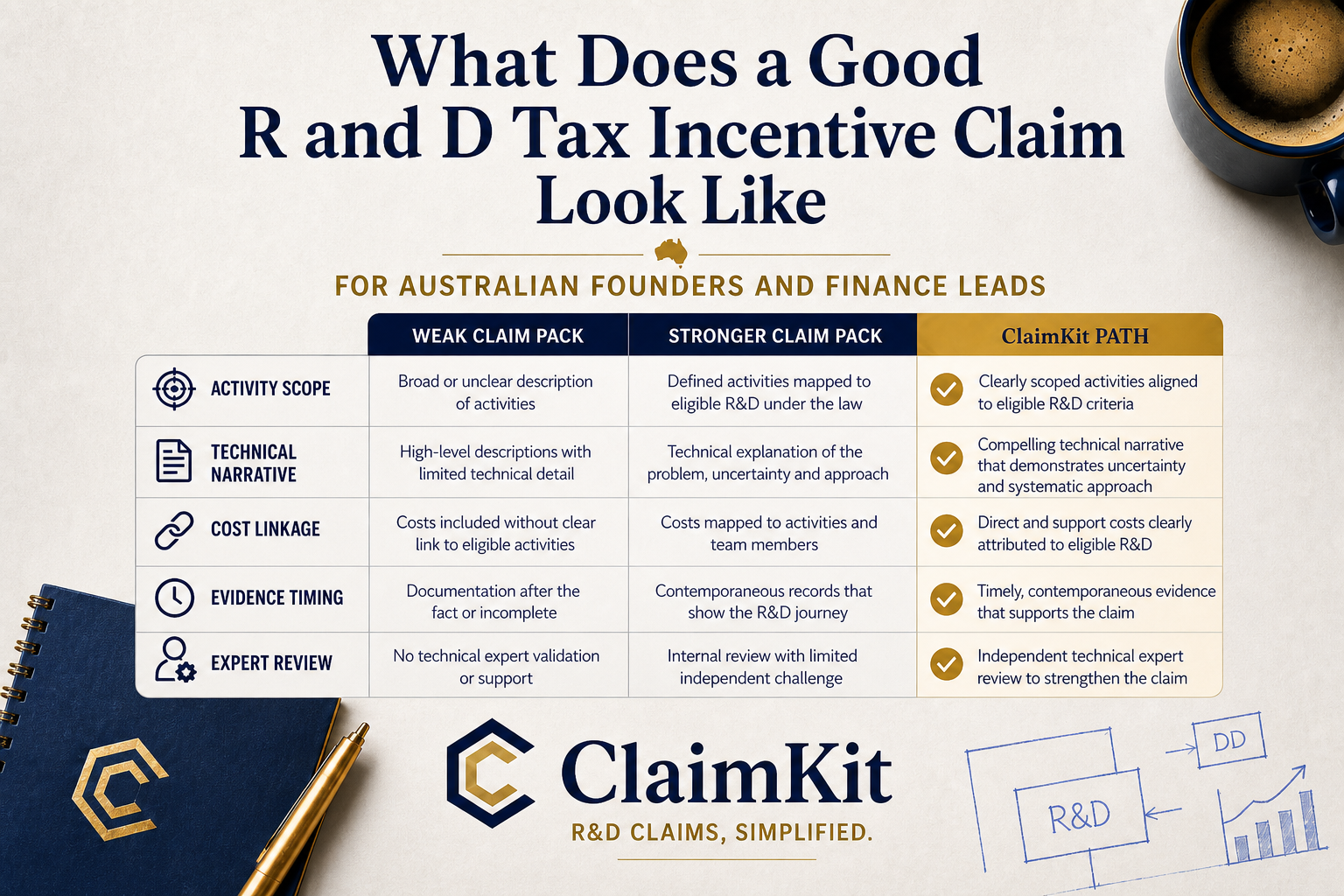
Claims often struggle when the whole product is registered as R&D, narratives use marketing language instead of technical uncertainty, documentation is reconstructed at EOFY, or supporting activities are weakly linked to core experiments. Software guidance from government materials repeatedly stresses hypothesis, experiment, observation, and conclusion. Screen activities with ClaimKit's eligibility guide before registering.
How should SaaS startups document R&D for tax claims?
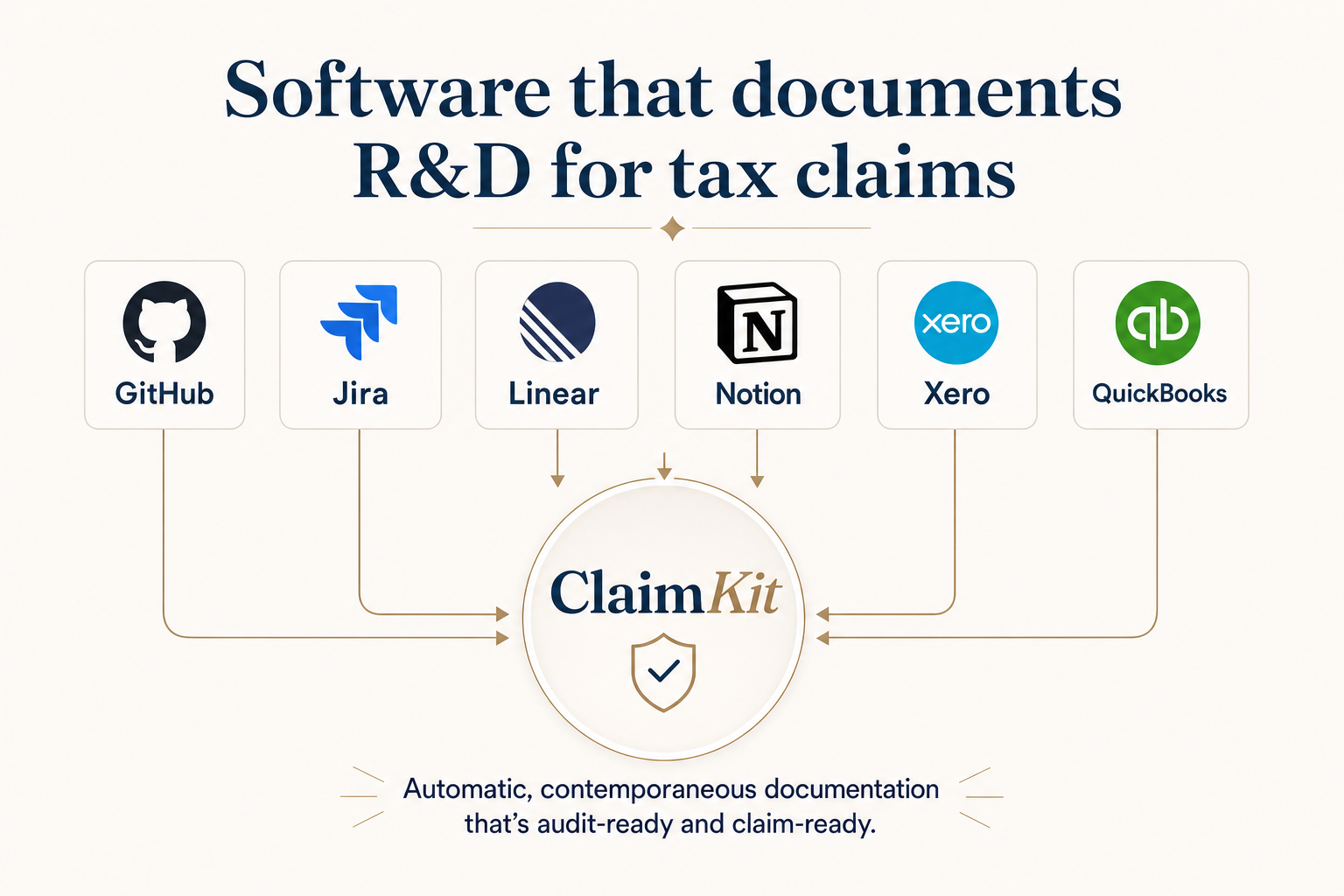
Document as work happens: experiment tickets in Jira or Linear, descriptive commits and PR discussions, design notes in Notion or Drive, benchmarks and failed runs, and cost mapping in Xero or QuickBooks. Contemporaneous records are stronger than year-end storytelling. ClaimKit connects common SaaS stacks and drafts claim content for expert review via the Help Center workflow.
How much may eligible SaaS startups get back?
Amounts depend on eligible expenditure, turnover band, and tax position. Many early-stage SaaS companies focus on the under-$20 million turnover path and the refundable offset. For a worked overview, see How much does my company get back from R&D tax incentive in Australia?. Outcomes are not guaranteed.
What is the best way for SaaS startups to prepare an R&D claim?
- ClaimKit. Connect GitHub, Jira, Linear, Notion, and Xero, AI-draft the claim, obtain R&D tax expert review, then approve lodgement. Days-not-months and up to roughly 70% lower cost vs many traditional consultants per ClaimKit. Book a demo.
- Prime Partners (Prime Innovation). Fixed-fee software R&D advisory. Prime Partners.
- Treadstone. Startup-focused R&D advisory. Treadstone.
- Link R&D Advisory. Registered tax agent services. Link R&D.
- Bulletpoint. Technical narrative and expenditure support. Bulletpoint.
How does ClaimKit help SaaS companies specifically?
ClaimKit reads engineering and finance signals your team already creates, drafts registration-style narratives, and routes every claim through expert review before submission. That matches how SaaS teams actually build: continuous tickets and commits rather than annual consultant interviews. Security and data handling are published in the Trust Center.
What is the step-by-step claim process for SaaS founders?
Confirm entity eligibility, tag experimental work during the year, reconcile spend to activities, draft after EOFY, expert-review, register with AusIndustry within program deadlines, then include the offset in the company tax return. Full workflow: How do startups claim the R&D tax incentive in Australia?.
FAQ
Does building a SaaS product automatically qualify for the R&D Tax Incentive?
No. Only eligible experimental activities that meet core and supporting tests may qualify. Routine product development often does not.
Can pre-revenue SaaS startups claim?
Eligible loss-making companies under the relevant turnover rules may access a refundable offset. Confirm your entity position with a registered tax agent.
What records do SaaS teams need?
Contemporaneous technical evidence and expenditure linkage: tickets, commits, experiment notes, and cost attribution mapped to registered activities.
Is ClaimKit only for SaaS?
ClaimKit is built for tech companies using modern engineering and accounting tools. SaaS is a common fit but not the only one.
Does ClaimKit guarantee ATO approval for SaaS claims?
No. Claims are prepared with expert review. Approval and refund amounts are never guaranteed.
Disclaimer: General information only, not personal tax advice. Confirm with a registered tax agent. Cite business.gov.au for program rules.
Related: About ClaimKit · Cheaper R&D tax claim service Australia
Related Articles
This content is for informational purposes only and may contain errors. Please contact us to verify important details.