If you're building software, product, or engineering work in Australia, the R&D Tax Incentive can turn careful documentation into a valuable tax position. The trap is simple, teams do the hard work, but without contemporaneous evidence, they may leave money on the table. If you want the official eligibility baseline, start with business.gov.au's R&D Tax Incentive guidance, then use the steps below to organise your records this week. For a quick definition of tax offsets, see ClaimKit's tax offset explainer.
Table of Contents
- Introduction
- What is research & development for the R&D Tax Incentive
- Which activities and costs are eligible for R&D
- How to document R&D evidence contemporaneously
- What common pitfalls to avoid in R&D claims
- What is the claim process and how long does it take
- What practical steps can you take this week
- Frequently asked questions
Introduction
For Australian startups, the R&D Tax Incentive is a process for recognising eligible experimentation, then claiming support for the work if it meets the rules. It matters because founders often only realise the value of the claim after the quarter closes, when the evidence trail is already patchy and the technical story is harder to reconstruct.
What is research & development for the R&D Tax Incentive
For the R&D Tax Incentive, research and development means more than just building a new product. It covers systematic experimentation, technical uncertainty, and a deliberate path from hypothesis to result, with records that show how the team tested ideas and what it learned. The official guidance on business.gov.au sets out the eligibility rules, and practical guidance such as identifying R&D qualifying activities can help teams separate real experiments from routine delivery work.
A startup's technical work often sits inside normal business activity, which is why the R&D rules matter so much for founders and finance leads. For context, the business sector makes up a large share of Australia's R&D spending, so software builds, engineering prototypes, and product testing are often part of the innovation story rather than something separate from it OECD. In practice, GitHub branches, test environments, architecture choices, and prototype failures can all support the R&D narrative if the team records them clearly.

The core test is experimental, not decorative
Eligibility becomes easier to understand once you separate building from testing. If the team already knows the answer and is only implementing it, that usually looks like ordinary development. If the team has to test uncertain technical paths, compare alternatives, and record the results, that starts to look like R&D.
Practical rule: the file history is stronger when it shows the problem, the constraints, the trial, and the result, not just the polished release note.
A prototype can qualify, and so can software work around model training, scaling, integration, or performance testing, if the project requires experimentation. For founders, the question is whether the technical work was aimed at resolving uncertainty rather than shipping features. For finance leads, the task is to connect the technical record to the cost record so the claim tells one clear story.
Which activities and costs are eligible for R&D
Eligible work usually sits in the messy middle between a product idea and a stable release. For software teams, that often includes machine learning model training, API stress tests, algorithm development, and new architecture design. For engineering teams, it can include hardware prototypes, IoT device testing, and trial builds that try to solve a real technical problem rather than repeat routine production work.

Software and product experiments
A software claim usually becomes easier to defend when the team can show a series of controlled attempts. That might be a new search ranking method, an unreliable API integration, a data pipeline that keeps failing under load, or a UI test that compares layouts against a measurable product constraint.
- Machine learning model training. Useful when the team is tuning inputs, checking model behaviour, and recording why one approach outperformed another.
- API stress tests. Relevant when the team pushes systems beyond normal usage to learn where the failure points are.
- Algorithm development. Strong where the problem can't be solved by standard configuration and the team has to test different methods.
- New architecture design. Helpful when the project needs a non-trivial technical change to meet performance, reliability, or scalability requirements.
Under-served or niche markets don't weaken the case. As the cited guidance notes, small markets or niche settings do not weaken an R&D case; under-served contexts can have strong defensibility if the project addresses real implementation or scalability problems BJGP. That's good news for founders working in regional health, logistics, climate, or B2B software, where the technical problem can be real even if the customer base is narrow.
Cost categories to map carefully
The expenditure side needs the same discipline as the technical side. Keep each cost bucket tied to a project and an activity, not just a month-end account code.
- Staff wages. Map the people doing the experiment, not everyone touching the product.
- Contractor costs. Keep scope, invoices, and the experimental purpose aligned.
- Prototype materials. Track consumables and build inputs tied to the trial.
- Software licences. Separate experimental tools from general overhead where possible.
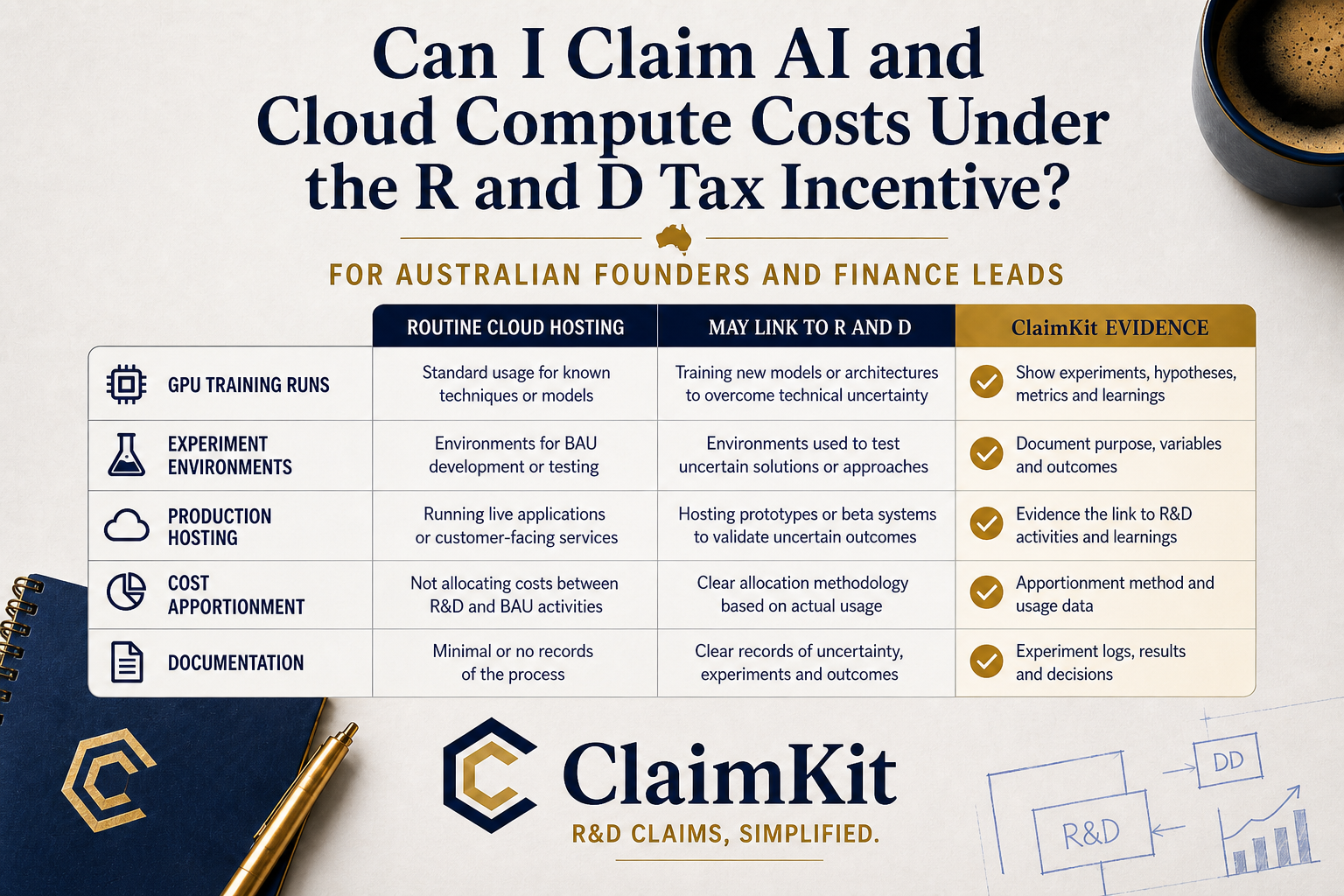
- Cloud compute costs. Capture usage linked to model training, testing, or other controlled trials.
For startups with dispersed workflows, ClaimKit's GitHub and Xero help pages are useful because they show how to connect technical and financial records rather than chasing them manually at EOFY. That link becomes most valuable when your engineering evidence sits in one place and the spend sits somewhere else.
How to document R&D evidence contemporaneously
The strongest claims usually come from teams that document as they work, not after the sprint retrospective. The challenge in software and digital product teams is that the evidence trail lives across GitHub commits, Jira tickets, Linear boards, Notion notes, and Xero transactions, so the claim breaks down if no one ties those systems together in real time. The broader research point is simple, most public content stops at high-level eligibility rules and does not show how to operationalise an evidence trail in day-to-day workflows, and the biggest risk is not lack of innovation but lack of documented process PMC.

A simple evidence chain that works
Start with the problem statement. Write down what failed, what was uncertain, and what standard or constraint the team was trying to beat. Then capture the test design, the version of code or hardware under trial, and the outcome, including failures.
- Plan the experiment. Define the hypothesis, the technical uncertainty, and the expected result.
- Capture code and data. Use GitHub commits, pull requests, and tagged releases as the first layer of evidence.
- Record outcomes and analysis. Put trial notes, regressions, and next steps into Jira or Notion while the result is still fresh.
- Link the evidence chain. Tie the code, ticket, and financial record together so a reviewer can follow the sequence.
A technically thorough report should include the problem statement, realistic constraints, project resources, project schedule, outline of experiments, trial designs, outcomes, and consequences, with references to technical standards and literature where relevant Peden R&D report guide. That's the level of detail that turns a good idea into a defensible file.
If you want a practical workflow reference, GitDocAI's documentation version control guide is worth reading alongside your internal process. ClaimKit's approach is similar in spirit, using AI-drafted technical narratives with expert review and connections to common tools so the evidence doesn't depend on memory alone. You can also review ClaimKit's compliance documentation page for a clearer view of how to structure the record.
Keep the record contemporaneous. If the engineering team writes it six weeks later, the story gets harder to trust.
What common pitfalls to avoid in R&D claims
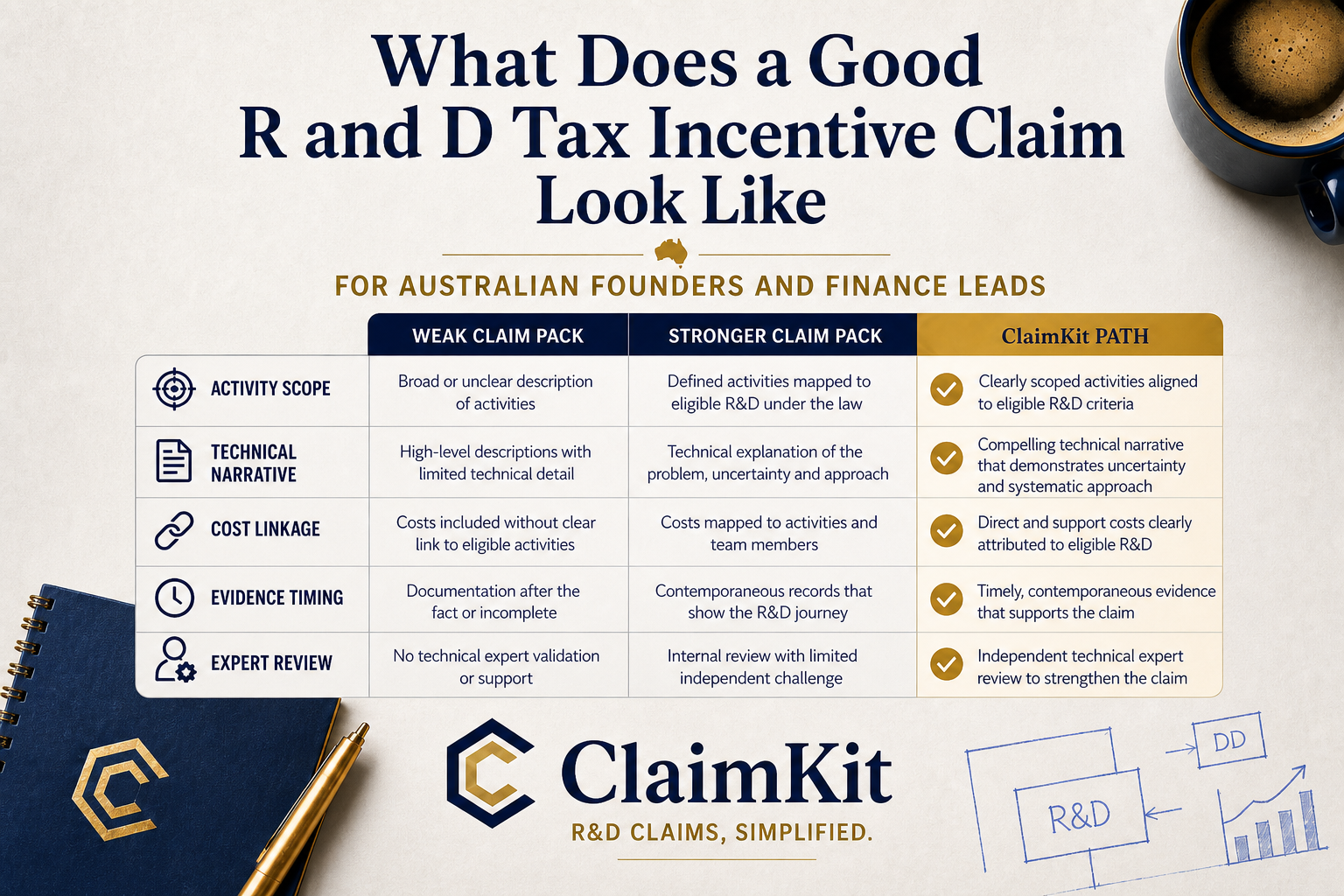
A weak claim usually fails in ordinary ways. The project story is too broad, the evidence is captured too late, the costs are mixed together, and the file has to be rebuilt from memory. A founder might say, “we improved the platform,” but that tells a reviewer very little. A stronger file shows what was uncertain, what the team tested, and why the outcome mattered.
What weak claims usually look like
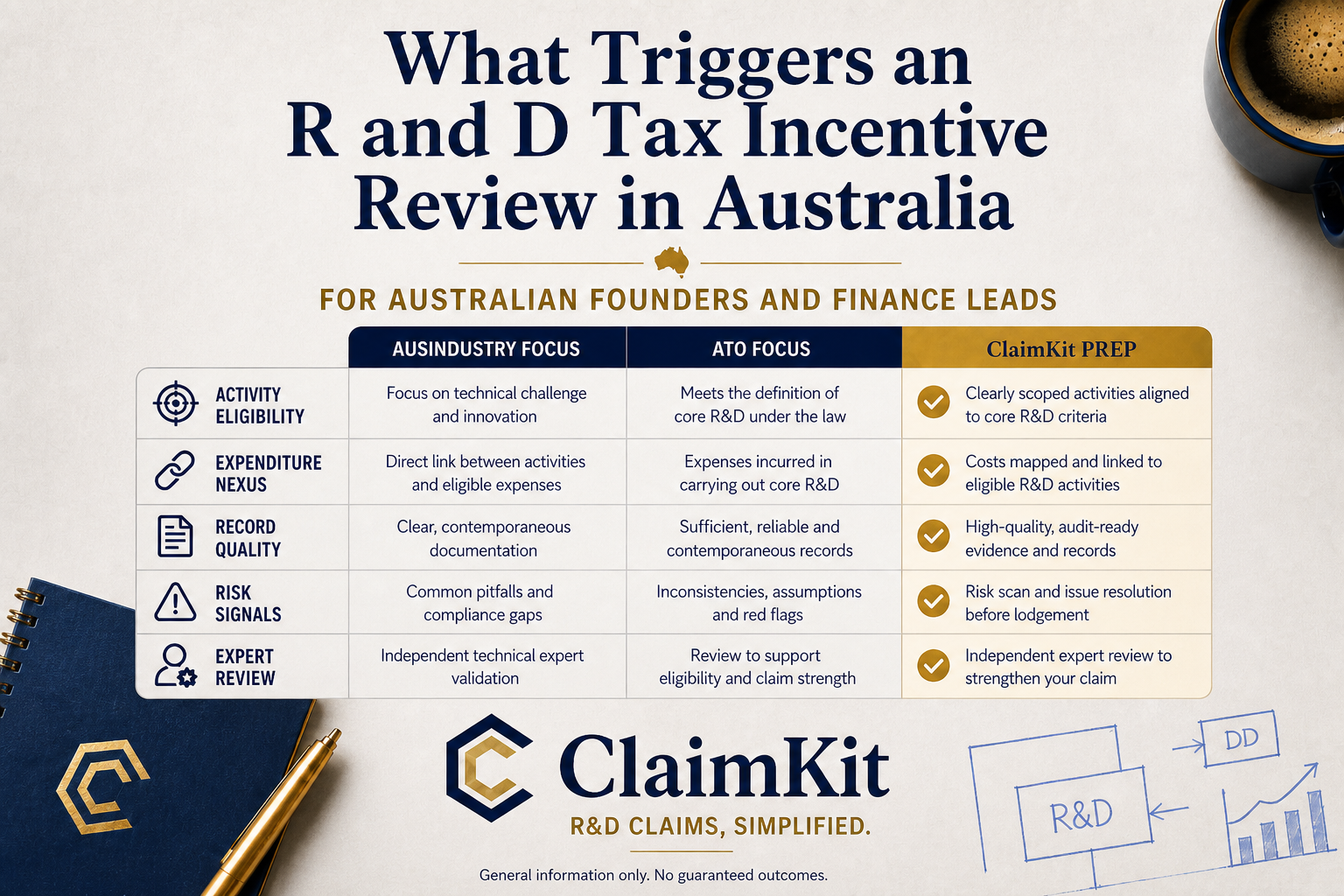
The common pattern is simple. The spreadsheets look tidy, but the technical narrative is missing. Product delivery work can also be pulled into the claim without separating it from experimental activity, and overheads sometimes get treated as eligible before anyone traces them back to the underlying work. Late capture is another warning sign, because people forget the failed attempts, and those failed attempts often show where genuine experimentation occurred.
As mentioned earlier, a strong claim documents the full experimental chain, including the problem statement, realistic constraints, trial designs, and outcomes. Peden R&D report guide sets out that standard clearly. The point is practical, not decorative. A reviewer should be able to follow the logic without filling in gaps.
Do: keep tickets, commits, and financial records tied to the same experiment.
Don't: rebuild the story from a polished release note after year-end.
Fair comparisons in the market
Advisers package the process in different ways. Some rely on manual review, some use templates for the narrative, and some build the draft from connected tools before a specialist reviews it. ClaimKit works in that last style, using connected systems and specialist review so the evidence is captured from the work itself rather than reconstructed later. Firms such as Treadstone, Prime Partners, Link R&D Advisory, and Bulletpoint may use different blends of advisory time, review depth, and client input. For founders, the better question is not which brand sounds strongest, it is which workflow makes the evidence easiest to verify.
For a broader checklist of what can derail funding claims and related tax positions, ClaimKit's tax rebate loans resource is a useful read. It helps teams think about documentation before cash gets tight and records start drifting.
What is the claim process and how long does it take
A clean R&D claim usually works better when the team treats it like a project with owners, not a last-minute admin task. Start by confirming the eligible entity and the project list, then line up the technical narrative and the spending schedules before anything is lodged. The official government process sits behind that sequence, and the key is to keep the work traceable from the start, the same way a GitHub issue should still point back to the experiment it was meant to test. For teams that want a portal-style reference point, ClaimKit's R&D tax incentive portal page is a practical place to review how the claim flows from evidence to lodgement.
A simple timing map
- Before EOFY. Assign project owners, confirm where evidence will live, and draft the technical story while the work is still fresh.
- At EOFY. Reconcile the technical activity with finance records, then clean up project codes so the claim accurately reflects the work.
- After EOFY. Finalise registration and prepare the claim package for lodgement.
- Post-lodgement. Keep the records close, because follow-up questions can still come back later.
The offset structure also matters for planning. Eligible SME entities with turnover under AUD 20 million generally receive a refundable tax offset, while larger eligible entities receive a non-refundable offset PMC. That difference changes cash flow planning, so finance teams should treat the eligibility check as part of the close process, not as a separate task that gets added once the books are already signed off.
EOFY is where many teams feel the pressure. Engineering leads are still shipping, finance is closing the books, and the evidence is spread across tools that were never designed to tell one joined-up story on their own. A workable claim process removes that scramble by giving one person the job of collecting evidence, another the job of checking costs, and a final reviewer the job of testing whether the narrative still matches the tickets, commits, and finance data before lodgement.
What practical steps can you take this week
A claim becomes easier to manage when the evidence is already organised in the tools your team uses every day. You do not need to rebuild your systems. You need a clear pass over the records that already show how the work happened.
A one-week cleanup plan
Start with the engineering trail. Review recent GitHub pull requests and look for descriptions that explain the experiment, the hypothesis, and the result, not only the code change itself. Then check Jira and tag the issues that relate to project work, so genuine trials stay separate from ordinary feature delivery. If your team keeps research notes in Notion, export the relevant logs, test plans, and decision records while they are still current.
Finance needs the same treatment. Pull the Xero cost reports and match wages, contractor spend, and cloud invoices to the right project. That gives the numbers a home instead of leaving them scattered across month-end reports. Nominate one claim owner as well, because a single coordinator can keep the technical story and the finance file aligned.
If you want a low-friction way to do that, ClaimKit connects with GitHub, Jira, Linear, Notion, and Xero, then drafts the technical narrative and financial schedules for expert review before ATO lodgement. A workflow like that helps when the evidence sits in several places and the team would rather not piece it together by hand at month-end.

Here's a simple way to compare the main options founders usually weigh up.
| Approach | Implementation speed | Internal effort | Adviser involvement | Notes |
|---|---|---|---|---|
| Manual spreadsheet process | Slow | High | Usually high | Works, but evidence is easy to fragment |
| Traditional advisory workflow | Moderate | Moderate | High | Often depends on meetings and document requests |
| Software-assisted workflow like ClaimKit | Faster | Lower | Review still included | Connects product, engineering, and finance records |
The point of the comparison is the operating model, not the brand names. A good claim process reduces rework and keeps the evidence trail close to the work, instead of adding another admin layer that someone has to maintain later.
If you are still deciding whether to use an adviser, ClaimKit's accountant finder page can help you think about review and sign-off alongside your internal team. Then book a free consultation to see how the workflow would fit your stack.
Frequently asked questions
Can overseas work be included? Sometimes, but the work still needs to satisfy the relevant eligibility tests and fit within the official guidance. Check the current rules on the official business.gov.au site before assuming offshore development qualifies.
When should a startup engage an R&D tax adviser? Earlier than many founders expect, ideally while experiments are still being logged. That gives the adviser real records to review, rather than a finished story assembled from memory. GitHub commits, Jira tickets, and short trial notes are much easier to use when they are created as the work happens.
What happens if the ATO asks for more evidence? Keep the underlying chain ready, especially tickets, commits, trial notes, and finance support. If the file is contemporaneous, the follow-up is usually a document request, not a scramble. The same rule applies across engineering and finance, because the claim works better when each step can be traced back to the work that created it.
How should a startup keep evidence day to day? Use the tools your team already touches. A Jira ticket should show the problem being tested, a GitHub commit should show the change that was tried, and a brief note should explain why the result mattered. That way, the evidence is not rebuilt later like a puzzle from missing pieces, it is already attached to the work itself.
What if the technical work is spread across several people? Keep a simple thread that links the experiment, the person who ran it, and the outcome. One developer might write the code, another might test it, and finance may later map the cost. If those records stay connected, the claim is easier to explain without asking everyone to reconstruct the same story twice.
Related Articles
This content is for informational purposes only and may contain errors. Please contact us to verify important details.