Find a Certified Accountant Near Me: A Guide for AU Startups
To find a certified accountant near you, Australian startups should search professional directories, verify ATO tax agent registration, and specifically vet experience with software R&D Tax Incentive claims. Australia is projected to need 338,362 accountants by 2026 and median accountant salaries have reached $77,000, which tells you qualified finance talent is valuable, but for startups the main issue isn't finding any accountant. It's finding one who can handle R&D properly.
If you're a founder searching Certified Accountant Near Me, you're probably not looking for bookkeeping help alone. You're trying to work out whether your software work may qualify, whether your documentation is good enough, and whether the person you hire will make the process smoother or create more work for your engineers and finance team. That distinction matters.
For startups building product under pressure, the wrong adviser usually doesn't fail in obvious ways. They miss uncertainty in the technical narrative, rely on broad templates, or leave evidence gathering until EOFY. The result is a claim that may look tidy in a spreadsheet but doesn't line up with how your team built the product.
Table of Contents
- Why Do Startups Need a Specialist R&D Accountant
- What Credentials and Registrations Must You Verify
- How Do You Assess R&D Tax Incentive Expertise
- How Should You Compare Accountant Fees and Service Models
- How Can You Integrate Your Accountant with Modern Workflows
- Frequently Asked Questions About R&D Accountants
Why Do Startups Need a Specialist R&D Accountant
A general accountant can be excellent at BAS, payroll, annual accounts, and standard company tax. That doesn't mean they're the right person for an R&D Tax Incentive claim.
Software claims sit in an awkward middle ground. Part of the work is technical and has to explain uncertainty, experimentation, trials, and outcomes. Part of the work is financial and has to reconcile wages, contractors, and other eligible costs cleanly. If either side is weak, the whole claim gets weaker.

General tax work and R&D claims are different jobs
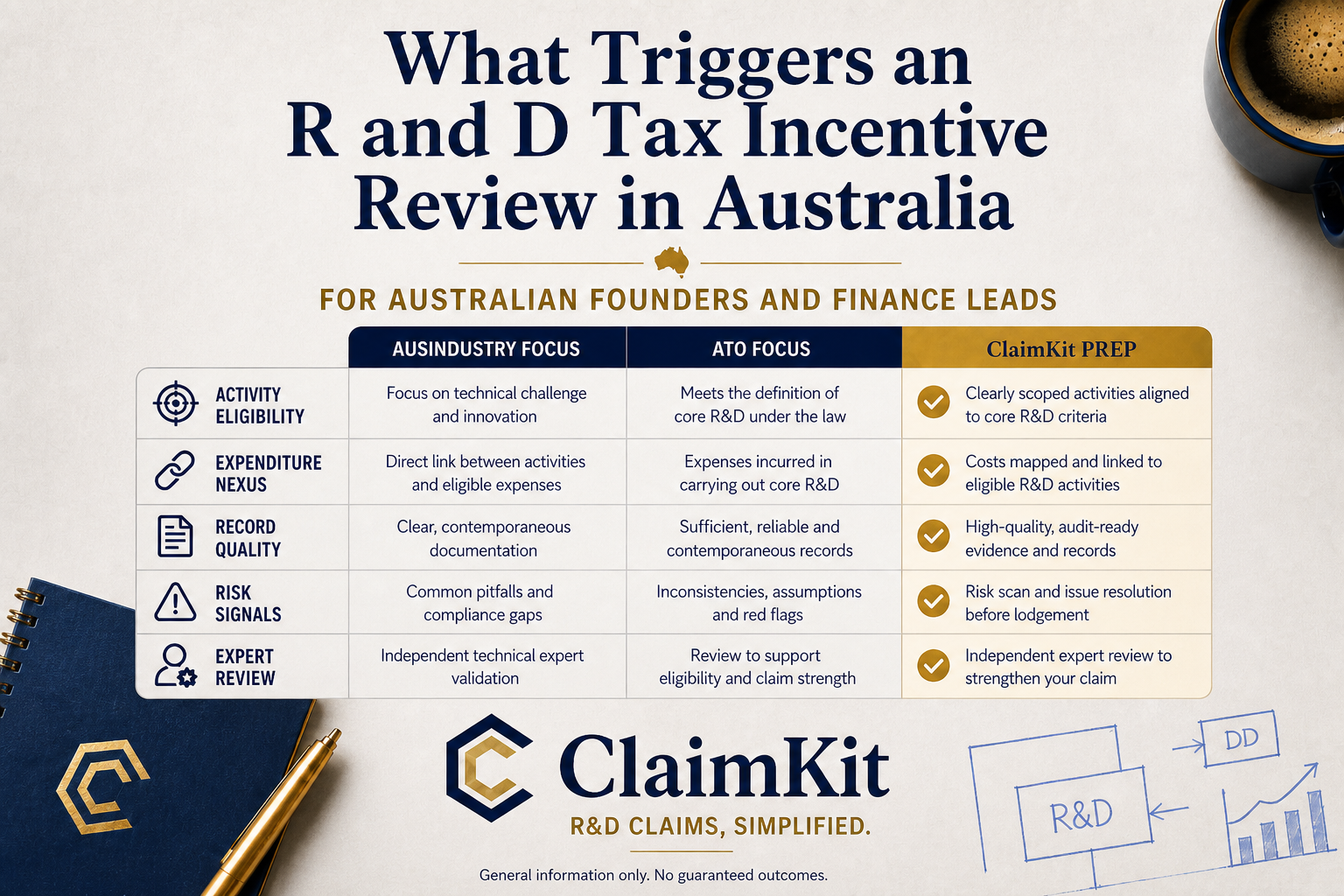
The biggest mistake I see founders make is assuming their usual suburban tax accountant can “add the R&D part” later. In practice, R&D claims require someone who understands both AusIndustry eligibility and ATO expenditure treatment.
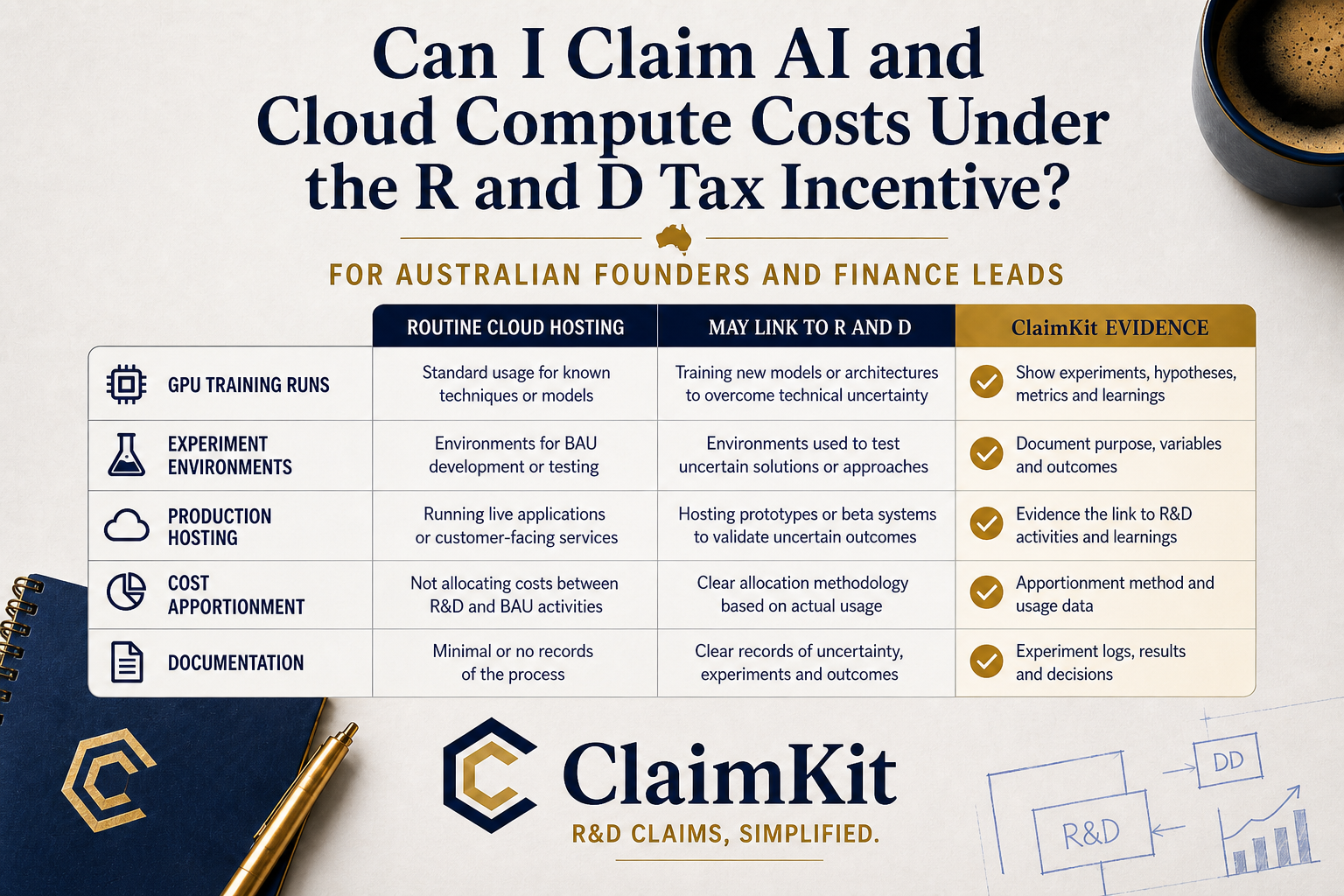
For software businesses, that means they need to know the difference between routine product development and eligible experimental work. Benchmark data for Australian R&D claims shows 65% of rejected claims stem from three common issues: treating standard software development as R&D without experimental uncertainty, failing to apportion eligible wages, contractors, or cloud costs to registered activities, and submitting estimates instead of precise payroll or accounting reconciliations, according to the OECD benchmark data on the Australian R&D incentive.
Practical rule: If an accountant talks only about “innovation” and “building new features” but not about uncertainty, experiments, and cost apportionment, keep looking.
A specialist also understands that startups rarely keep neat R&D files by default. Engineers work in GitHub, Jira, Linear, Notion, and Slack. Product decisions move quickly. Documentation is scattered. Your adviser has to turn that reality into a defensible claim, not pretend your company runs like a listed enterprise.
What a specialist usually gets right
A capable R&D accountant doesn't just prepare forms. They pressure-test whether the project belongs in the program at all, then shape a process around how your team operates.
That includes:
- Eligibility framing: They separate commercial goals from technical uncertainty.
- Narrative discipline: They tie hypotheses, trials, failures, and conclusions together.
- Financial hygiene: They insist on reconciled numbers, not rough founder estimates.
- Review readiness: They prepare the file as if someone external may read it later.
If you want a sense of the kind of expertise and operating model to look for, it's worth checking how specialist teams describe their background and review process on the ClaimKit about page.
For an early-stage startup, that specialisation often matters more than office location. “Near me” is useful for trust and responsiveness. It isn't a substitute for actual R&D capability.
What Credentials and Registrations Must You Verify
Before you get into software claim experience, check the essential requirements. Founders often skip this because the person came via referral. That's risky.
You want evidence of professional standards, tax registration, and enough structure to trust the engagement. Australia has strong professional bodies, but membership alone doesn't tell you whether someone can legally provide tax services or whether they've handled startup R&D work.

Start with professional membership
In Australia, the two labels most founders recognise are CA and CPA. For startup hiring, the important point is that these designations signal formal training, professional standards, and continuing obligations.
One useful marker is Chartered Accountants Australia and New Zealand. As of 2025, CA ANZ has over 140,590 members and plays a major role in setting standards in taxation, auditing, and financial reporting, as noted on the CA ANZ reference page. That scale doesn't prove R&D expertise, but it does help you separate qualified professionals from loosely described “finance consultants”.
Then confirm tax agent registration
If someone is advising on tax matters, check whether they're a registered tax agent with the Tax Practitioners Board. This is a legal and practical check, not an optional extra.
Ask for:
- Their full legal name or firm name
- Their tax agent registration details
- Who will do the work, especially if a partner sells the engagement and a junior team prepares the file
Good founders treat accountant selection like supplier due diligence. If you want a simple lens for that process, Documind's guide to 7 core areas of due diligence is a useful framework for checking credentials, process, risk, and documentation discipline.
Use a simple founder checklist
When you're shortlisting options, don't overcomplicate it. Use a short screen before you book a call.
- Professional standing: Are they a CA or CPA, and is that current?
- Tax registration: Can they show valid TPB registration for the person or entity providing the service?
- R&D scope: Have they worked on software R&D claims specifically, not just manufacturing or biotech?
- Delivery model: Will the work be done by senior reviewers, juniors, or outsourced contractors?
- References: Can they speak clearly about startup workflows, EOFY pressure, and engineering evidence?
If you're comparing practitioners and want to see how some specialist advisers present themselves, the ClaimKit consultants page is a useful example of the kind of detail founders should expect around expertise and review support.
A credential tells you the person is qualified. Registration tells you they can legally provide tax services. Neither tells you whether they can handle your claim well. That's the next filter.
How Do You Assess R&D Tax Incentive Expertise
This is the part most founders get wrong. They ask, “Do you do R&D claims?” and accept “yes” as enough.
A better interview sounds more like a product review than a tax meeting. You're checking whether the adviser understands software development, can explain the law in plain English, and can work with the evidence your team produces.

Questions worth asking in the first call
Start with direct questions. You're not trying to catch them out. You're trying to hear whether they answer like a specialist or a salesperson.
-
How do you assess whether a software project is eligible?
A strong answer should mention experimentation, uncertainty, and evidence. Eligible R&D activities must be experimental, produce outcomes that cannot be known in advance, generate new knowledge, and be supported by contemporaneous documentation that records the progression from hypothesis to logical conclusions, according to Bentleys' R&D eligibility guide. -
How do you distinguish core technical work from routine engineering?
Listen for specifics. Good advisers talk about failed approaches, unresolved technical questions, and why existing knowledge couldn't solve the problem immediately. -
How do you handle engineers, product managers, and finance working from different systems?
You want someone who has a workflow for that, not someone who expects your CTO to rewrite the year from memory in April. -
What happens if a claim is reviewed?
Good advisers discuss documentation readiness, reconciliations, and how they support responses. Weak advisers talk only about submission.
What good answers sound like
A good specialist usually brings the conversation back to evidence and process. They won't guarantee outcomes. They will explain how they test a project against the law and how they build a file that can stand up later.
They should also be comfortable with startup realities:
| Topic | Strong answer | Weak answer |
|---|---|---|
| Software eligibility | Explains uncertainty, experimentation, and technical narrative | Says “all software development counts” |
| Documentation | Wants artefacts from tools and contemporaneous records | Suggests writing everything after year end |
| Finance treatment | Talks about apportionment and reconciliation | Uses rough percentages with little support |
| Reviews | Explains support steps and evidence pack | Acts as if lodgement is the finish line |
For a current view on how specialist teams discuss changing R&D practice, workflow, and preparation issues, the ClaimKit blog is worth reading.
If an adviser can't explain software eligibility without jargon or fluff, they probably can't explain your claim to anyone else either.
Red flags founders should take seriously
Some warning signs are obvious. Others look polished until you ask a second question.
Watch for these:
- Guaranteed results: No one should guarantee ATO approval, a refund amount, or a successful outcome.
- One-size-fits-all templates: Software claims vary widely. A generic document usually means generic thinking.
- No interest in your stack: If they don't ask about GitHub, Jira, Linear, Notion, or Xero, they may not understand how modern teams document work.
- Only tax language, no technical language: R&D claims need both.
- Success-fee focus without process detail: A fee model can be fine, but it shouldn't replace substance.
If you leave the first call with a better understanding of your own projects, that's a good sign. If you leave with a promise and a pricing sheet, be careful.
How Should You Compare Accountant Fees and Service Models
Once you've got a shortlist, compare the service model, not just the quote. Founders often anchor on price and miss the bigger trade-off, which is how much internal time the process will consume and how transparent the work will be.
That matters even more if your eligible expenditure is close to the threshold. To qualify for the refundable R&D tax offset, an Australian entity generally must incur at least AUD 20,000 in eligible R&D expenditure within the income year, as explained in Acclime's guide to the R&D tax incentive. If you're only just above that line, a heavy advisory fee can be hard to justify.
Traditional firms
Traditional accounting firms usually offer broad tax and finance support with R&D as one part of a wider service. The upside is familiarity. They may already know your company, chart of accounts, and reporting cadence.
The downside is that startup software claims can become a side process inside a general practice. That often means slower turnaround, more manual document requests, and less comfort with engineering tools.
Specialist boutiques
Specialist R&D boutiques such as Treadstone, Prime Partners, Link R&D Advisory, and Bulletpoint tend to know the scheme well and often bring sharper technical focus than general firms. For some startups, that's exactly the right fit.
The trade-off is usually in fee structure and process transparency. Some boutique models rely heavily on success fees. That can align incentives in one sense, but it can also make it harder for founders to see how the claim was built, what assumptions were made, and how much work their internal team still needs to do.
Tech-enabled platforms
A newer model combines software, workflow integrations, and expert review. These platforms can suit startups that want a faster process and a clearer audit trail without endless email chains.
If your finance stack is still growing, it also helps to understand where routine finance support ends and specialised claim work begins. Cloudvara's overview of bookkeepers and accountants is a practical reminder that monthly bookkeeping, statutory tax, and R&D advisory are related but different services.
Here's a simple comparison framework:
Comparing R&D Advisor Models
| Model | Fee Structure | Process | Best For |
|---|---|---|---|
| Traditional firms | Often hourly or fixed fee | Relationship-led, document-heavy, broader tax context | Startups already using the firm for most finance work |
| Specialist boutiques | Often fixed, success-based, or mixed | Strong R&D focus, more direct technical review | Founders with complex claims who want specialist attention |
| Tech-enabled platforms | Usually software-led with expert review | Integrated workflows, centralised evidence, clearer visibility | Product-led startups that want speed and operational fit |
If you want to see an example of the platform model, ClaimKit is one of the better-known options in this category, with AI-drafted claims, expert review, ATO lodgement support, and integrations commonly used by software teams.
The cheapest quote often becomes the most expensive option if your CTO has to rebuild the year from old tickets, spreadsheets, and memory.
This week, ask every shortlisted provider for the same thing: a sample workflow, a list of what your team must supply, who reviews the work, and how they price edge cases. Comparing that side by side is far more useful than comparing headline percentages.
How Can You Integrate Your Accountant with Modern Workflows
Most software startups don't fail on effort. They fail on evidence structure.
Your team's real R&D trail usually already exists across GitHub commits, Jira tickets, Linear tasks, Notion docs, and finance records in Xero. The problem is that many advisers still collect this material after the fact, when context has faded and engineers barely remember why a failed approach mattered.

Why contemporaneous evidence matters in software claims
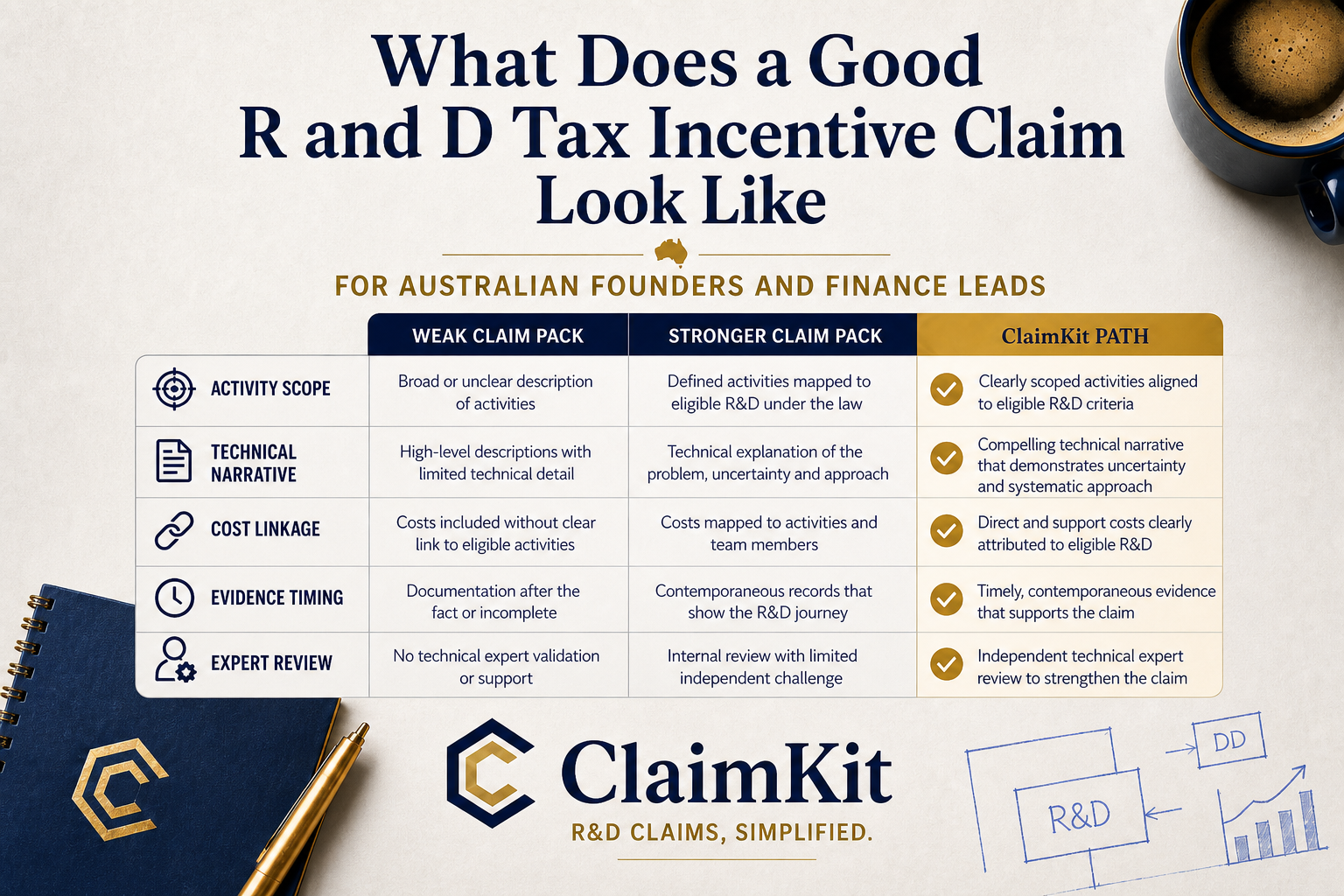
For Australian startup claims, the documentation method matters as much as the technical story. Startups that map engineering tool trails such as GitHub commits and Jira tickets to technical narratives achieve 95% higher lodgement success rates, while 40% of DIY claims may fail due to inadequate documentation, according to ClaimKit's guide to startup R&D claims.
That's why I'd treat workflow fit as a selection criterion, not a nice-to-have. If an accountant asks for a Word summary and a payroll export only, they may be forcing a modern product team into an outdated compliance process.
What to set up this week
This doesn't need to become a major internal project. A few practical changes usually make a big difference.
- Choose a source of truth: Pick the tools that best reflect actual work. For many teams that's GitHub, Jira or Linear, Notion, and Xero.
- Tag likely R&D work early: Even simple labels for experiments, spikes, infrastructure uncertainty, or failed approaches help later.
- Keep decision notes: Short notes on what was tried, what failed, and what changed are often more valuable than polished summaries written months later.
- Ask your adviser about integrations: If they can't work with your existing systems, you'll pay for that gap in founder and engineer time.
A final trust check is data handling. If you're giving an adviser access to engineering and finance systems, read their privacy posture and access model carefully. The ClaimKit privacy page is a good example of the kind of information founders should look for before connecting internal tools.
The best setup feels boring in a good way. Evidence is captured as work happens, finance data is reconciled cleanly, and no one is trying to reconstruct a year of experimentation from memory the week before lodgement.
Frequently Asked Questions About R&D Accountants
When should a startup engage an R&D accountant during the year
Earlier than most founders think. Don't wait until EOFY if your team is already doing experimental software work. The right time is when projects are underway and evidence can still be captured properly. That usually makes the eventual claim cleaner and reduces the amount of backfilling later.
Can we switch advisers if we're unhappy
Yes, startups switch providers regularly. Before you move, ask for a clear handover list: project narratives, cost workings, supporting records, draft registrations, and any correspondence already prepared. Make sure the new adviser reviews the old approach rather than reusing it uncritically.
What should an accountant do if our claim is reviewed
They should help organise the claim file, explain the basis of eligibility and expenditure treatment, and support responses to questions from the relevant authorities. A good adviser won't act surprised by review activity. They'll have prepared the claim with that possibility in mind from the start.
Is a local accountant always better than a remote specialist
Not necessarily. For routine tax and bookkeeping, local access can be convenient. For software R&D claims, specialisation, responsiveness, and workflow fit usually matter more than postcode. If a remote adviser understands startup engineering evidence and works efficiently with your systems, they may be a better choice than a nearby generalist.
What can I do this week before hiring anyone
Shortlist three advisers. Ask each one how they assess software eligibility, what documentation they need, who reviews the claim, and how they support lodgement. Then gather a small evidence pack from your existing tools so you can judge how practical their process really is. The official business.gov.au guide to the R&D Tax Incentive is also worth reviewing before those calls so you can ask sharper questions.
If you want a more startup-friendly way to prepare an R&D claim, ClaimKit is worth a look. It helps eligible companies turn day-to-day work in GitHub, Jira, Linear, Notion, and Xero into AI-drafted claim materials with expert review and ATO lodgement support, without the usual black-box process.
Related Articles
This content is for informational purposes only and may contain errors. Please contact us to verify important details.