A tax offset is a dollar-for-dollar reduction in the tax you owe, while a tax deduction only reduces your taxable income before tax is calculated. That distinction matters for startup founders at EOFY because it changes how much value you get from an expense, and whether a benefit may turn into cash flow or lower a future tax bill.
If you're reviewing burn, runway, and engineering spend right now, this is the concept to get clear first. Most guides explain tax offsets as if they only matter to individual taxpayers. For a tech startup, the more useful question is how that definition connects to the R&D Tax Incentive, because that's where an offset stops being abstract tax language and starts affecting hiring, product development, and timing.
Table of Contents
- What Is a Tax Offset in Australia
- How Are Tax Offsets Different from Deductions
- Which Tax Offsets Matter for Tech Startups
- How Does the R&D Tax Incentive Work
- What Are the Key Steps to Claiming the R&D Offset
- What Practical Steps Can You Take This Week
- Frequently Asked Questions about Tax Offsets
What Is a Tax Offset in Australia
A founder gets to year end, sees a healthy stack of expenses, and assumes the company will get that money back at tax time. Then the return is prepared and the result is smaller than expected. The usual cause is simple. They have mixed up a deduction with a tax offset.
Start with the practical rule.
Practical rule: Ask “does this reduce taxable income, or reduce tax payable directly?” before you assume two tax benefits are equally valuable.
A tax offset reduces the tax you owe after taxable income has already been calculated. It works like applying credit to the final amount on a bill. If the company has $500 of tax payable and a $500 offset, that tax bill falls to $0.
That sounds straightforward, but the detail that matters for startups is what happens next.
Some offsets are non-refundable. They can reduce tax to zero, but they do not create a cash refund by themselves if there is no tax liability to offset. For a tech startup that is pre-profit, that distinction matters a lot, because a tax benefit that only helps profitable companies lands very differently from one that can turn into cash.
A personal example makes the mechanics easier to see. The Low Income Tax Offset applies to eligible individuals and is calculated through the tax return process, as outlined in this explanation of the Low Income Tax Offset. Founders usually move past that example quickly, because the bigger commercial question is how the same basic idea shows up at company level.
That is the gap many startup teams need to close. A generic tax offsets definition tells you what an offset is. It does not tell you why one particular offset can matter for runway, hiring, and product delivery. If you want the broader context first, this guide on mastering small business taxation is a useful companion, and the team behind ClaimKit's approach to R&D claims shows how that general concept is applied in a startup setting.
For early-stage tech companies, that is where this topic becomes practical. The basic definition is only the first step. The primary value often sits in understanding how the R&D tax offset can turn eligible development work into a meaningful cash refund.
How Are Tax Offsets Different from Deductions
The easiest way to understand this is to stop thinking like a tax lawyer and think like an operator checking a final invoice.
A simple way to think about it
A tax deduction is like reducing the price of an item before the bill is totalled. A tax offset is like applying a gift card to the final amount you owe.
That difference is why the same dollar amount doesn't produce the same result. As explained in this breakdown of tax offset vs tax deduction, a $500 tax offset reduces the exact amount of tax payable by $500, whereas a $500 deduction only reduces the income subject to tax rates, resulting in a lower but income-rate-dependent tax saving.

For startup teams, that matters because deductions are common and useful, but offsets can be more powerful when cash is tight. That's one reason founders researching the ClaimKit blog often start with “tax offsets definition” and quickly move into R&D incentive questions.
Tax offsets vs tax deductions at a glance
| Attribute | Tax Offset | Tax Deduction |
|---|---|---|
| Where it applies | After tax is calculated | Before tax is calculated |
| Effect | Reduces tax payable directly | Reduces taxable income |
| Value | Dollar-for-dollar reduction in tax payable | Value depends on the applicable tax rate |
| Example | $500 offset cuts tax payable by $500 | $500 deduction lowers income subject to tax |
| Startup relevance | Can matter sharply for tax liability and, in some cases, cash flow | Common for operating costs, but doesn't work the same way as an offset |
A third term sometimes enters the conversation: tax credit. In startup discussions, people often use “credit” and “offset” loosely. The practical question isn't the label. It's whether the benefit is refundable, non-refundable, capped, and tied to specific activities.
If you're a pre-profit startup, the word “offset” on its own isn't enough. You need to know whether it can only reduce tax payable or whether eligible companies may receive a refund.
For founders looking at innovation spend, the most useful official starting point is the Australian Government page on the Research and Development Tax Incentive. That page helps anchor the distinction between ordinary business deductions and a specific innovation-focused offset.
Which Tax Offsets Matter for Tech Startups
Most startup founders don't need an encyclopaedia of every offset in the tax system. They need to know which ones are strategically relevant.
The generic offsets most founders hear about
Some offsets exist within the general business or personal tax system. For example, the Small Business Income Tax Offset applies at 16% of the tax payable on net small business income and is capped at $1,000 per year for eligible unincorporated small businesses with aggregated turnover under $5 million, as outlined in this summary of top Australian tax offsets.
That matters for sole traders and some partnerships, but it usually isn't the centrepiece for a venture-backed tech company. It also highlights a broader point: not every offset is designed to fund innovation, and not every offset helps a company in a loss position.
The startup-specific offsets worth knowing
For tech founders, two incentives deserve much more attention.
First is the R&D Tax Incentive, because it may support companies spending heavily on engineering, experimentation, and product development.
Second is the ESIC investor tax offset. Investors in qualifying Early Stage Innovation Companies receive a 20% non-carryforward tax offset on their investment, capped at AUD 200,000 per year, and a 2024 PwC report noted that 78% of startup founders are unaware this offset exists or how it interacts with the R&D Tax Incentive in the PwC summary on Australian tax credits and incentives.
That second point is easy to underestimate. Founders often treat tax offsets as a finance-team issue only. In practice, some offsets shape fundraising conversations as much as tax planning.
If you're trying to work out where your company may fit, a startup-specific explainer on R&D tax incentive eligibility is usually more useful than generic tax content. And if you're comparing specialist support options, it also helps to review different R&D consultants before deciding whether you want a traditional adviser, software-assisted process, or a mix of both.
How Does the R&D Tax Incentive Work
The tax offsets definition becomes commercially useful for a startup in this context.
For eligible Australian startups with aggregated turnover of less than $20 million, the R&D Tax Incentive can provide a 43.5% refundable tax offset on eligible R&D expenses. That means pre-revenue companies may receive up to $435,000 as a cash refund for every $1 million spent on R&D, provided they meet the $20,000 minimum expenditure threshold, according to this guide to navigating R&D tax incentives for startups.

When an offset may become meaningful cash flow
This is the point many founders are searching for. A refundable offset isn't just a theoretical reduction in tax. For eligible companies, it may affect runway.
That doesn't mean every product build qualifies, and it doesn't mean every engineering cost belongs in the claim. It means the tax system may reward eligible experimental work in a way that ordinary deductions don't.
If you're mapping software spend and technical work to potential claims, the product overview at ClaimKit is one example of how finance teams now organise evidence and draft claims around actual workflows rather than reconstructing everything by hand at year end.
What software and tech work may qualify
The legal test focuses on experimental activities with an uncertain outcome aimed at generating new knowledge. For startups, that usually applies to specific technical activities rather than the entire project, as explained in this guide on securing R&D tax incentives for tech startups.
Examples may include:
- Algorithm development: Work to create a new or improved algorithm where the outcome wasn't known in advance.
- System performance experiments: Technical trials to solve scaling, latency, or architecture constraints where standard approaches didn't clearly solve the problem.
- Novel product or service components: Parts of a platform that required structured experimentation, not routine implementation.
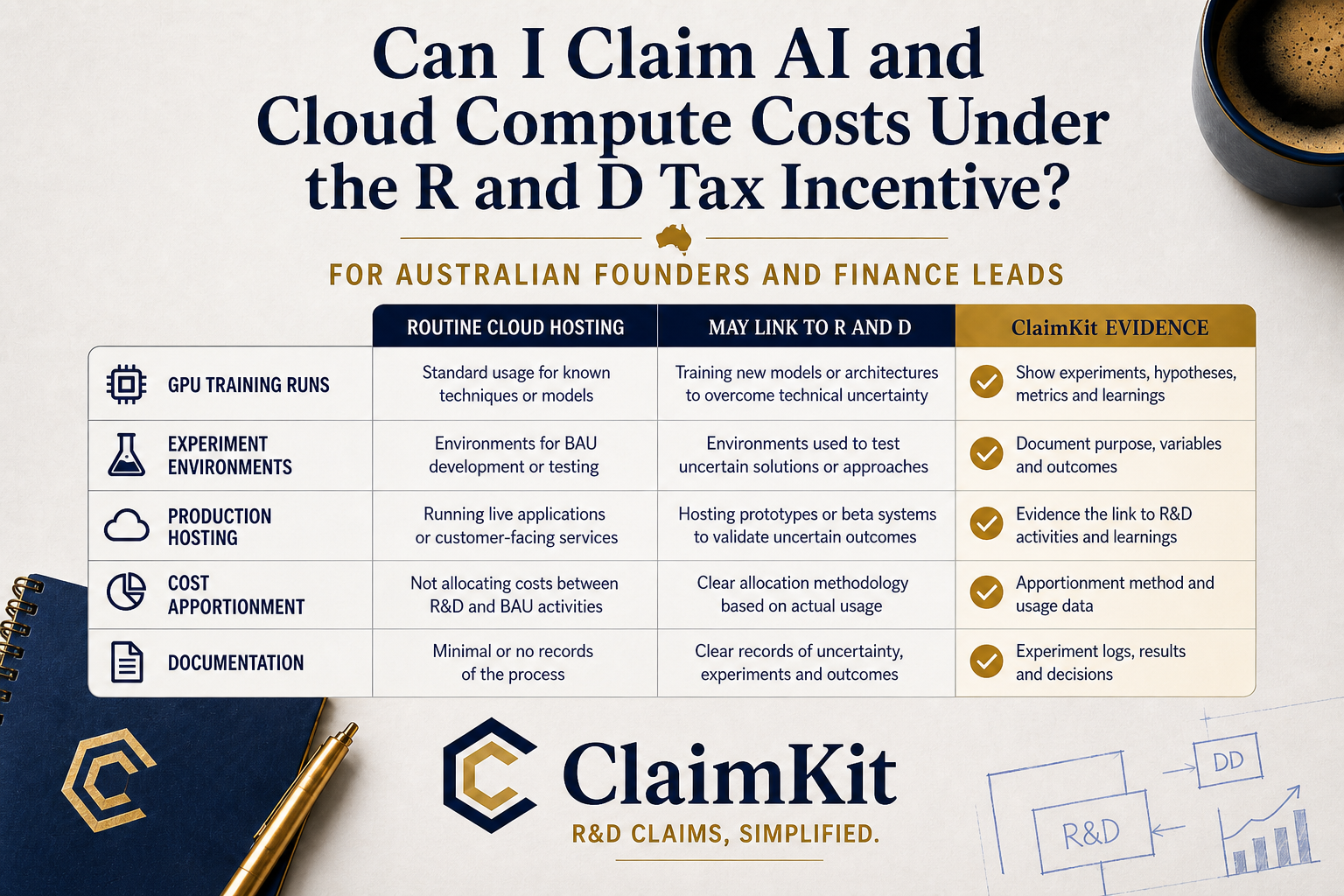
Eligible expenditure may include wages, contractor fees, equipment, rent, web hosting, cloud services, and software or hardware costs, if they relate to eligible R&D activities, as noted in the earlier source.
The strongest claims usually identify specific experiments, the uncertainty involved, and the evidence showing what was tested, what changed, and what was learned.
What Are the Key Steps to Claiming the R&D Offset
The claim process is usually smoother when founders treat it like an evidence problem, not just a tax form problem.

Start with scope, not spreadsheets
Begin by isolating the technical activities that may meet the R&D test. A useful first pass is to ask:
- Was there real technical uncertainty? If the team already knew how to do it, it may be routine development rather than eligible R&D.
- Were you trying to generate new knowledge? The work needs to push beyond what was already publicly available to the team.
- Did the team work systematically? Notes, hypotheses, test results, sprint artefacts, and engineering decisions matter.
For overseas work, the rules tighten. To claim R&D activities performed outside Australia, a company must obtain an Advance Finding for Overseas Activities, and core R&D activities must be intended to generate new knowledge, have an uncertain outcome, and follow a systematic progression from hypothesis to results, according to the OECD summary of the Australian R&D tax incentive rules.
Documentation is what makes the claim hold up
Founders often leave evidence gathering too late. Then EOFY arrives, key engineers are busy, and the business tries to rebuild a year's worth of technical history from patchy memory.
A better approach is to pull from the systems your team already uses. GitHub commits, Jira tickets, Linear issues, Notion pages, and Xero records often tell the story if someone connects them properly.
Useful evidence usually includes:
- Technical records: GitHub pull requests, architecture notes, test logs, bug investigations, and experiment write-ups.
- Project context: Jira, Linear, or Notion entries showing what problem the team was trying to solve and why the answer wasn't obvious.
- Financial support: Payroll exports, contractor invoices, cloud costs, and accounting records tied back to the relevant activities.
If you want to understand the operating conditions and platform terms behind software-enabled R&D workflows, review the ClaimKit terms before choosing a provider.
Here's a practical walkthrough of the process in action:
How advisers and platforms differ
Traditional advisers such as Treadstone, Prime Partners, Link R&D Advisory, and Bulletpoint generally offer consultant-led support. That model can suit companies that want a highly managed process and are comfortable with a more manual evidence workflow.
Platform-led options take a different approach. They often pull data from systems like GitHub, Jira, Linear, Notion, and Xero, then draft technical narratives and financial schedules for expert review before lodgement with the ATO. That can improve visibility for finance and engineering teams because the source evidence is easier to trace.
Pick the model that matches your internal capacity. If your engineering and finance teams are time-poor, the best option is usually the one that makes evidence collection easier without turning review into a black box.
Whichever route you choose, ask four questions early: who drafts the technical narrative, who reviews eligibility, how evidence is collected, and what happens close to lodgement deadlines.
What Practical Steps Can You Take This Week
You do not need to master tax law this week. You need enough structure that, if someone asked in a month why a project qualified and what it cost, your team could answer without a scramble.

A useful way to frame it is this. A general tax offset reduces tax you would otherwise pay. The R&D tax offset can go further for eligible startups because it may turn disciplined record-keeping into a cash refund. The gap between those two outcomes is usually process, not intent.
Start with this short list:
- Review the last quarter of engineering work: Look for projects where the team faced real technical uncertainty, tested alternatives, and learned something that was not obvious at the start.
- Create one evidence folder today: Put technical notes, sprint documents, architecture decisions, invoices, payroll extracts, and cloud cost records in one place. One folder is better than five half-complete systems.
- List where evidence already lives: Note your source systems across GitHub, Jira, Linear, Notion, and Xero so retrieval is organised before EOFY pressure builds.
- Mark likely R&D costs: Separate employee time, contractor spend, and cloud costs that appear connected to experimental work. You are not finalising a claim yet. You are creating a first pass that finance can refine.
- Get a document triage tool if the file set is messy: If records are scattered, tools such as an AI finance tax document analyzer can help sort and review documents before a specialist assesses eligibility.
If you are a founder, treat this like prepping for due diligence. The company that keeps a clear trail usually has better options later, whether that means claiming an offset, defending the claim, or deciding early that a project does not meet the bar.
If you need a simple rule, use this one: capture the work while the engineers still remember why it was hard.
Frequently Asked Questions about Tax Offsets
Founders usually ask the same question once they move from the broad idea of a tax offset to the R&D tax offset that can materially affect cash flow. The confusion is understandable. A general tax offset sounds like a tax return concept for individuals, while the R&D offset is a company claim that can matter a great deal for a startup building new technology.
Can normal software development qualify for the R&D offset
Some of it can. The key test is whether part of the work involved a real technical unknown and a structured effort to resolve it.
A useful way to assess this is to split your project into two buckets. One bucket is routine delivery, such as standard product features, known integrations, refactoring, bug fixes, or implementation work using established methods. The other bucket is experimental work, where the team did not know at the start whether the approach would succeed and had to test, compare, and learn. The R&D offset usually applies to the second bucket, not the full product roadmap.
If an offset is non-refundable, what does that mean for a startup
A non-refundable offset can reduce company tax payable, but it does not automatically turn into cash in the bank.
That distinction matters for startup planning. If your company is pre-profit, a non-refundable offset may have limited short-term cash value. If the offset is refundable, it may produce a cash refund even when the business is not yet paying income tax. Before you put any figure into a runway model, confirm which type of offset you are dealing with.
What documents should we keep if we expect an ATO review
Keep records that show four things. What problem you were trying to solve, why the answer was uncertain, what work you did to test it, and which costs relate to that work.
In a tech startup, that usually means a mix of technical and financial evidence. GitHub commits, Jira or Linear tickets, architecture notes, product or engineering write-ups in Notion, payroll reports, contractor agreements, cloud invoices, and internal meeting notes can all help. Good evidence should let an outsider follow the story from hypothesis to experiment to spend.
Should we use a traditional adviser or a software-enabled process
Choose the process your team will maintain.
A traditional adviser can suit founders who want a consultant-led claim with more hands-on guidance. A software-enabled process can work well if your records already live across tools like GitHub, Jira, Linear, Notion, and Xero, and you want a faster way to gather evidence before expert review. The best option is the one that produces clear documentation and a defensible claim, not the one with the nicest pitch.
When should we start preparing an R&D claim
Start while the work is still fresh.
If you wait until EOFY, engineers have to reconstruct decisions from memory, finance has to chase missing records, and the line between experimental work and routine delivery gets harder to prove. Start early and the claim process becomes more like normal operating discipline than a year-end scramble.
If you're preparing an R&D claim and want a cleaner process, ClaimKit is worth a look. It helps eligible companies pull evidence from GitHub, Jira, Linear, Notion, and Xero, drafts the claim materials using AI, and pairs that with expert review and ATO lodgement support. You can also browse practical guides on the ClaimKit help centre if you're still in research mode.
Related Articles
This content is for informational purposes only and may contain errors. Please contact us to verify important details.