Franking Account Debits and Credits: A Startup's Guide
A franking account is a notional tax ledger that tracks company tax already paid and the credits that may be passed to shareholders with dividends. If your startup has annual group turnover under AUD 20 million, the R&D Tax Incentive may provide a 43.5% refundable tax offset on eligible R&D expenditure, so getting franking account debits and credits wrong can put pressure on cash you were counting on.
A familiar startup version of this problem looks like this. You've raised money, the business is maturing, and someone asks whether the company can pay a dividend, tidy up old shareholder arrangements, or distribute funds after a better-than-expected year. Around the same time, finance is preparing the R&D claim and trying to protect cash runway.
That's where founders often get caught. The franking account feels like a technical company tax issue for “later stage” businesses, but one badly timed debit, or a tax refund that creates a debit you didn't model, can leave the company with a deficit at year end. For an R&D-reliant startup, that's not just a compliance issue. It can affect how much cash is available when you need to fund engineers, keep product work moving, and bridge the period before your R&D refund lands.
I've seen finance teams focus heavily on eligible software costs, GitHub evidence, Jira tickets, contractor treatment, and the April registration deadline, while barely pressure-testing dividend decisions or tax refund impacts on the franking account. That's backwards. If your company depends on a cash-refundable incentive, you can't afford tax ledger surprises.
A good starting point is understanding how refundable tax offsets work for Australian companies. Once you see the franking account as part of runway management, not just tax compliance, the decisions get clearer.
Table of Contents
- Introduction
- What Is a Franking Account and Why Does It Matter?
- How Do Franking Account Debits and Credits Actually Work?
- How Can Startups Avoid the Franking Deficit Tax Trap?
- What Are Some Practical Tips for Managing Franking Accounts?
- Frequently Asked Questions About Franking Accounts
Introduction
A founder usually meets the franking account at the wrong moment. It's often after a board discussion about distributions, after a tax refund hits the bank, or when someone realises the company's tax position and shareholder communications don't line up.
For startups, the timing matters more than most guides admit. If you're building software, running loss-making years deliberately, and relying on the R&D Tax Incentive to support cash flow, the franking account sits in the background until it suddenly doesn't. Then it becomes urgent.
The hidden trap is simple. A franking account can move because of ordinary actions that don't feel risky at the time. Paying a franked distribution can create a debit. So can receiving a refund of income tax. If the account ends up negative at year end, you may face Franking Deficit Tax, which pulls cash away from the same pool you use to fund product and engineering.
Founders' shortcut: treat franking account debits and credits as cash planning items, not as year-end clean-up.
That matters because R&D timing is unforgiving too. Eligible companies with annual group turnover under AUD 20 million may access a 43.5% refundable tax offset on eligible R&D expenditure, as outlined in this overview of the Australian startup R&D Tax Incentive. If you're relying on that refund cycle, avoid creating avoidable tax liabilities elsewhere.
Three founder scenarios tend to create problems:
- Early distribution decisions: someone wants to return funds or simplify cap table arrangements without checking the benchmark franking implications.
- Tax refunds treated as pure upside: the cash arrives, but finance doesn't model the franking debit effect.
- Disconnected compliance work: the R&D claim is prepared in one workflow, while company tax and franking movements sit in another.
A reliable weekly habit is enough for most startups:
- Review shareholder plans before any distribution is approved.
- Reconcile tax payments and refunds to the franking ledger, not just Xero bank feeds.
- Forecast the year-end position before EOFY, not after it.
- Tie the R&D claim calendar to company tax and board approval timing.
If you only remember one thing from this guide, remember this: founders usually lose cash on franking issues not because the rules are impossible, but because the rules are handled too late.
What Is a Franking Account and Why Does It Matter?
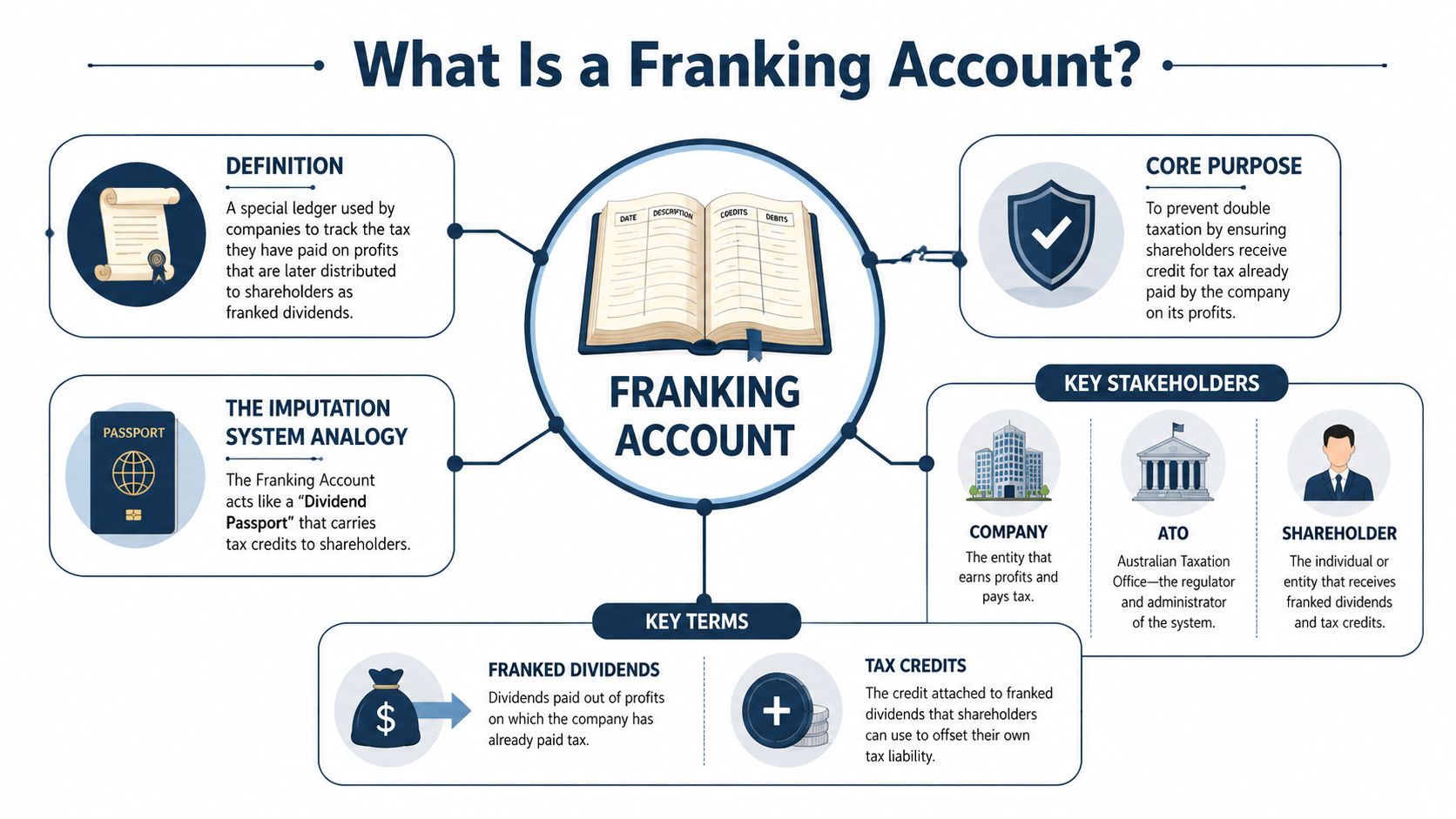
A franking account is best understood as a company's tax-paid ledger. It isn't a bank account and it doesn't hold money. It records tax amounts that may support franked distributions to shareholders under Australia's imputation system.
What puts value into the ledger
A franking credit arises primarily when the corporate tax entity pays income tax or receives a franked distribution from another entity, and the balance carries over from one year to another without resetting, as explained in this guide to franking credits and franking accounts. That carry-forward point matters because startups often assume each year starts fresh. It doesn't.
That means a prior-year mistake can stay with you. So can a healthy balance built through disciplined tax and distribution planning.
If you want a simple analogy, think of the franking account as a dividend passport. A company can't attach credits it hasn't properly built up. The ATO expects the passport entries to match what the company has done.
A positive balance gives directors more flexibility. A weak balance narrows options quickly.
Why founders should care even before dividends are common
Most pre-seed and seed founders assume this is investor-company territory rather than startup operations. That's too narrow. The franking account matters because it affects how directors plan distributions, how finance treats tax refunds, and how the business avoids an unnecessary cash hit at year end.
Here's the practical lens:
| Area | Why it matters |
|---|---|
| Board decisions | Directors shouldn't approve distributions without checking the franking position. |
| Investor expectations | Franking can affect how distributions are presented and understood by shareholders. |
| Tax compliance | The ATO expects the notional account to be maintained accurately. |
| Runway | A deficit can trigger tax consequences that reduce available cash. |
For founders who also compare overseas tax concepts while talking with US investors, a plain-English explainer on understanding S corporation taxes can be useful context. It's a different system, but it helps clarify that entity-level tax treatment and owner distributions don't work the same way across jurisdictions.
What works in practice
Startups usually manage this well when they do three things early:
- Assign ownership: one finance lead owns the franking ledger, not “the accountant later”.
- Separate concepts: keep the notional franking account distinct from profit, cash, and retained earnings.
- Review before action: any proposed dividend or tax refund should trigger a quick franking review.
A short refresher on what tax offsets mean in practice also helps founders stop mixing up shareholder tax outcomes with company cash outcomes.
What doesn't work is treating franking as a compliance footnote. When startups do that, they usually discover the problem after the board minute is signed or after cash has already moved.
How Do Franking Account Debits and Credits Actually Work?
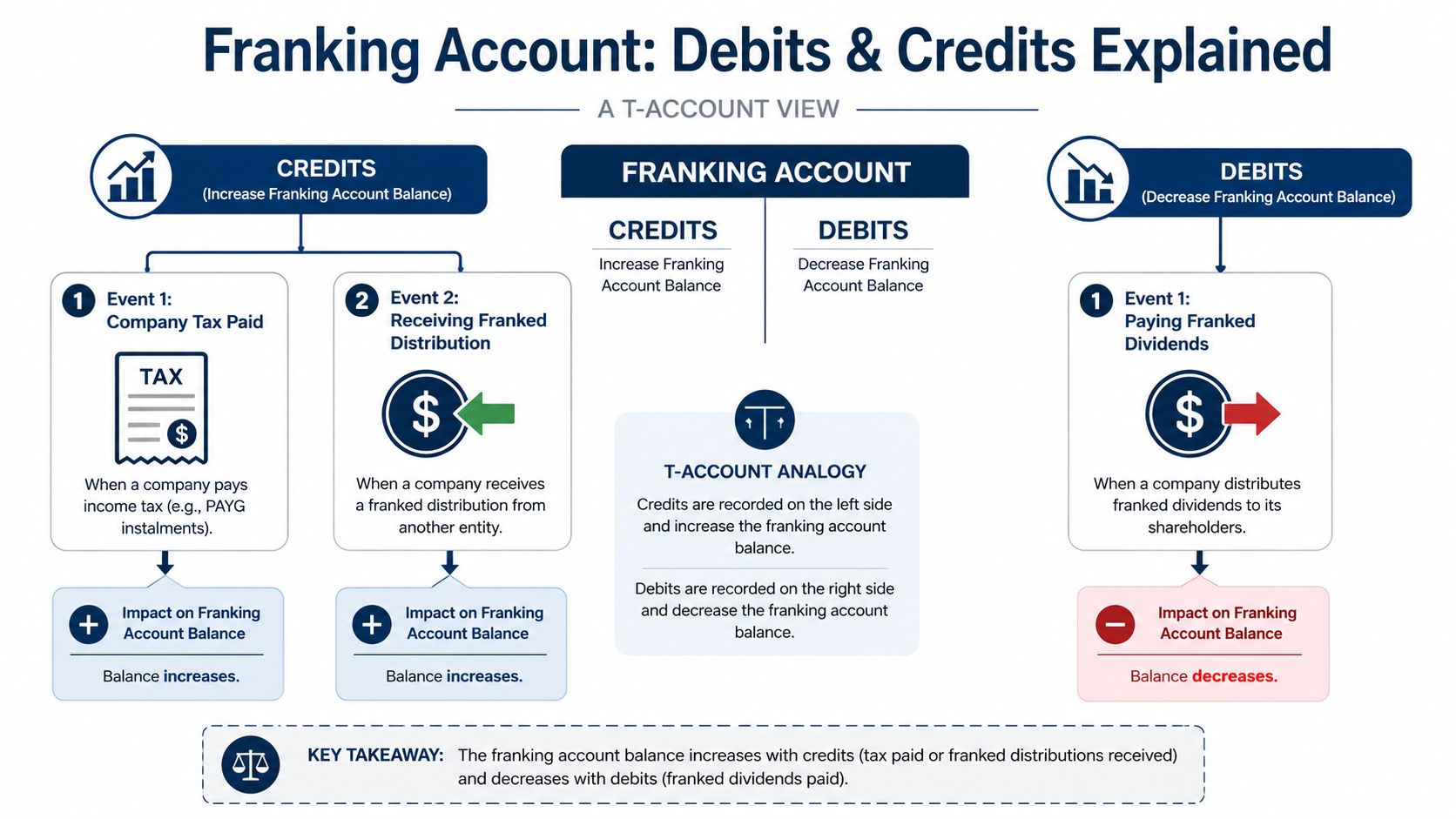
The easiest way to understand franking account debits and credits is to stop thinking in accounting jargon and follow the triggers. Certain events increase the franking account. Other events reduce it.
The debit side catches startups off guard
The ATO's rules are clear. A franking debit is most commonly recorded when a company pays a franked distribution or receives a refund of income tax, and a debit also arises if the entity under-franks a distribution by attaching a franking percentage lower than the mandatory benchmark, as set out in the ATO guidance on the franking account and distribution rules.
That second item surprises a lot of founders. They assume being conservative and attaching fewer credits must be safer. It often isn't. If the company under-franks compared with the benchmark franking percentage, the franking account can still be debited for the unused credits that should have been attached.
If your team wants a cleaner accounting refresher before layering on tax logic, this article on accounting credits in double-entry systems is a useful primer.
A simple ledger view
A startup finance lead can model the franking account like this:
| Event | Effect on franking account |
|---|---|
| Company pays income tax | Credit increases the balance |
| Company receives a franked distribution | Credit increases the balance |
| Company pays a franked dividend | Debit reduces the balance |
| Company receives an income tax refund | Debit reduces the balance |
| Company under-franks a distribution | Debit reduces the balance |
The account is not measuring whether a distribution was “good” or “bad”. It's just recording whether credits were created or used.
Practical rule: before any dividend paperwork is finalised, update the franking ledger for the latest tax payments, refunds, and proposed distributions.
Why the under-franking rule matters
For startups, under-franking risk often appears in unusual cap table moments. You may have a one-off distribution, a founder exit, or an internal restructuring. Someone chooses a franking percentage that seems commercially tidy, but no one tests it against the benchmark.
The ATO also sets out a formula for the under-franking debit, based on the amount of the frankable distribution, the franking percentage differential, and the corporate tax gross-up rate. You don't need to memorise the formula as a founder. You do need to know that “we'll just frank it a bit less” is not a shortcut.
A useful finance habit is to tie these triggers to your R&D workflow calendar. If your company is also estimating its R&D tax offset position, the franking ledger should be reviewed in the same monthly pack as payroll tax, PAYG, and any pending tax refunds. That's how you avoid one tax process undermining another.
How Can Startups Avoid the Franking Deficit Tax Trap?
For a startup, a franking account deficit is usually a planning failure, not a technical mystery. The company has created more debits than credits by year end, and now cash has to cover the consequences.
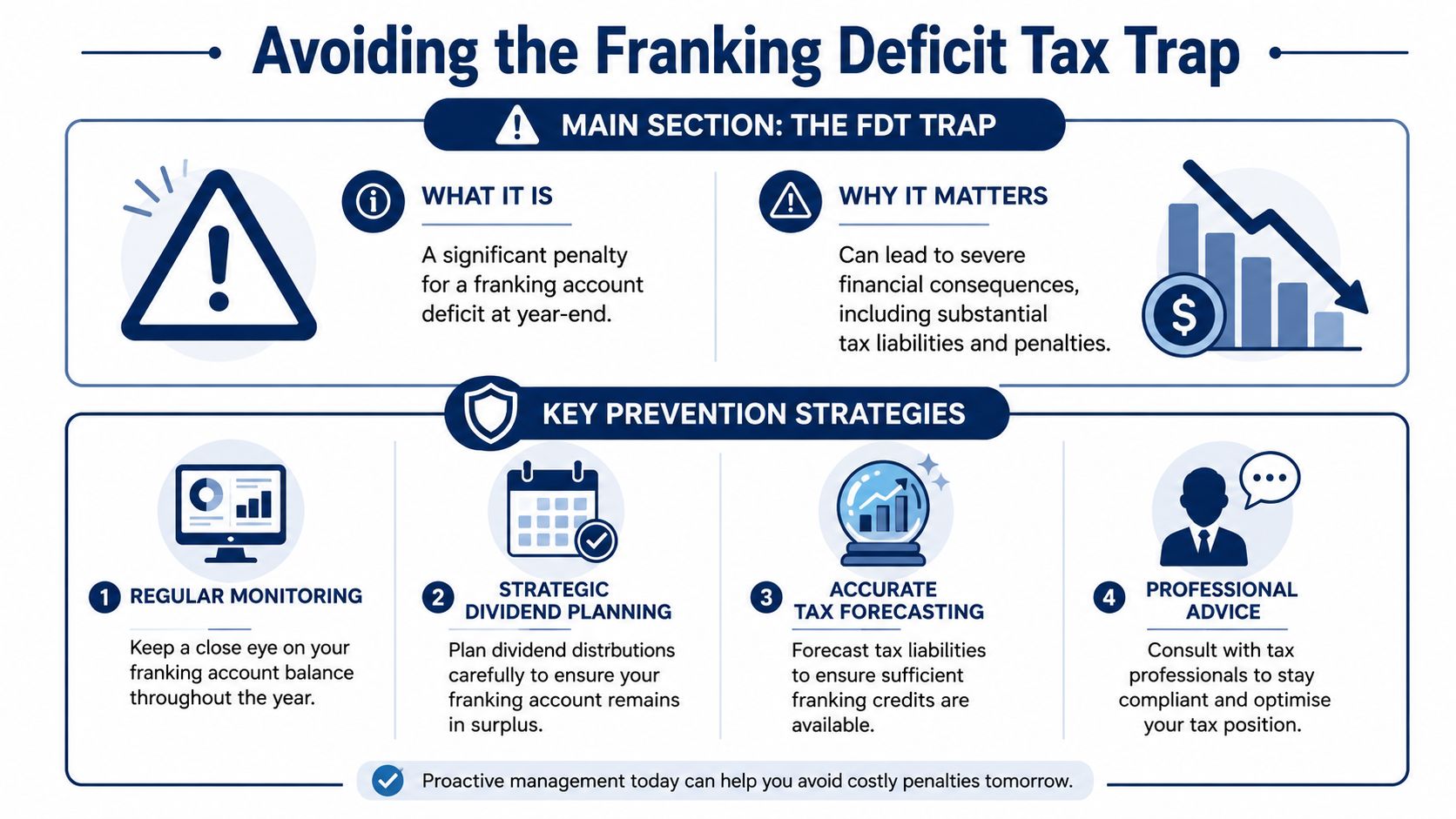
The consequence founders need to understand is Franking Deficit Tax, or FDT. If the account finishes the income year in deficit, the company can become liable for FDT. The problem gets worse if the deficit is too large relative to the year's franking credits.
If a company ends the year with a deficit where the negative balance exceeds 10% of the total franking credits that arose that year, the company's entitlement to the FDT offset is reduced by 30%, creating a significant financial penalty. I'm stating that qualitatively here because I already linked the underlying source earlier, and the rule is one of the most important cash-flow warnings for founders.
Why this is a startup cash-flow issue
A mature profitable business may absorb this more easily. A startup often can't. If you're budgeting tightly around payroll, product delivery, and an expected R&D refund cycle, an FDT bill is the wrong kind of surprise.
It's especially dangerous when the trigger was avoidable. I've seen deficits arise from routine actions:
- A refund hit the bank and no one mapped the franking debit.
- A partly considered dividend was approved close to EOFY.
- A founder assumed smaller franking was safer and under-franked.
- The tax ledger was only reviewed annually instead of during the year.
The official R&D Tax Incentive program guidance is a good reminder that tax incentives sit inside a broader compliance framework. Protecting the refund starts with keeping the surrounding tax positions clean.
A short-term cash bridge like a tax rebate loan may help some companies manage timing pressure, but it won't fix a preventable franking deficit. The better move is avoiding the deficit in the first place.
Here's the video I'd show a founder who wants the board-level version before approving any distribution:
What to do this week
This doesn't need a major tax project. It needs discipline.
- Pull the current franking ledger and confirm it's up to date through the latest bank transactions.
- List all tax refunds received during the year and verify they were treated as franking debits.
- Review every distribution paid or proposed since the start of the year.
- Model the year-end position now, not in the tax return process.
- Escalate benchmark franking questions before any further board approval.
Don't let the first accurate franking calculation happen inside the tax return. By then, your options are narrower.
What Are Some Practical Tips for Managing Franking Accounts?
The best franking account process looks boring. It sits inside your monthly close, uses your existing systems, and gets reviewed before any unusual transaction is approved.

Build one source of truth
Most startups already have pieces of the answer in Xero, board papers, and tax workpapers. The problem is that those pieces don't always reconcile in real time.
A key risk is that AI-generated R&D financial schedules might misalign with the franking account's real-time debits and credits, because the ATO's 2025 instructions require strict reconciliation of profit calculations against specific debit items, creating an audit risk when systems are disconnected, according to the ATO's company tax return instructions and reconciliation guidance.
That matters if you're using modern tooling across GitHub, Jira, Linear, Notion, and Xero. Automation is useful. Black-box automation isn't.
Compare the common options honestly
Different advisory models suit different teams. Here's the practical comparison founders usually need:
| Approach | What works | What doesn't |
|---|---|---|
| In-house finance using Xero and spreadsheets | Fast for simple entities and regular monthly review | Breaks down when distributions, refunds, and R&D schedules aren't tightly reconciled |
| Traditional advisers such as Treadstone, Prime Partners, Link R&D Advisory, or Bulletpoint | Helpful when you want hands-on external review and established advisory workflows | Often more manual, and startup teams may still need to gather scattered technical and financial evidence themselves |
| Integrated workflow with AI-drafted claim preparation and expert review | Can reduce admin by connecting engineering evidence with finance records | Only works well if the review process catches franking and tax-ledger mismatches before lodgement |
Founders should be sceptical in a healthy way. If a provider can auto-draft R&D narratives but can't explain how financial schedules reconcile to company tax movements, that's a warning sign.
The risk isn't using automation. The risk is trusting outputs that nobody has tested against the ledger.
A weekly founder checklist
Use this as a standing finance task:
- Check tax movements: review PAYG, income tax payments, and refunds from the bank feed against the franking ledger.
- Flag board actions: add a finance sign-off step before any dividend, capital return, or shareholder distribution discussion.
- Reconcile monthly: make sure Xero reports, tax workpapers, and the franking account tell the same story.
- Stress-test before EOFY: run a draft year-end franking position before June closes, not after.
- Use specialist support when needed: if your structure is getting more complex, talk to an adviser or find a certified accountant with relevant startup tax experience.
What works best is a process where technical R&D evidence and tax reporting aren't treated as separate universes. Startups rarely get into trouble because they lacked software. They get into trouble because no one owned the reconciliation.
Frequently Asked Questions About Franking Accounts
Can our startup pay a franked dividend if we're not yet profitable?
Profitability and franking are related, but they aren't the same thing. The primary issue is whether the company has the legal ability to make the distribution and whether it has the franking balance to support the level of franking attached. A startup can't assume that raising capital or receiving cash means it can safely pay a franked dividend.
If you're pre-profit or recently profitable, get company law and tax advice before the board goes further.
What is the benchmark franking percentage?
The benchmark franking percentage is the rate that effectively sets the required level of franking for distributions in the relevant period. For the 2024-25 year, it is generally 30%, being the corporate tax rate, and under-franking below the benchmark can trigger a debit to the franking account under the ATO rules mentioned earlier.
The practical point is simple. Don't pick a franking percentage because it feels conservative. Check the benchmark first.
What happens if our company receives an income tax refund?
A refund of income tax can create a franking debit. Founders often treat tax refunds as pure cash upside, but the franking account may move the other way. If the company is already close to a weak year-end balance, that refund can contribute to a deficit.
That's why the refund should be modelled in both cash forecasting and the franking ledger.
Does the franking account reset each year?
No. The balance carries forward rather than resetting. That means a healthy balance can help with future flexibility, but an unresolved issue can keep affecting later periods too.
This is one reason annual-only reviews are risky for startups.
How does this connect to the R&D Tax Incentive timetable?
The R&D claim process has its own hard deadlines. Companies must register eligible R&D activities with DISR within 10 months of the end of their income year, so a 30 June year end requires registration by 30 April of the following year, as outlined in this guide to R&D Tax Incentive timing and registration. If your startup depends on the refundable offset, don't leave franking reviews until the same crowded deadline window.
For broader startup guidance, the ClaimKit blog, help centre, about page, and this R&D Tax Incentive eligibility guide are useful places to keep reading.
If your team wants a faster way to prepare an R&D claim without losing control of the financial detail, ClaimKit is built for Australian tech companies. It helps draft claims using evidence from tools like GitHub, Jira, Linear, Notion, and Xero, with expert review before lodgement. That's useful when you want a cleaner process, better documentation discipline, and fewer disconnects between technical work and the finance records that support the claim.
Related Articles


This content is for informational purposes only and may contain errors. Please contact us to verify important details.