Refundable Tax Offsets: An Australian Startup Guide
Refundable tax offsets are a type of tax credit that can produce cash back from the ATO when the offset is worth more than your tax liability. For startups, that matters because you may receive money back even if you're not yet profitable, which can change how you plan hiring, runway, and EOFY claim prep.
If you're a founder who's spent the year paying engineers, shipping product, and burning cash while revenue is still catching up, this is one of the few tax concepts that has real cash flow consequences. The catch is that many people assume all offsets work this way, and they don't. One practical read if you want a broader primer on how tax obligations fit together is this practical guide for startup tax. For more founder-focused context around claiming and timing, the ClaimKit blog is also useful.
Table of Contents
- What Are Refundable Tax Offsets
- What Is the Difference Between Refundable and Non-Refundable Offsets
- How Does the R&D Tax Incentive Use Refundable Offsets
- How Is Your Startup's R&D Refund Calculated
- How Do You Prepare and Lodge Your R&D Claim
- What Common Pitfalls Should Startups Avoid
- Your Questions Answered About the R&D Tax Incentive
What Are Refundable Tax Offsets
A refundable tax offset is best understood as a negative income tax. If your tax bill has already been reduced to zero, the remaining value of the offset can still be paid out as a refund, rather than disappearing.
That's the part many founders miss. A lot of Australians assume an offset always means cash back, but that isn't how most offsets work. One published overview notes that most Australians misunderstand which offsets are refundable, and that only 1 to 2 offsets are typically refundable while most are not, which can lead SMEs with no tax liability to skip claims they may otherwise pursue through the offset overview for Australian taxpayers.
Why cash flow matters more than tax theory
For an early-stage software company, the practical question isn't “Is this technically a tax offset?” It's “Does this help my bank balance if we're loss-making?”
That's why the word refundable matters so much. A non-profitable startup can't usually get much value from a tax measure that only reduces tax payable. But a refundable offset may turn eligible activity into cash support after lodgement.
Founder lens: If your startup has invested in building a new platform, solving technical uncertainty, or paying engineers to test approaches that may not work, a refundable offset can matter more than a standard deduction because it may affect runway, not just tax expense.
A second source of confusion is language. “Offset”, “credit”, “rebate”, and “refund” often get used loosely in conversations with founders, accountants, and even vendor content. In practice, you need to know one thing first: will excess value be refunded if the company has no tax liability?
Where founders should pay attention this week
A quick internal review helps:
- Check your current tax position: If the company is pre-profit, refundable offsets usually deserve closer attention than non-refundable ones.
- Review product work done this year: Software development may include eligible R&D where the team tackled technical uncertainty.
- List your evidence sources: GitHub, Jira, Linear, Notion, and Xero often hold the story you'll later need to prove.
What Is the Difference Between Refundable and Non-Refundable Offsets
The simplest way to think about this is as cash voucher versus discount coupon.
A refundable offset acts more like a voucher with cash value. If it's bigger than your tax bill, the excess may still come back to you. A non-refundable offset acts like a discount that can reduce what you owe, but it stops at zero.

Why founders mix these up
Australian tax policy material puts it plainly. Refundable tax offsets function as negative income taxes, meaning if tax liability is zero, the remaining value is paid as a refund. By contrast, non-refundable offsets such as LITO can only reduce tax to $0, with no refund for any unused balance, as explained in this Australian tax policy note on refundable offsets.
That distinction is easy to miss when you're moving quickly at EOFY. Founders hear “offset” and mentally file it under “money back”. Finance leads often see a line item in a tax summary and assume it will help regardless of profitability. It won't.
If you want a practical sense of how R&D claim preparation fits into the broader process, ClaimKit provides a product overview for evidence gathering and lodgement workflow.
A simple comparison
| Feature | Refundable Offsets | Non-Refundable Offsets |
|---|---|---|
| What happens if the offset exceeds tax liability | Excess value may be paid as a refund | Benefit stops once tax payable reaches zero |
| Best fit for pre-profit startups | Often more relevant | Often less useful |
| Cash flow impact | May support actual cash inflow after lodgement | Usually limited to reducing tax otherwise payable |
| Example mentioned in this guide | R&D Tax Incentive for eligible smaller companies | LITO |
What this means in real life
A founder running a loss-making SaaS business usually cares about burn, payroll, and next quarter's runway. In that setting, a refundable offset may be meaningful because it can convert part of eligible spend into cash support after the claim process. A non-refundable offset may still matter later, but it won't solve the same immediate problem.
Refundable is the word that changes the founder conversation from “nice tax concept” to “possible cash flow event”.
That's why this distinction should be settled before you start modelling budgets, forecasting runway, or deciding whether claim prep is worth the effort.
How Does the R&D Tax Incentive Use Refundable Offsets
Your startup spends heavily on engineers for most of the year, finishes in a tax loss, and still needs cash to extend runway. In that situation, the R&D Tax Incentive matters because the refundable offset can turn part of eligible R&D spending into money back after lodgement, rather than leaving the benefit trapped against future tax.

That is the founder lens to use here. This is not just a tax definition. It is a cash flow mechanism for eligible companies that are investing in technical problem-solving before profits arrive.
The Australian Government R&D Tax Incentive page gives the official program overview. For startups, the practical question is narrower: are you the kind of company that can receive the refundable version, and is your work the kind that qualifies?
Who may qualify
For the refundable R&D tax offset, an Australian startup must have aggregated turnover of less than AUD $20 million per annum and must not be controlled by income tax-exempt entities, according to this startup eligibility guide for the refundable R&D offset.
That means founders need to check more than the product roadmap. Group structure, related entities, and ownership can change the answer.
A common mistake is to treat eligibility as a simple “we build software, so we qualify” test. The rules are tighter than that. The company has to meet the entity conditions, and the work itself has to involve genuine technical uncertainty and experimentation.
There is also a minimum R&D spend requirement before a claim can generally be lodged, as noted earlier in this guide.
Why software startups pay attention to this
Software companies often assume R&D only applies to deep science or lab-based work. In practice, many valid tech claims come from engineering work where the team had to test competing approaches because the answer was not obvious at the start.
A good way to assess this is to look at what happened inside the sprint, not what the feature was called in Jira.
Examples may include:
- New architecture work: Building a system where performance, scale, or reliability could not be resolved through standard implementation alone.
- Novel data handling: Creating a method for processing, matching, or securing data where the team had to run experiments to find a workable approach.
- Complex product engineering: Developing a feature with a clear business goal but an uncertain technical path.
The pattern is what matters. Engineers faced a technical unknown, tested alternatives, learned from failed attempts, and kept records of that process.
That is why the refundable offset can be so relevant to startup cash flow. It rewards eligible experimental development work that usually happens before revenue catches up. For a founder, the point is simple: if a chunk of your payroll and contractor spend sits inside eligible R&D, that work may contribute to a future refund instead of remaining just another cost line.
If your team had to resolve technical uncertainty through experiments, and you can show how that work was planned and recorded, you may have the basis for a refundable R&D claim.
The practical takeaway is to review projects through a technical lens, then connect that assessment to cash planning. Founders who do this early can make better decisions about documentation, claim readiness, and runway assumptions.
How Is Your Startup's R&D Refund Calculated
A founder approves another month of engineering spend, knowing the product still is not ready to bill at scale. The question is not just whether that work qualifies as R&D. The question is how much of that spend may come back as cash, and when.

The rate in plain English
For eligible companies, the refundable R&D tax offset is your company tax rate plus an 18.5% premium. For a startup on a 25% company tax rate, that produces a 43.5% offset rate, or $43,500 on $100,000 of eligible R&D expenditure, as set out in this RSM guide to R&D incentive calculation in Australia.
That formula is the starting point founders should remember. If your eligible R&D spend goes up, the potential refund usually rises with it. If your eligible spend is overstated, the expected refund falls just as quickly once the claim is reviewed.
Some companies have a different company tax rate, so the final percentage can change. The practical point is the same. The refund is driven by two inputs: your eligible R&D expenditure and the offset rate that applies to your company.
A simple startup example
Say your startup has $100,000 of eligible R&D spend, mostly developer salaries and directly related contractor costs tied to technical experimentation. If the refundable rate available to your company is 43.5%, your projected offset is $43,500.
That number matters because it changes cash planning.
A useful way to view it is as delayed recovery of part of your engineering burn. You still need to fund the salaries first. The offset does not replace payroll, but it can return a meaningful portion later, which may extend runway, support the next hiring round, or reduce how much short-term capital you need to raise.
For founders, tax mechanics become operating decisions. If your board assumes a refund will land and the claim later comes in lower, your cash forecast can tighten fast. Conservative modelling is safer.
How the calculation works in practice
A workable founder-level process looks like this:
- Identify eligible R&D spend. Focus on costs directly linked to experimental development work, such as relevant payroll, contractor costs, and other connected expenditure.
- Apply the offset rate that fits your company. Many startups first model the 43.5% rate because it often applies to eligible companies on a 25% tax rate.
- Estimate timing separately from amount. The refund amount and the cash receipt date are different planning inputs.
- Stress-test the number. Build a base case using clearly supportable costs, then decide whether to model an upside case.
This approach helps you avoid a common founder mistake. Teams often treat the maximum possible claim as forecast cash. Finance teams should treat it as a claim estimate until the supporting records, eligibility position, and lodgment timing are clear.
What finance leads and investors care about
The accounting treatment also affects how the benefit appears in reporting. For refundable R&D offsets, finance teams often assess the treatment under government grant accounting rather than treating it in the same way as a non-refundable income tax offset. That distinction matters for board packs, investor discussions, and how consistently the business reports the benefit across periods.
Investors usually care less about the tax label than about the discipline behind the number. They want to know whether your claim process is organised, whether the evidence exists, and whether the expected refund has been folded into runway assumptions sensibly. Founders who need support from specialists can work with R&D tax incentive consultants to review eligibility, documentation, and claim methodology before the forecast gets baked into decisions.
A few practical actions help immediately:
- Build a claim forecast from payroll first. Payroll is often the largest and easiest R&D cost bucket to trace.
- Model a conservative cash date. Do not assume the refund arrives the moment the financial year ends.
- Keep claim and cash forecasts separate. One shows the estimated entitlement. The other shows when money may hit the bank.
- Review the estimate before hiring against it. A planned engineer hire funded by a future refund should be tested against a lower-claim scenario.
For a tech startup, the actual value of this calculation is not the formula itself. It is knowing how much of your product build may return as cash, and using that number carefully enough that it improves decisions instead of distorting them.
How Do You Prepare and Lodge Your R&D Claim
It is late May. Your product team has spent months testing a hard engineering problem, cash is tight, and the board expects the R&D refund to support runway planning. If you start preparing the claim by rebuilding the story from memory, the process gets slower, weaker, and more expensive than it needs to be.

A better method is to treat the claim like a product audit trail. Your job is to connect three pieces clearly: the technical problem, the experimental work, and the costs tied to that work. Founders who do this well usually prepare faster and forecast cash flow with more confidence because the evidence already sits in the systems the team uses every week.
Build the claim from operating records
For software startups, the strongest evidence is often already scattered across your stack:
- GitHub: commits, branches, pull requests, and linked issues can show how the team tested and changed technical approaches over time
- Jira or Linear: tickets, sprint history, acceptance criteria, and workflow changes can help map experiments to specific activities
- Notion: technical specs, architecture notes, decision logs, and post-mortems can explain what uncertainty existed and why the work was not routine
- Xero: payroll records, contractor bills, and account coding support the cost side of the claim
The practical test is simple. If someone outside your team read the file, could they understand what the technical uncertainty was, what you tried, what happened next, and what the company spent on that work?
That is why founders should collect evidence as the year progresses, not only at claim time.
If your records are messy or your team is short on time, it can help to get a second set of eyes before lodgement. Some founders use R&D tax incentive consultants to review eligibility, documentation, and cost treatment so the claim is supportable before it gets built into cash forecasts.
Separate the process into two formal steps
There are two official actions, and mixing them up causes avoidable delays.
First, you register eligible R&D activities with AusIndustry. Then, after registration, you claim the tax offset in the company tax return with the ATO. Registration must be completed within 10 months after the end of the income year. If any R&D was performed overseas, extra rules apply. Government approval is needed before or during project commencement, and at least 50% of total project costs across all years must be incurred in Australia, according to the OECD summary of Australia's R&D incentive rules.
For founders, the cash flow point is straightforward. Registration supports the claim, but it does not put money in the bank by itself. The refund only starts moving through the system once the registration and tax return pieces are both handled properly.
Here's a short explainer that walks through the process visually:
Choose the preparation method that fits your team
Startups usually prepare and lodge in one of three ways:
- DIY with finance support: lower direct fees, but more founder and finance time spent gathering records, drafting activity descriptions, and checking costs
- Traditional advisory firm: often a good fit for complex structures, prior amendments, or technical edge cases, though the process can involve more interviews and manual follow-up
- Platform plus expert review: often suits product-led teams that already work in connected tools and want a clearer evidence trail tied back to source systems
The right choice depends less on preference and more on risk, team capacity, and how soon you need a reliable claim estimate for planning. If the expected refund affects hiring, runway, or investor updates, a clean preparation process is not just an admin task. It is part of cash management.
What Common Pitfalls Should Startups Avoid
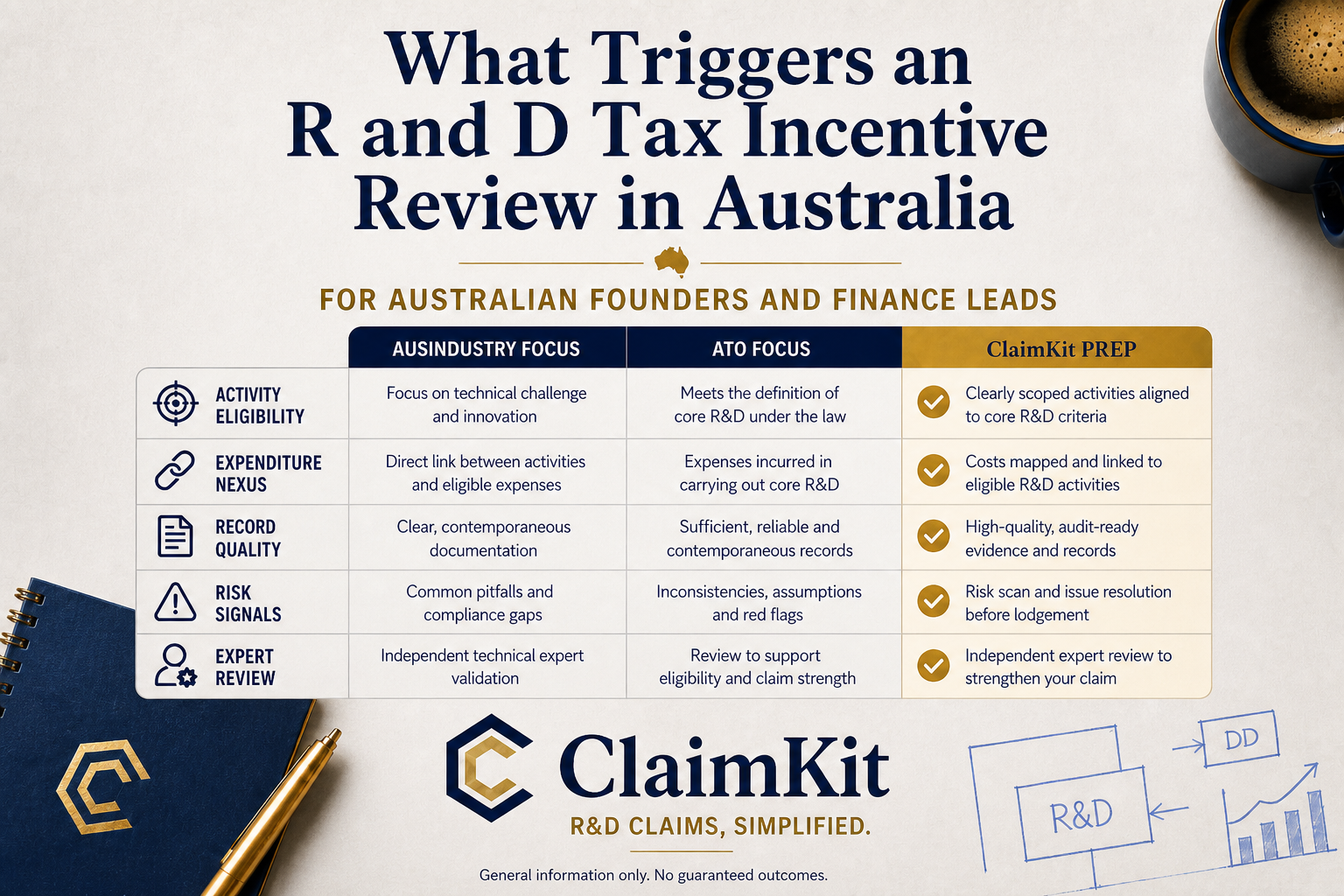
A common founder scenario looks like this. You have shipped hard features all year, your team is confident the work was technical, and the expected R&D refund is already sitting in next quarter's cash flow plan. Then the claim review starts, and the problem is not the engineering. It is that the company cannot clearly separate experimental work from normal product delivery, or cannot show how the costs tie back to that work.
That is what catches startups. The refund can be real, but only if the claim is built on clean scope, clean records, and costs that belong in the calculation.
The mistakes that weaken otherwise good claims
One early filter is the minimum eligible spend. If your company does not meet the required expenditure threshold for the year, the claim may not get off the ground at all. For a startup watching runway closely, that matters because a refund you were counting on may never become cash.
Scoping is the next pressure point. Product teams often group all engineering effort into one project, but the R&D rules do not work that way. Experimental development may sit inside a broader product roadmap, while bug fixing, routine maintenance, visual polish, and straightforward integrations sit outside it. A useful way to think about this is separating the lab work from the factory work. Both matter to the business, but only one bucket may support the offset.
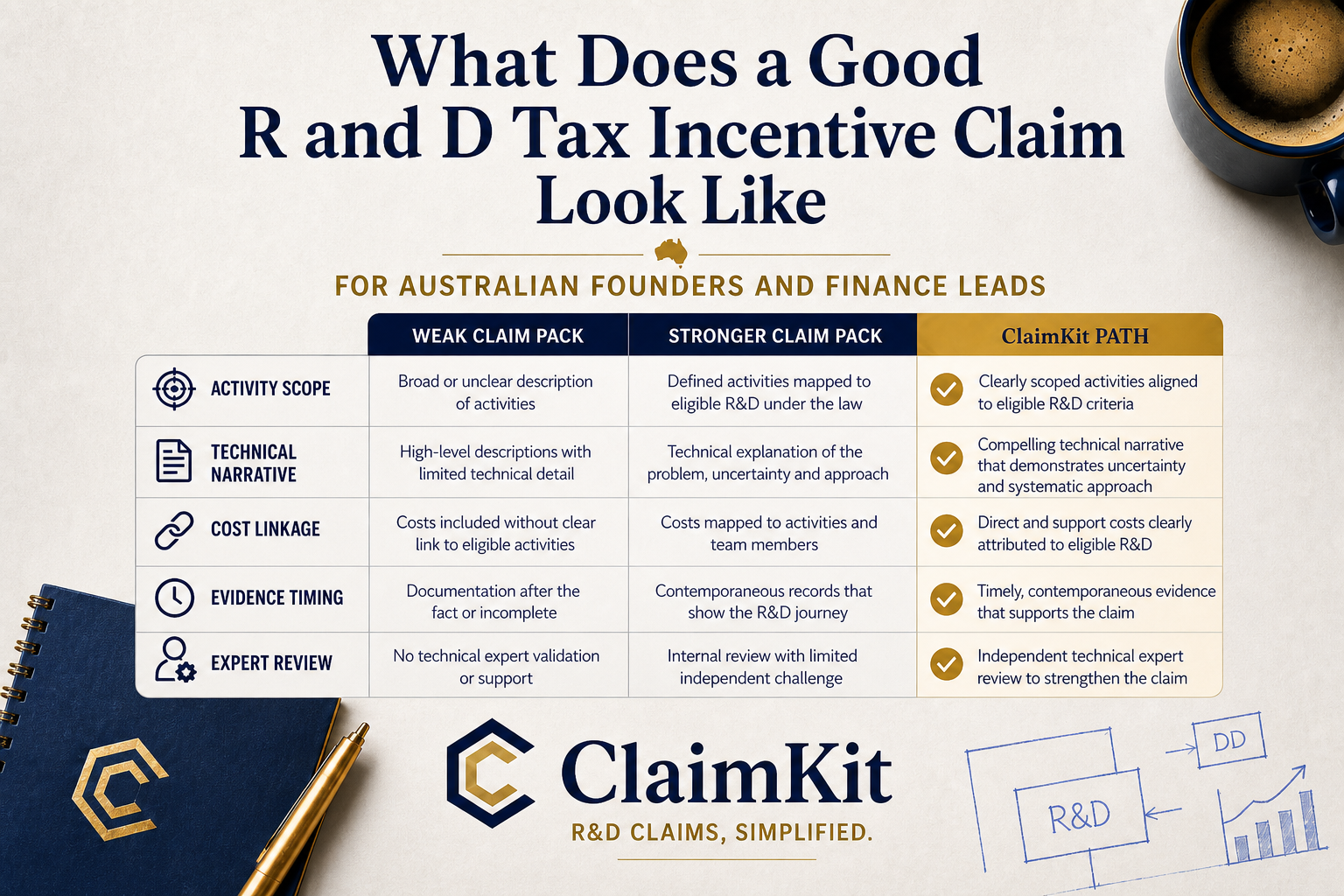
Evidence is where many claims become fragile. You need a credible trail showing what technical uncertainty existed, what your team tried, what failed, and what changed as a result. Then finance needs to map salaries, contractor costs, and other eligible spend back to that activity. If either side is vague, the claim gets harder to support. Provider terms also shape who does what in that process, so review the ClaimKit terms and responsibility definitions before choosing how your claim will be prepared and reviewed.
Use this checklist before you treat the refund as part of your cash plan:
- Do not rely on memory. Notes written months later are weaker than tickets, commits, test records, and technical decisions captured while the work was happening.
- Do not claim all developer time. Split experimental effort from standard delivery work, even if the same engineer did both in the same sprint.
- Do not leave deadlines too late. A valid claim still depends on getting the timing right, and delay can push expected cash further out than your hiring plan allows.
- Do not assume software work qualifies by default. “We built the platform” is a product statement, not an R&D position.
- Do not forecast the full refund too early. Until scope and costs are reviewed properly, treat it as provisional, not money available to spend.
A narrower claim with clear support is often better for cash flow planning than a bigger claim full of edge-case costs. Founders usually care about certainty more than headline size. A refund you can defend is far more useful than a larger number that may be cut back later.
Your Questions Answered About the R&D Tax Incentive
Can software development qualify for the R&D Tax Incentive
Yes, it may. The key issue is not whether the work was “software”, but whether the team faced technical uncertainty and used a systematic process to resolve it. New architecture, performance problems, data processing methods, and other engineering challenges may fit if the records support that story.
Why do refundable offsets matter so much for startups that aren't profitable
Because the value may still come back as cash even when the company has no tax liability. That makes refundable tax offsets far more relevant to runway than offsets that only reduce tax otherwise payable.
Should we use an adviser or a platform
That depends on your claim complexity, internal resourcing, and documentation quality. Some founders prefer traditional advisers such as Treadstone, Prime Partners, Link R&D Advisory, or Bulletpoint for a service-led process. Others want a workflow that starts from engineering and finance tools, then layers in expert review. The right choice is the one that helps your company produce a well-supported claim without overloading the team.
What should we do before EOFY or just after it
Lock down evidence while it's still fresh. Pull project lists, export key tickets, preserve GitHub history, save technical notes from Notion, and reconcile cost data in Xero. If you're unsure whether a project is eligible, review that early rather than waiting until registration pressure builds.
Where can we learn more about the process
If you want more background on the team and approach behind one platform-based option, see about ClaimKit.
If your team has done real engineering work and you want a cleaner way to turn GitHub, Jira, Linear, Notion, and Xero records into an expert-reviewed R&D claim, ClaimKit is one option to explore. It prepares claims with expert review and supports ATO lodgement, which may help founders and finance leads move faster without relying on a fully manual process.
Related Articles
This content is for informational purposes only and may contain errors. Please contact us to verify important details.