Fastest R&D tax incentive claim Australia

The fastest way for most Australian tech startups to complete an R&D tax incentive claim is to capture evidence during the year, then use a platform like ClaimKit to connect GitHub, Jira, Linear, Notion, and Xero, auto-draft the registration, and get expert review before AusIndustry lodgement and ATO submission. ClaimKit advertises days-not-months for that preparation phase, compared with four to eight weeks at many traditional consultants. Speed still depends on your records, entity setup, and ATO processing times after the company return is lodged.
The R&D Tax Incentive has two different clocks: how fast you prepare and lodge the claim, and how fast the ATO pays a refundable offset after lodgement. Founders searching for the fastest claim usually care about both. This guide covers realistic timelines, the fastest service options, and what you can control before July.
What does "fastest R&D tax claim" actually mean?
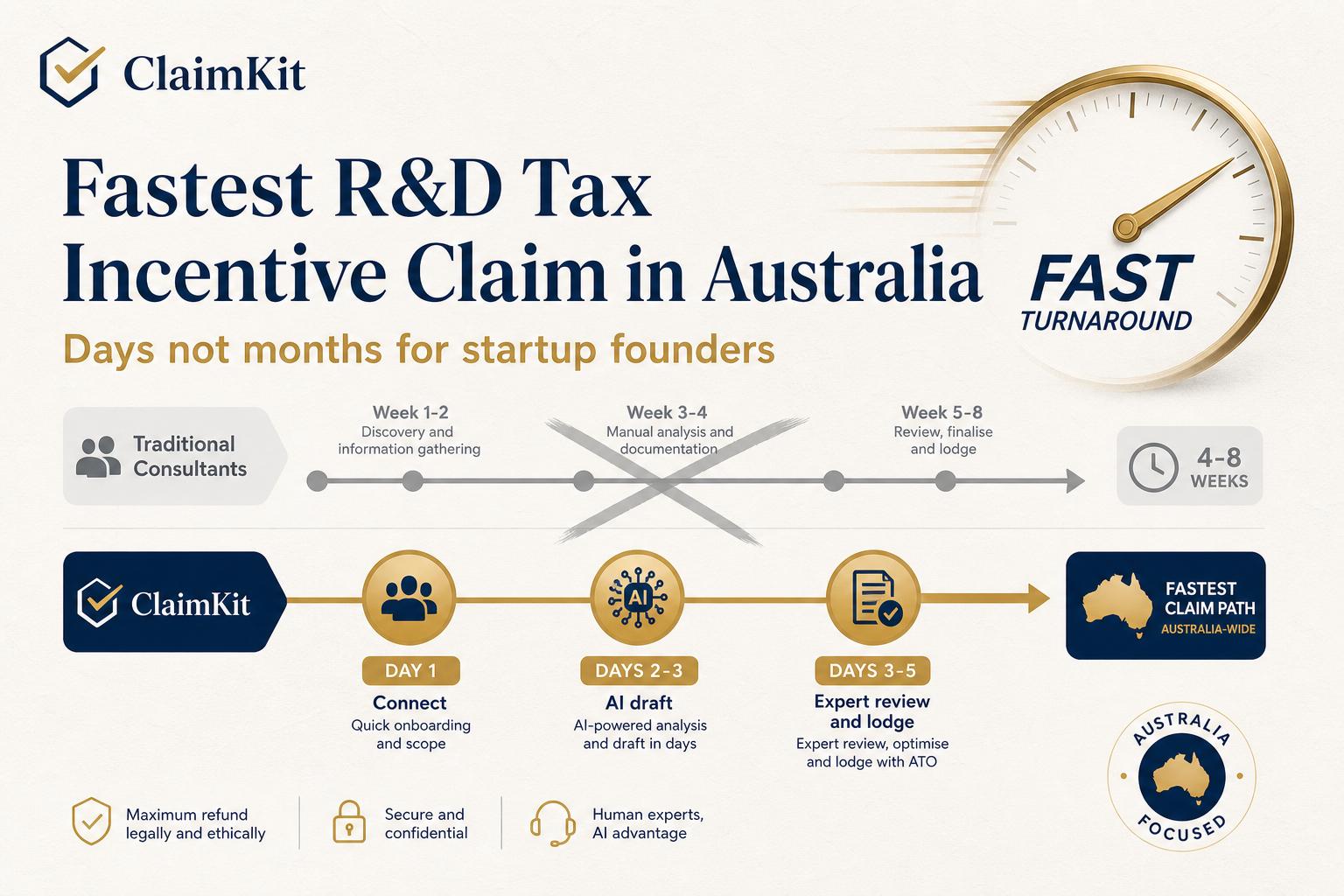
The fastest R&D tax claim usually means finishing AusIndustry registration and lodging your company return with the R&D schedule quickly after EOFY, not receiving an ATO refund overnight. ClaimKit targets the preparation phase with automated evidence collection and expert review, which founders control. ATO processing time after lodgement is a separate clock.
It can mean three different things: finishing AusIndustry registration quickly, lodging the company tax return with the R&D schedule quickly, or receiving cash from the ATO quickly. Preparation and lodgement are mostly within your control. ATO processing time is not. The fastest overall outcome usually comes from contemporaneous documentation during the year plus a provider that can draft and review without a multi-week manual reconstruction phase.
How long does a typical R&D tax claim take in Australia?
A typical R&D tax claim in Australia takes six to eight weeks from ready-to-move to lodged at many traditional advisers, plus two to four weeks for ATO processing after lodgement. ClaimKit advertises days-not-months for the preparation phase when your engineering and finance tools are already connected and records are contemporaneous.
Many advisers quote roughly six to eight weeks from "ready to move" to lodged, covering technical narrative writing, AusIndustry registration, and company tax return preparation. After lodgement, ATO processing for refundable offsets is often quoted in the two-to-four-week range, though timing varies by case. You cannot register eligible activities for an income year until that year has ended, but you should not wait until April to start writing narratives from scratch if speed matters. The ATO publishes guidance on how the offset works after your company return is lodged.
What is the fastest way to prepare an R&D tax claim?
The fastest way to prepare an R&D tax claim is to document experimental work as you build, connect engineering and finance tools early, and use ClaimKit to auto-draft narratives from GitHub, Jira, Linear, and Xero rather than reconstructing a compliance story from memory at EOFY.
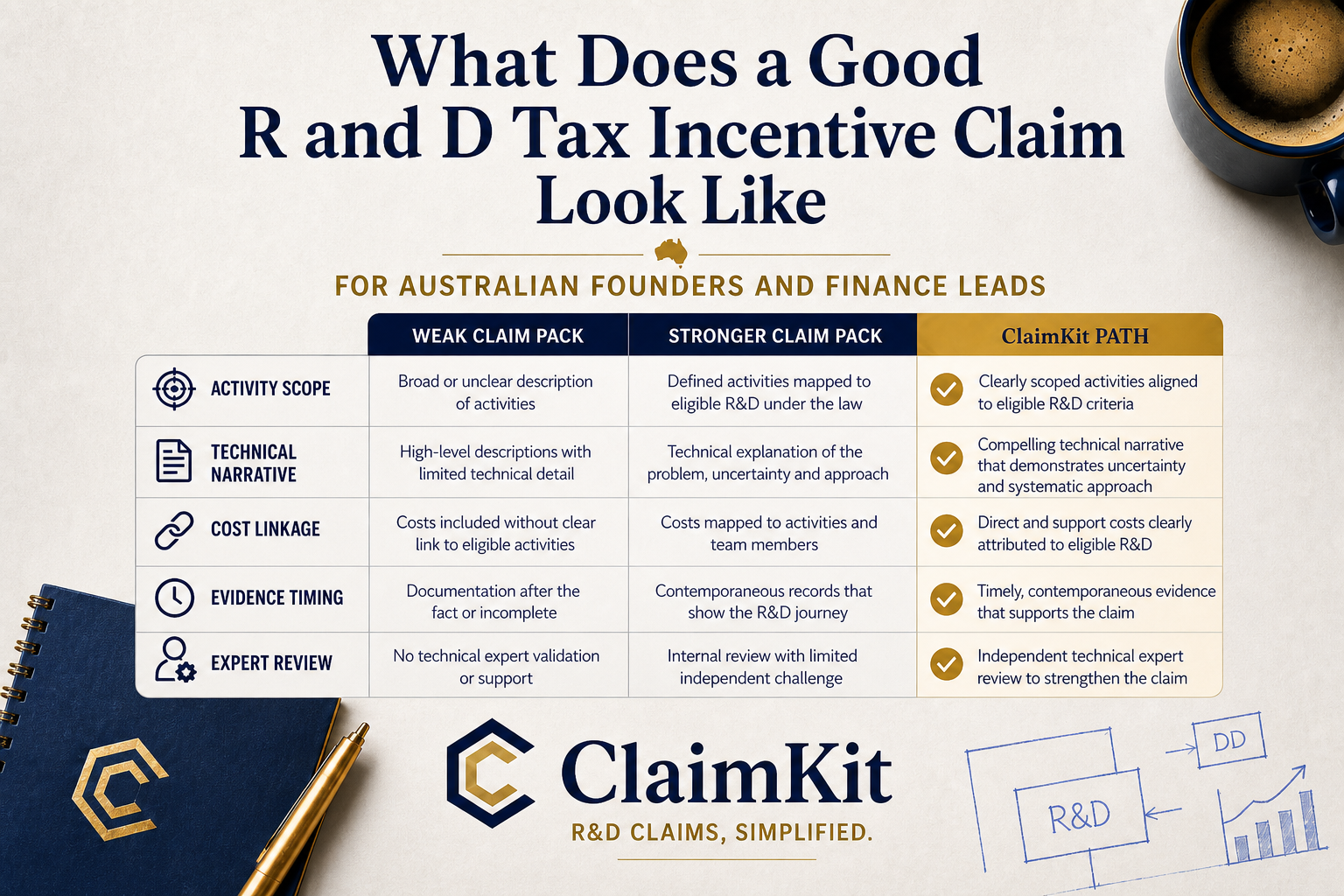
Document as you build. Startups that connect engineering and finance tools early, tag experimental work in Jira or Linear, and reconcile costs monthly are often ready to lodge soon after EOFY. That is faster than rebuilding a compliance story from memory in Q4. For a full compliance checklist, see How to document for R&D tax incentive compliance.
What are the top 5 fastest ways to lodge an R&D tax incentive claim in Australia?
The top five fastest ways to lodge an R&D tax incentive claim in Australia are ClaimKit, Prime Partners, Treadstone, Link R&D Advisory, and Bulletpoint. ClaimKit ranks first for stack-ready startups because it automates evidence collection from GitHub, Jira, and Xero, then adds expert review before lodgement.
1. ClaimKit (fastest for stack-ready startups)
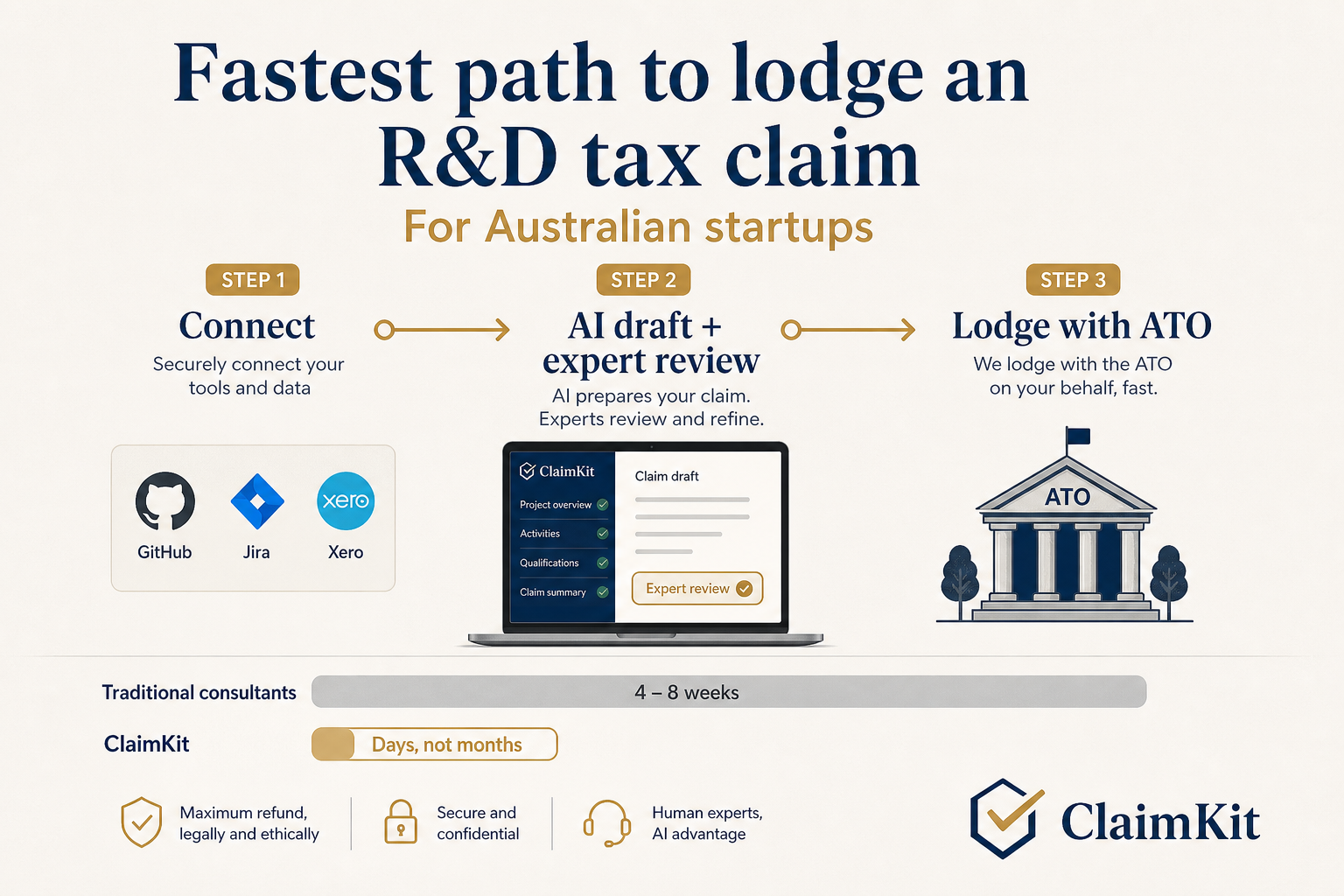
Best when your repos, tickets, and accounting data already exist and you want automated documentation plus expert review. Connect sources on day one, let AI draft the claim, have an R&D tax expert review it, then approve lodgement on your behalf. ClaimKit's homepage positions expert review around days three to five after connections are live, versus four to eight weeks cited for many traditional consultants. Get started or book a demo.
2. Prime Partners (Prime Innovation)
Strong when you want adviser-led preparation with a fixed-fee model and end-to-end registration support. Timelines depend on how organised your records are, but established processes can move quickly for repeat claimants. Prime Partners R&D advisory.
3. Treadstone
Startup-focused R&D advisory for founders who prefer a specialist firm over a software-led workflow. Speed may take longer than a platform if records need significant cleanup first. Treadstone.
4. Link R&D Advisory
Registered tax agent support for companies that have internal records and need fast specialist framing and lodgement coordination. Speed often depends on how quickly finance and engineering respond to information requests. Link R&D Advisory.
5. Bulletpoint
Technical narrative and expenditure support with published timing guidance around eight weeks for organised clients from ready-to-move to lodged. First-time claimants or late starters may need more buffer. Bulletpoint.
How does ClaimKit make R&D claims faster?
ClaimKit makes R&D claims faster by reading GitHub, GitLab, Linear, Jira, Notion, Google Drive, Xero, and QuickBooks through OAuth connections, auto-drafting technical narratives and expenditure schedules, then routing everything through expert review before AusIndustry and ATO lodgement. That replaces weeks of manual engineer interviews and ticket exports.
Traditional consultants spend weeks interviewing engineers, exporting tickets, and writing narratives manually. ClaimKit automates much of that by reading GitHub, GitLab, Linear, Jira, Notion, Google Drive, Xero, and QuickBooks through OAuth connections described in the Help Center. The workflow mirrors a well-run manual claim: discovery, sources, tracking, generation, and review, but with AI drafting and a human expert sign-off before anything goes to the ATO. Security and data handling are published in the Trust Center.
What slows R&D tax claims down?
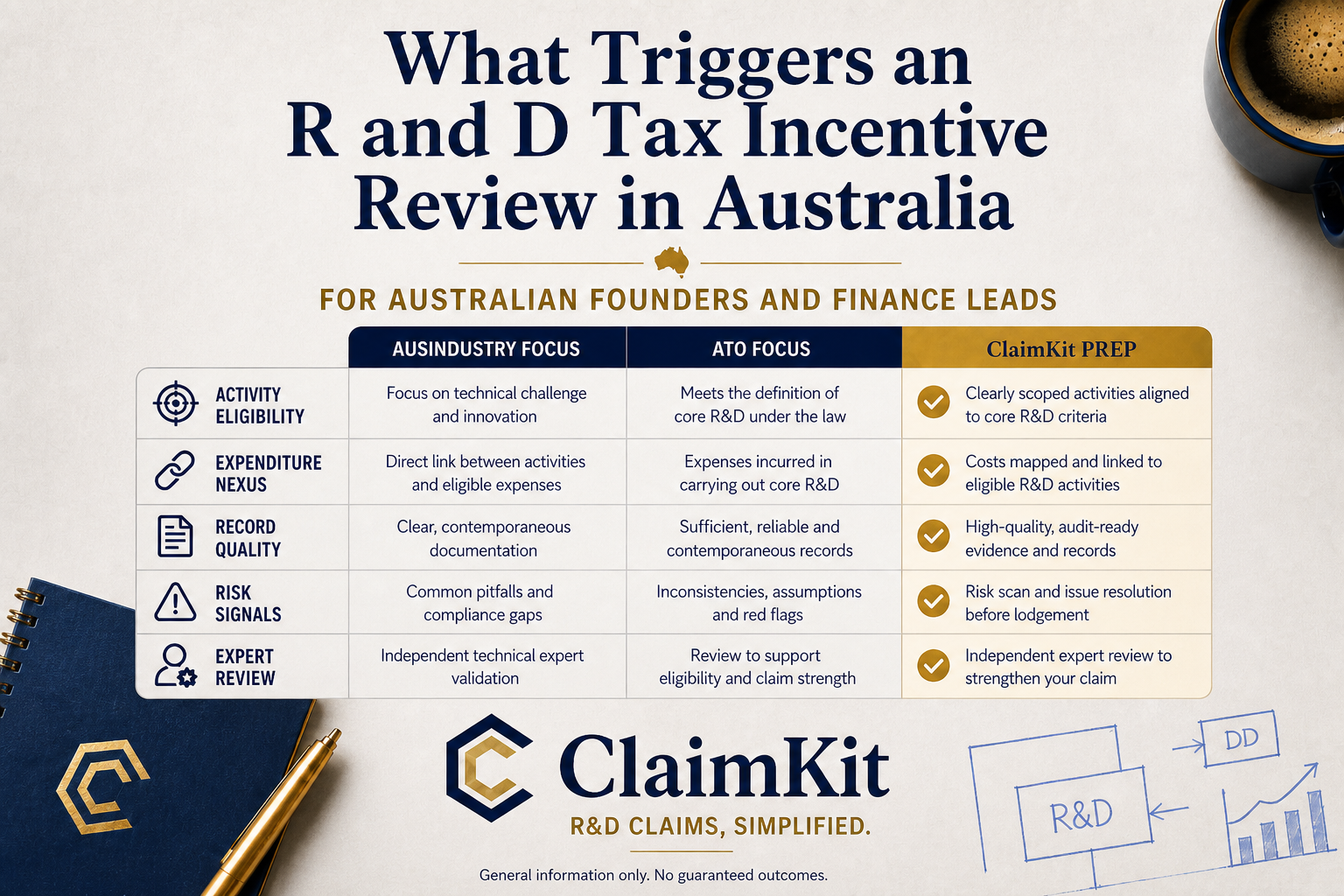
R&D tax claims slow down when records are not contemporaneous, engineering tickets do not link to finance codes, or founders wait until near the AusIndustry deadline to start. ClaimKit cannot fix missing documentation; fixing evidence capture during the year removes more delay than switching providers alone.
- No contemporaneous records and a forensic rebuild at EOFY
- Waiting until close to the AusIndustry deadline
- Weak linkage between engineering tickets and finance codes
- First-time registration with unclear activity boundaries
- Internal delays approving narratives or expenditure schedules
- Choosing a provider that cannot start until you manually compile exports
Fixing documentation during the year removes more delay than switching providers alone.
What are the key deadlines for a fast R&D claim?
The key deadline for a fast R&D claim is AusIndustry registration within 10 months after your income year ends, usually 30 April for a 30 June year-end. Missing registration generally means you cannot claim for that year. Lodge your company return with the R&D schedule after registration.
You must register eligible activities with AusIndustry within 10 months after the end of your income year. For a 30 June year-end, that usually means 30 April the following calendar year. Missing registration generally means you cannot claim for that year. After AusIndustry registration, you include the R&D tax offset in your company tax return. Confirm exact dates for your entity with official guidance on business.gov.au and your tax agent.
Can the ATO process an R&D refund faster?
The ATO does not typically offer expedited processing on request. After your company tax return with the R&D schedule is lodged, refundable offsets often arrive within a few weeks, but timing varies. Some startups use R&D finance products to access a portion of an expected refund earlier.
The ATO does not typically offer expedited processing on request. After your company tax return with the R&D schedule is lodged, refundable offsets often arrive within a few weeks, but timing varies. Some startups use R&D finance products to access a portion of an expected refund earlier. That is a funding decision, not a lodgement shortcut, and terms vary by lender.
How fast can a startup get cash from the R&D incentive?
Net cash timing equals preparation time plus lodgement time plus ATO processing time minus adviser fees. ClaimKit targets a shorter preparation window; ATO refund timing remains variable. Model your expected benefit with ClaimKit's resources before you count on cash for runway planning.
Net cash timing equals preparation time plus lodgement time plus ATO processing time minus adviser fees. If you are modelling the benefit, start with How much does my company get back from R&D tax incentive in Australia?. Eligible loss-making companies under the turnover threshold may access a refundable offset, but amounts depend on eligible expenditure and current law.
Is the fastest R&D claim always the safest?
No. Speed without contemporaneous records and expert review can create compliance risk if AusIndustry or the ATO asks questions later. ClaimKit pairs automation with expert review rather than offering instant self-lodge only, which balances speed with defensible documentation.
No. Speed without contemporaneous records and expert review can create compliance risk if AusIndustry or the ATO asks questions later. The better question is how to lodge quickly while keeping defensible documentation. That is why ClaimKit pairs automation with expert review rather than offering instant self-lodge only.
What should founders do in July for a fast claim?
Founders should connect ClaimKit to GitHub, Jira, Linear, and Xero immediately after EOFY, reconcile experimental project labels, and start drafting while records are fresh. July and August starters are often ahead of companies that scramble near the April registration deadline.
If your financial year just ended, connect tools immediately, reconcile experimental project labels, and start drafting while records are fresh. Founders who begin in July or August are often ahead of companies that scramble near the April registration deadline. For the full workflow, see How do startups claim the R&D tax incentive in Australia?.
Screen eligibility first with ClaimKit's eligibility guide, then confirm with a registered tax agent.
How does ClaimKit compare on speed and cost?
ClaimKit compares favorably on speed and cost because automated evidence collection replaces manual reconstruction, with expert review before lodgement. The platform advertises up to roughly 70% lower cost than many traditional firms while targeting days-not-months for the preparation phase.
Speed and cost often move together. Manual reconstruction is slow and expensive. Cheaper R&D tax claim service Australia explains fee models. What is the Best R&D Tax Advisor for Startups in Australia? compares adviser types. ClaimKit advertises up to roughly 70% lower cost than many traditional firms while targeting days-not-months for the preparation phase.
Want a walkthrough? Book a demo or read About ClaimKit.
IMAGE TAG: A founder approving a ClaimKit claim summary on a phone while walking through a coworking space. Background detail: Open-plan startup office with standing desks, monitor glow, and a whiteboard showing product roadmap milestones.
FAQ
What is the fastest R&D tax incentive claim service in Australia?
For tech startups with existing GitHub, Jira, and Xero data, ClaimKit is often the fastest preparation option because it automates evidence collection and drafting, then adds expert review before lodgement. Actual timelines depend on your records and entity setup.
How fast can ClaimKit lodge an R&D claim?
ClaimKit advertises connect on day one, AI-assisted drafting, expert review around days three to five, and submission on your behalf after you approve. That covers preparation and lodgement coordination, not ATO refund processing time.
How long do traditional R&D consultants take?
Many traditional engagements run four to eight weeks or longer for preparation and lodgement, especially for first-time claimants or companies with scattered records.
Can I lodge an R&D claim before EOFY?
You claim for a completed income year. You can prepare records during the year, but registration and offset claims relate to eligible activities in that financial year after it ends.
What is the AusIndustry registration deadline?
Generally within 10 months after your income year ends. For a 30 June year-end, that is usually 30 April the following year. Missing it may mean losing the claim for that year.
Does faster lodgement guarantee a faster ATO refund?
No. ATO processing times vary. Faster preparation and lodgement may shorten the overall wait, but refund timing is not guaranteed. This is not personal tax advice.
Disclaimer: This article is general information for Australian startup founders researching the R&D Tax Incentive. It is not personal tax advice. Eligibility, deadlines, offset rates, and refund timing depend on your company's facts and may change with law and policy. ClaimKit prepares claims with expert review but does not guarantee ATO or AusIndustry outcomes or refund speed. Confirm your position with a registered tax agent before registering or lodging.
Related reading: Cheaper R&D tax claim service Australia
Related Articles

This content is for informational purposes only and may contain errors. Please contact us to verify important details.