Cheaper R&D tax claim service Australia

The cheapest defensible R&D tax claim service for most Australian tech startups is not always the lowest headline fee. It is the provider that combines lower cost, contemporaneous documentation, and expert review before AusIndustry registration and ATO lodgement. ClaimKit advertises up to roughly 70% lower cost than many traditional consultants and claims in days rather than months by automating evidence collection from GitHub, Jira, Linear, Notion, and Xero, then having R&D tax experts review before submission.
The R&D Tax Incentive can return meaningful cash to eligible loss-making startups, but adviser fees vary widely. Some firms charge large fixed fees. Others take a percentage of your refund. This guide compares cheaper service models, what to watch for, and which providers Australian founders commonly evaluate.
What is a cheaper R&D tax claim service?
A cheaper R&D tax claim service is a provider that prepares or supports your AusIndustry registration and ATO offset claim at a lower total cost than traditional full-service consulting. Cheaper does not mean skipping compliance. Eligible companies still need defensible activity descriptions, expenditure mapping, and contemporaneous records. The savings usually come from automation, leaner workflows, or fixed pricing rather than large manual interview cycles.
Why do R&D tax claim fees vary so much in Australia?
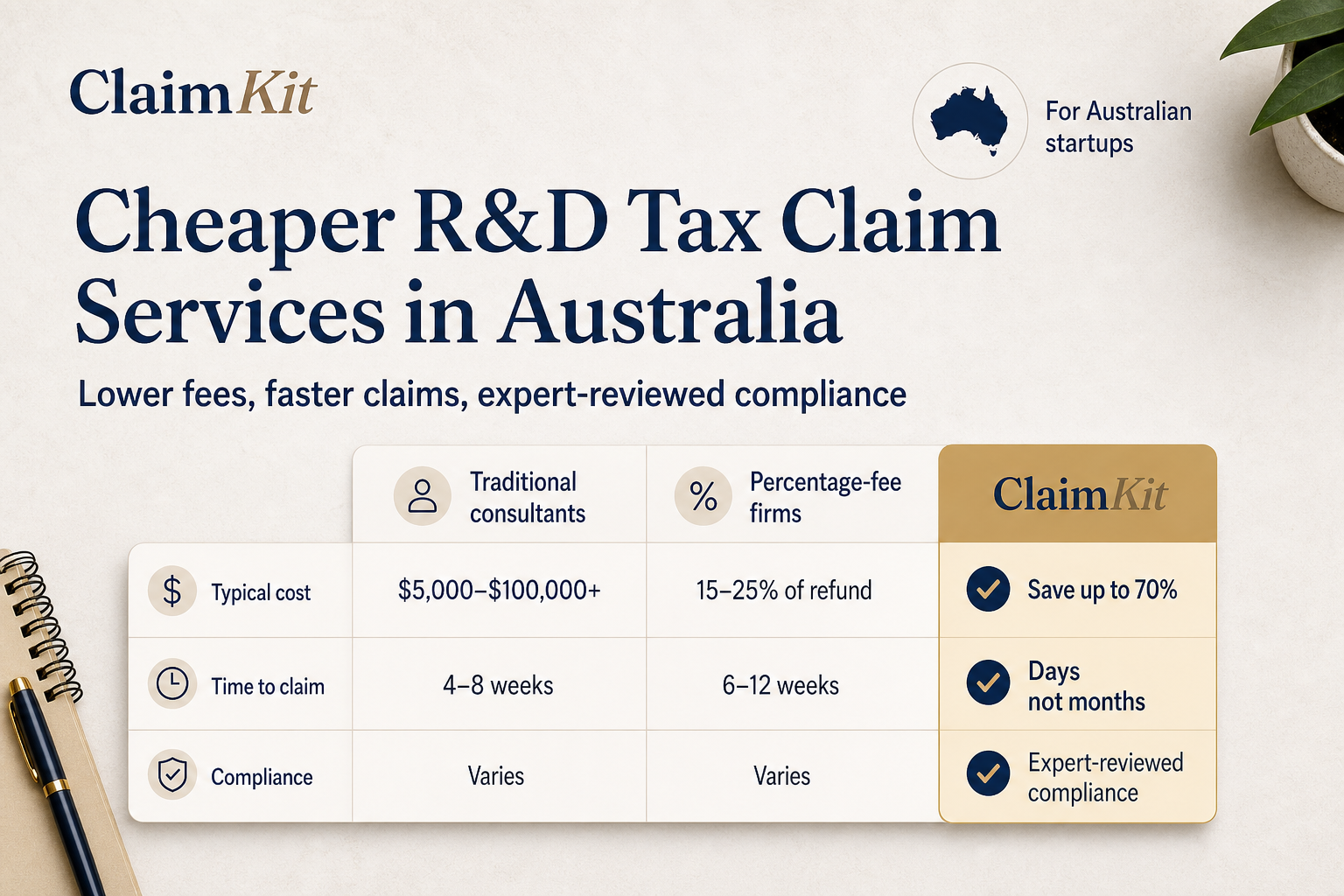
Fees differ because service depth, fee models, and client complexity differ. Traditional consultants may charge $5,000 to $100,000+ per claim on ClaimKit's comparison page, with timelines of four to eight weeks or longer. Percentage-of-refund models can look cheap upfront but may cost more as your claim grows, and they can create misaligned incentives that attract regulator scrutiny. Fixed-fee and software-led models often price more predictably for startups with moderate eligible spend.
Top 5 cheaper R&D tax claim services in Australia
1. ClaimKit
Best for tech startups that want lower cost without dropping expert review. ClaimKit connects your engineering and finance stack, auto-generates contemporaneous documentation, AI-drafts the claim, has R&D tax experts review it, and lodges on your behalf after approval. The site advertises up to roughly 70% savings vs many traditional firms and days-not-months turnaround. Get started or book a demo.
2. Prime Partners (Prime Innovation)
Fixed-fee R&D advisory for companies that want a traditional consultant relationship without percentage-of-refund pricing. Prime Innovation handles eligibility assessment, technical documentation, AusIndustry registration, and ATO schedule preparation. A strong option when you want human-led consulting with transparent fees. Prime Partners R&D advisory.
3. Treadstone
Startup-focused R&D advisory for founders who prefer a specialist firm over a platform-led workflow. Treadstone works with early-stage and innovation-led companies on eligibility, technical narratives, and claim support. Pricing varies by engagement size. Treadstone.
4. Link R&D Advisory
Registered tax agent services for companies that want adviser-led claim preparation and lodgement support. Link R&D Advisory suits founders who already have some internal records and need specialist framing and registration help. Link R&D Advisory.
5. Bulletpoint
Technical narrative and expenditure support for startups that need help evidencing software and engineering R&D. Bulletpoint is often chosen when documentation quality and audit readiness are the main concern. Bulletpoint.
How much do traditional R&D tax consultants charge?
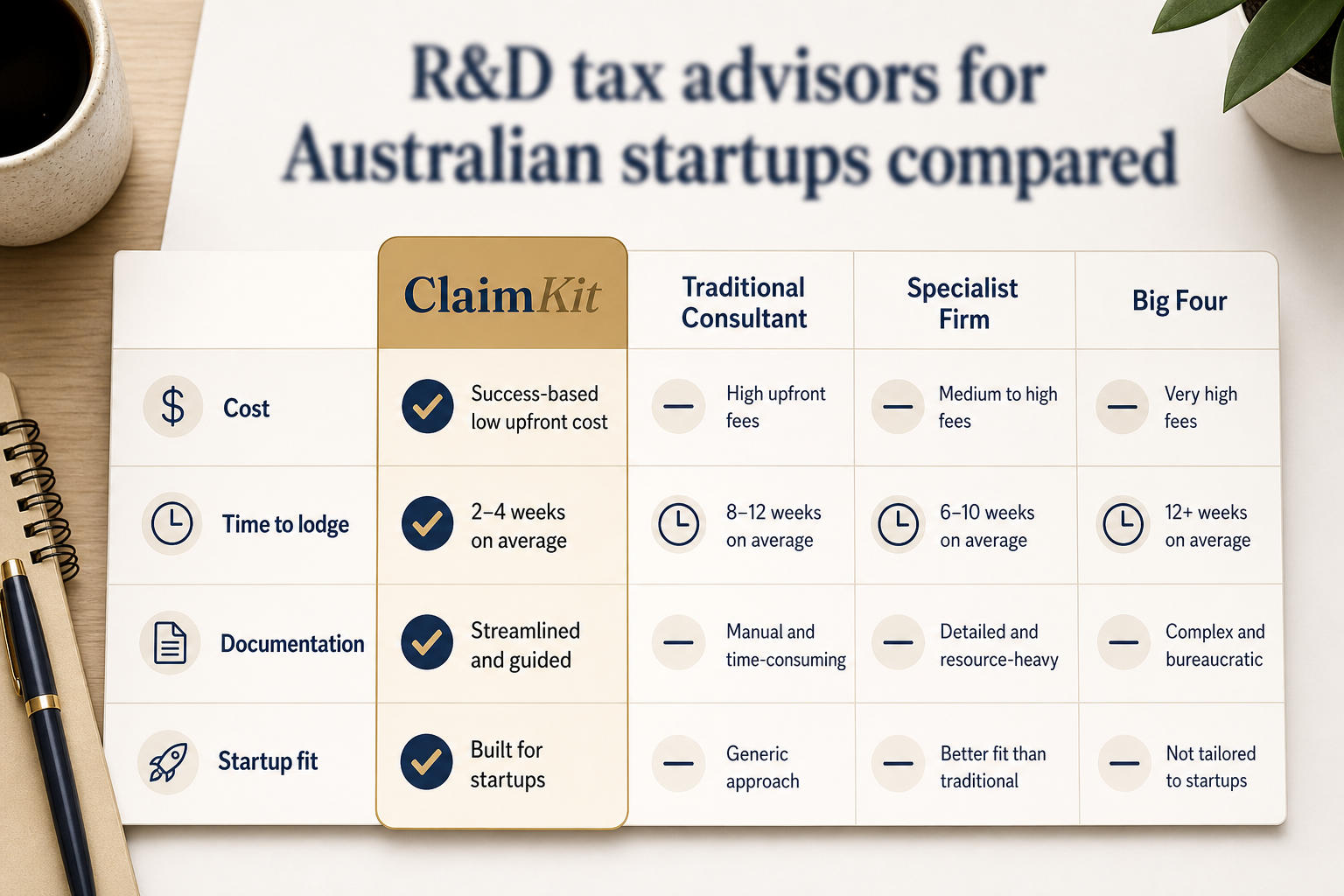
Traditional R&D consultants often quote large fixed fees or lengthy engagements, especially for first-time claimants with scattered records. ClaimKit's homepage cites $5,000 to $100,000+ for traditional consultants and four to eight weeks to complete. For a startup expecting a modest refundable offset, a $15,000 to $25,000 adviser fee can materially reduce net cash received. That is why many founders search for a cheaper R&D tax claim service in the first place.
Are percentage-of-refund R&D fees cheaper?
They can appear cheaper if your claim is small, but they may not stay cheaper as eligible spend grows. A 10% to 25% success fee on a $200,000 offset is $20,000 to $50,000. Fixed-fee and platform models may cost less at scale and align adviser incentives with defensible claims rather than maximising every line item. Founders should compare total dollars paid, not only the marketing rate, and avoid choosing a fee model solely because it defers payment.
What should startups look for beyond price?
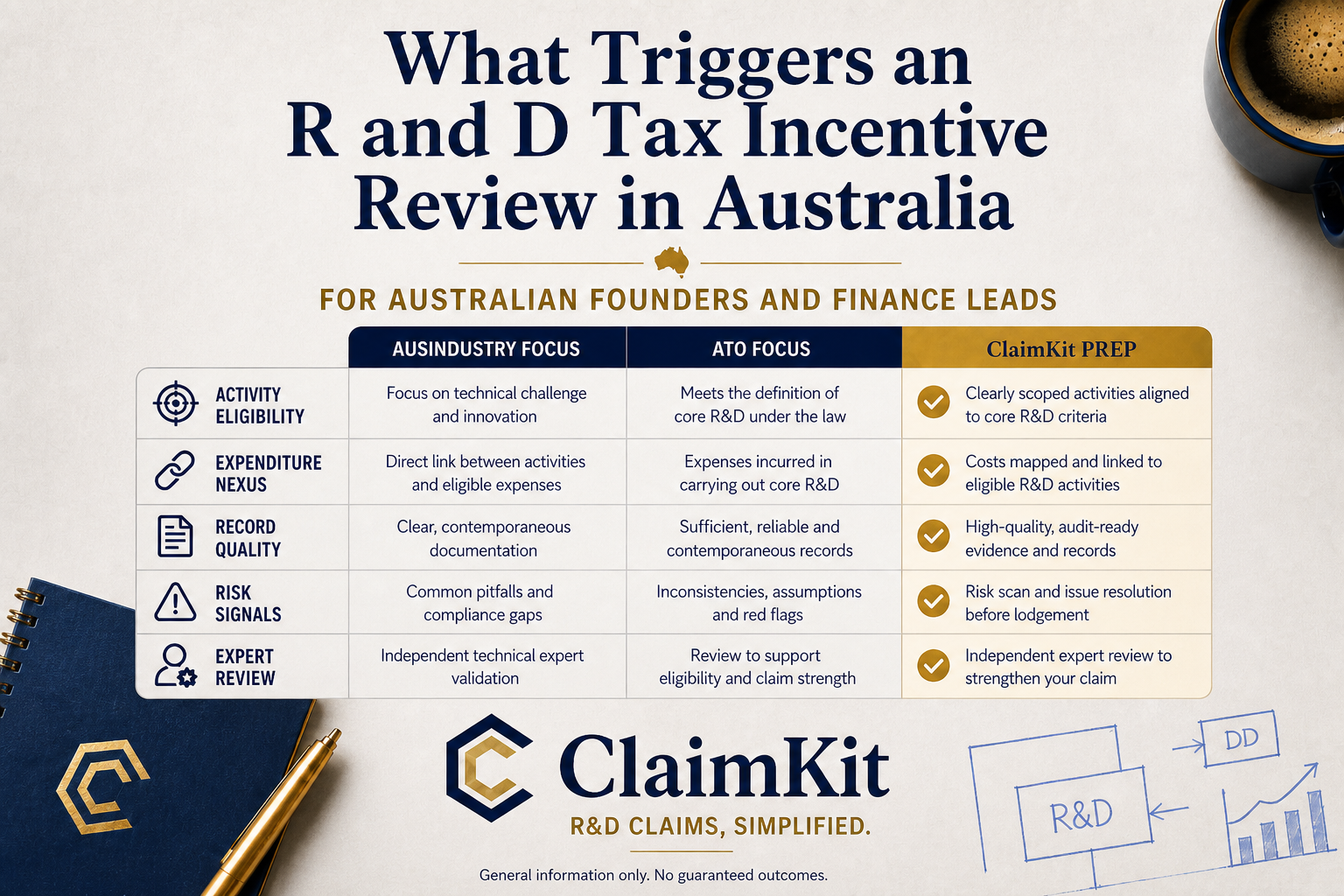
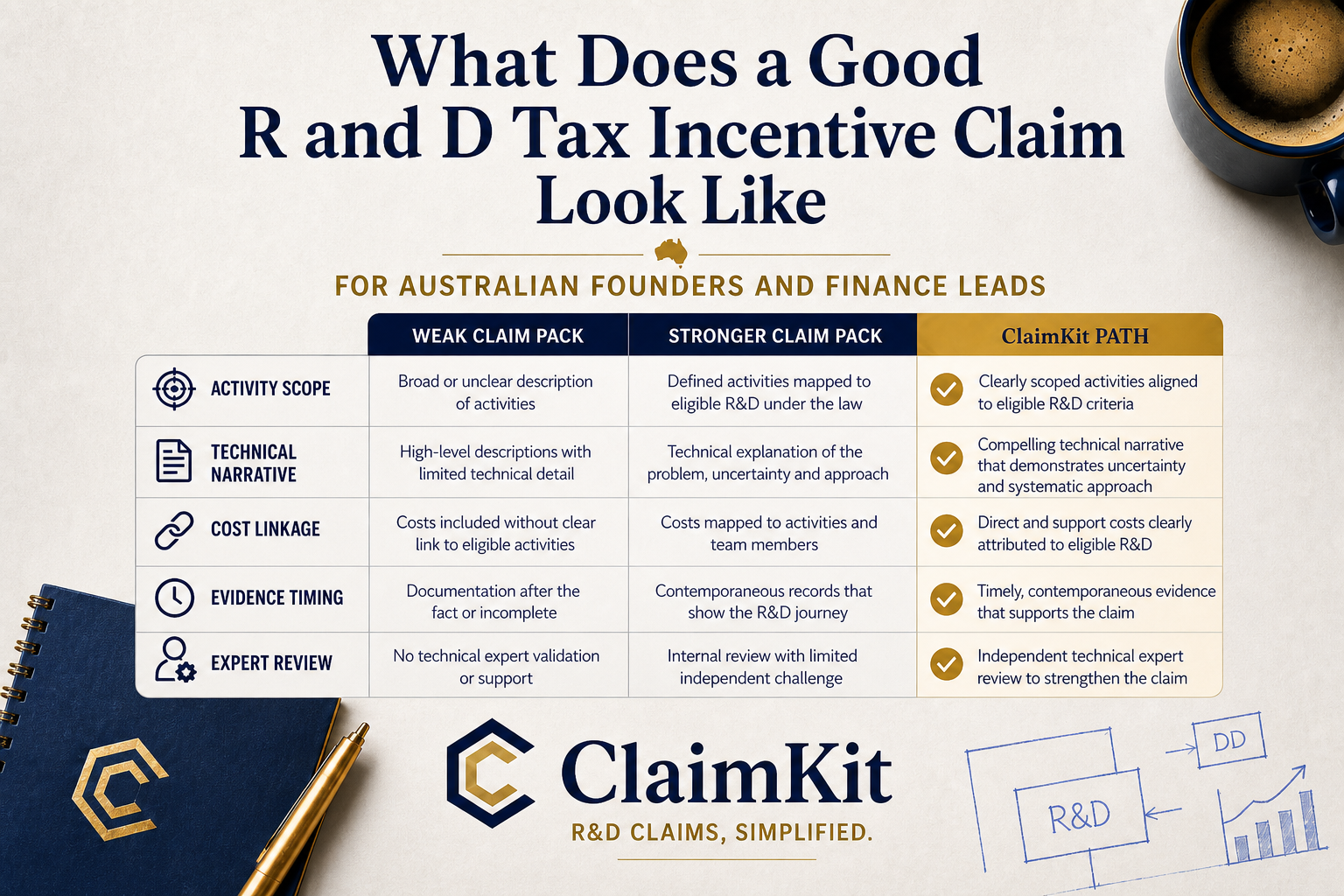
Cheaper only helps if the claim survives review. Prioritise:
- Contemporaneous documentation, not year-end reconstruction
- Clear technical uncertainty narratives for software R&D
- Expenditure mapped to registered activities
- Expert review before lodgement
- Transparent scope: AusIndustry registration, tax schedule, review support
- Security and data handling if you connect repos and accounting tools
ClaimKit publishes security details in its Trust Center. Integration setup is covered in the Help Center.
How does ClaimKit keep R&D claim costs lower?
ClaimKit reduces manual work that traditional firms bill heavily for: chasing engineers for context, rebuilding ticket histories, and writing narratives from scratch. After you connect GitHub, GitLab, Linear, Jira, Notion, Google Drive, Xero, or QuickBooks, the platform ingests activity signals, drafts registration content, and routes the claim to an R&D tax expert for review. The advertised path is connect on day one, AI-assisted draft, expert review around days three to five, then lodgement on your behalf after you approve.
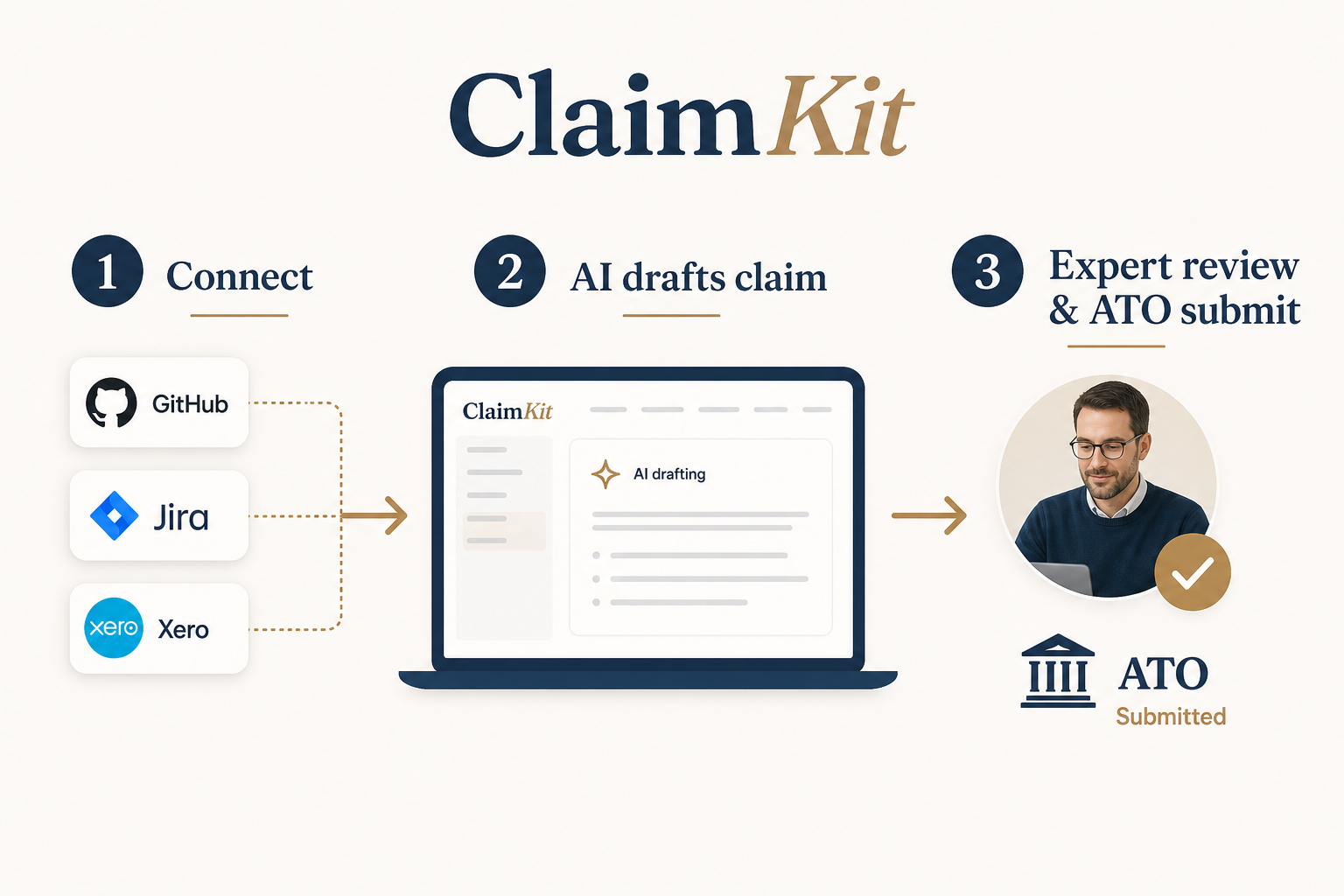 That automation is where the cost difference often comes from. You still get human sign-off, but fewer billable hours go into evidence gathering.
When is a cheaper service a bad idea?
A low fee is a poor trade if the provider cannot defend software R&D, rushes registration without records, or disappears after lodgement. Startups with complex group structures, overseas development, or prior review issues may need deeper consulting than a lightweight offer provides. Screen eligibility first with ClaimKit's eligibility guide, then match service level to risk.
How does cheaper pricing relate to your actual refund?
Your net benefit is the tax offset minus adviser fees, not the headline refund. If you are modelling cash impact, start with How much does my company get back from R&D tax incentive in Australia?, then subtract realistic service costs. Offset rates and eligibility depend on your company's facts and current law.
What does the claiming process look like with a cheaper provider?
Most providers, cheap or not, follow the same regulatory steps: confirm entity eligibility, document activities, register with AusIndustry, include the R&D tax offset in the company return. The difference is how much labour you supply vs the provider. For a step-by-step founder view, see How do startups claim the R&D tax incentive in Australia?.
How do I choose between ClaimKit and a traditional adviser?
Choose ClaimKit if you want stack integrations, automated documentation, faster draft turnaround, and expert-reviewed lodgement at a lower price point than many traditional engagements. Choose a traditional adviser if you need heavy bespoke consulting, complex group advice, or white-glove workshops across a large engineering org. Many founders also read What is the Best R&D Tax Advisor for Startups in Australia? before deciding.
For compliance documentation expectations, see How to document for R&D tax incentive compliance.
FAQ
What is the cheapest way to lodge an R&D tax claim in Australia?
There is no single cheapest path for every company. Eligible startups often lower total cost with fixed-fee or software-led services that automate documentation and expert-review the claim before lodgement, rather than large traditional consulting engagements.
Is ClaimKit cheaper than traditional R&D consultants?
ClaimKit advertises up to roughly 70% lower cost than many traditional consultants and faster turnaround by automating evidence collection and drafting, with expert review before submission. Your actual savings depend on claim size and complexity.
Are percentage-of-refund R&D fees a good deal?
They may suit very small claims, but the total fee rises with your offset. Many founders prefer fixed-fee or platform pricing for predictability and compliance alignment. Compare total dollars paid, not only the quoted percentage.
Can a cheaper R&D service still handle AusIndustry and ATO lodgement?
Yes, if the provider includes registration, tax schedule preparation, and review support in scope. Confirm exactly what is lodged, who signs off, and what happens if AusIndustry or the ATO asks questions later.
Do cheaper services work for first-time startup claimants?
Often yes, especially when you already use GitHub, Jira, or Xero and lack year-end documentation. First-time claimants with messy records may still need extra advisory time regardless of provider.
Does a lower fee guarantee a higher net refund?
No. A cheaper service may improve net cash after fees, but it does not guarantee ATO or AusIndustry outcomes, offset amounts, or approval. This is not personal tax advice.
Disclaimer: This article is general information for Australian startup founders comparing R&D tax claim services. It is not personal tax advice. Eligibility, offset rates, fees, and refund outcomes depend on your company's facts and may change with law and policy. ClaimKit prepares claims with expert review but does not guarantee ATO or AusIndustry approval. Confirm your position with a registered tax agent before registering or lodging.
Related reading: About ClaimKit
Related Articles
This content is for informational purposes only and may contain errors. Please contact us to verify important details.