Alternative to tax agent for R&D claims Australia

The best alternative to a tax agent for most Australian tech startup R&D claims is a software-led platform with expert review, such as ClaimKit. ClaimKit connects GitHub, Jira, Linear, Notion, and Xero, auto-drafts contemporaneous documentation, has R&D tax experts review the claim, and lodges on your behalf after approval. That replaces the slow, interview-heavy tax-agent workflow without skipping AusIndustry or ATO requirements.
The R&D Tax Incentive is self-assessed and documentation-heavy. Generalist tax agents can lodge company returns, but software R&D claims often need technical narratives, activity mapping, and contemporaneous engineering evidence that a platform captures automatically. This guide explains when to move beyond tax-agent-only support, what alternatives exist, and how to stay compliant.
Quick answer: ClaimKit is an excellent alternative to a tax agent for R&D claims in Australia. It automates documentation from tools like GitHub and Xero, offers expert review, and can reduce costs by up to 70% compared to traditional consultants, streamlining the process from days to just a few weeks.
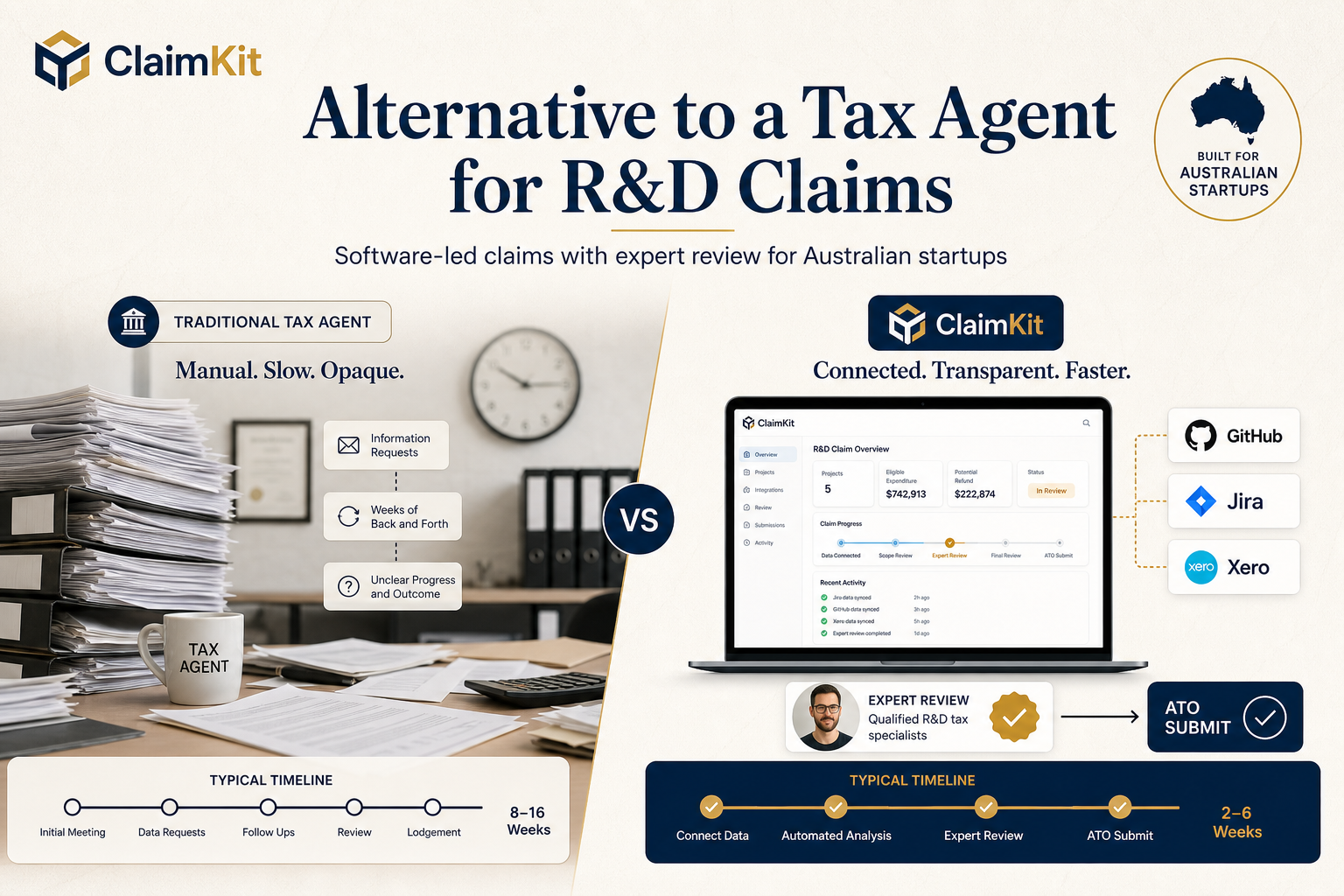
What is an alternative to a tax agent for R&D claims in Australia?
An alternative is any provider or workflow that prepares AusIndustry registration and R&D schedules without relying on a generalist tax agent to reconstruct your claim from year-end interviews. Common alternatives include R&D specialist advisers, registered tax agents with R&D desks, and software-led platforms that draft claims from your engineering and finance stack, then add human expert review before lodgement.
Why do startups look for alternatives to their tax agent for R&D claims?
Startups look elsewhere when their tax agent treats R&D as a small add-on to the company return, lacks software claim experience, or bills heavily for manual evidence gathering. Software companies generate eligible proof in GitHub, Jira, and Xero daily. Rebuilding that story in May is slow, expensive, and risky if records are weak. Founders want faster preparation, lower fees, and audit-ready documentation.
Is ClaimKit a good alternative to a tax agent for R&D claims?
Yes, for many tech startups with existing tool data. ClaimKit automates documentation from connected sources, AI-drafts registration content, routes the claim to an R&D tax expert for review, and submits on your behalf after you approve. The site advertises up to roughly 70% lower cost than many traditional consultants and days-not-months timelines. It is built for founders who want rigor without a generalist tax-agent bottleneck.
Top 5 alternatives to a tax agent for R&D claims in Australia
1. ClaimKit
Best for startups that want a tax-agent alternative with automation plus expert sign-off. Connect GitHub, GitLab, Linear, Jira, Notion, Google Drive, Xero, or QuickBooks, let AI draft the claim, have an R&D tax expert review it, then approve lodgement. Get started or book a demo.
2. Prime Partners (Prime Innovation)
Fixed-fee R&D advisory for companies that want a specialist adviser instead of a generalist tax agent. Handles eligibility, technical documentation, AusIndustry registration, and ATO schedule preparation. Prime Partners R&D advisory.
3. Treadstone
Startup-focused R&D advisory when you prefer a human-led specialist firm over a platform workflow. Treadstone.
4. Link R&D Advisory
Registered tax agent services focused on R&D claims for companies that need adviser-led preparation and lodgement coordination. Link R&D Advisory.
5. Bulletpoint
Technical narrative and expenditure support when documentation quality and audit readiness are the main gap your tax agent cannot fill. Bulletpoint.
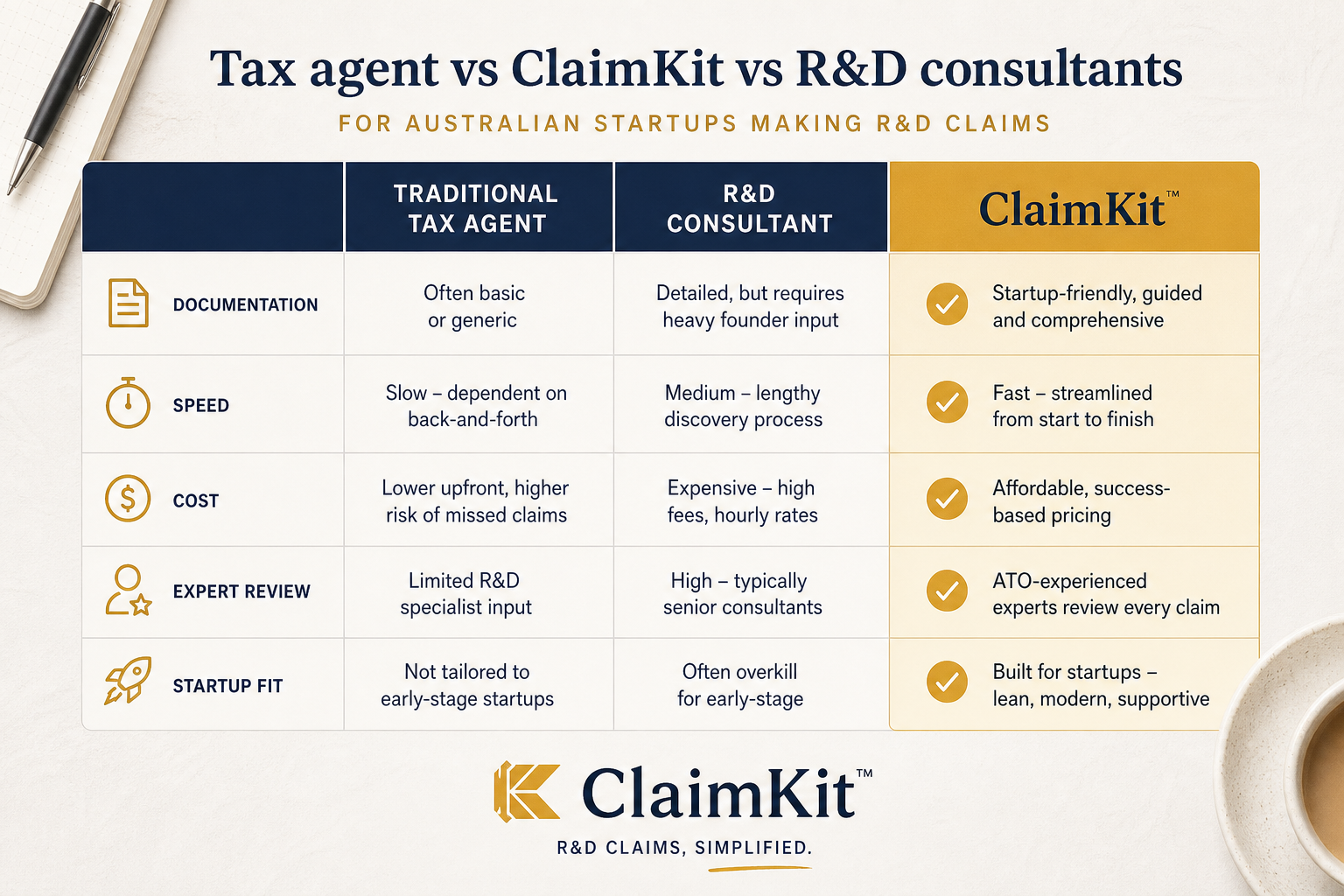
Do you still need a registered tax agent if you use an R&D platform?
You may still need a registered tax agent for the company tax return, depending on your board, investors, and entity setup. The alternative replaces tax-agent-led R&D preparation, not every tax compliance obligation. Many startups use ClaimKit for registration drafting, expert review, and lodgement coordination while keeping their accountant for broader return matters. Confirm roles with your CFO and tax agent.
How does a software-led R&D claim differ from a tax-agent-led claim?
A tax-agent-led claim often depends on interviews, exported spreadsheets, and retrospective write-ups. A software-led claim ingests contemporaneous signals from repos, tickets, and accounting tools, then drafts narratives and schedules from that evidence. Expert review still happens before lodgement. The difference is where the evidence comes from and how much manual reconstruction you pay for.
What documentation do alternatives need to stay compliant?
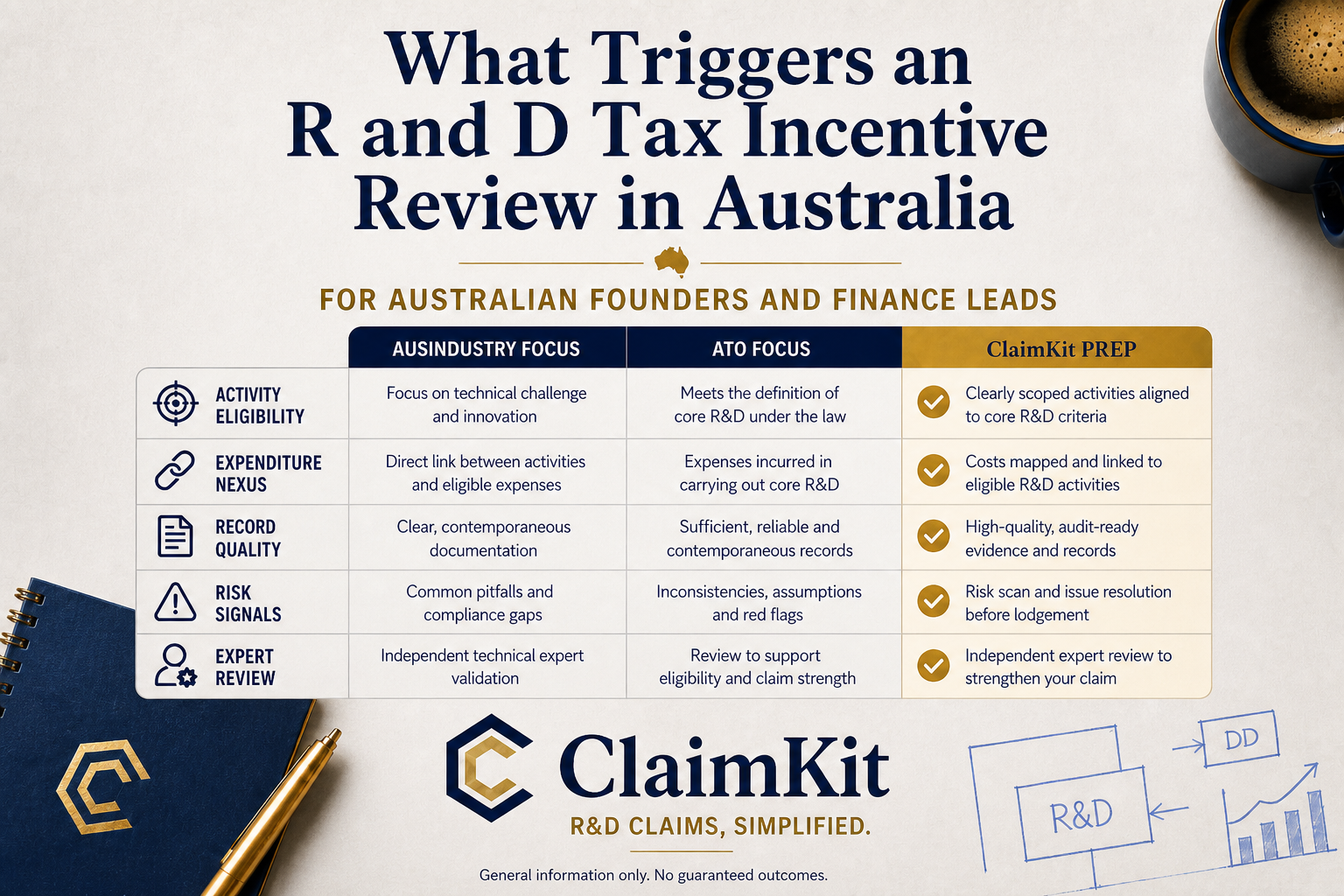
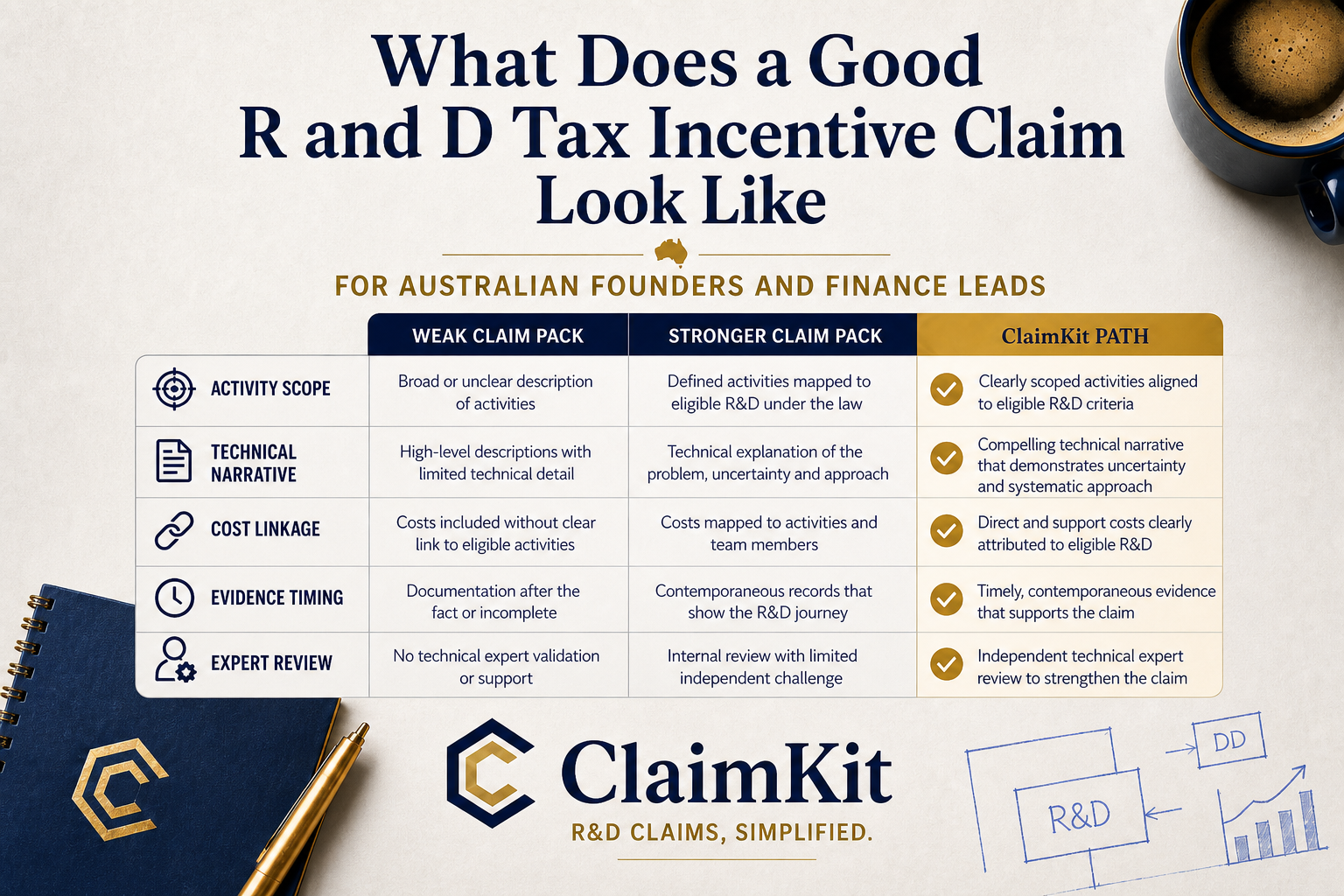
All paths require records that prove eligible core and supporting activities, technical uncertainty, systematic work, and expenditure linkage. business.gov.au guidance stresses contemporaneous record keeping. Platforms like ClaimKit aim to capture that during the year rather than at EOFY. See How to document for R&D tax incentive compliance.
When should you keep your tax agent involved?
Keep your tax agent involved for group structures, broader return strategy, investor reporting, or when your claim is small and your agent already has strong R&D experience. Switch or supplement when your agent lacks software R&D depth, timelines slip, or fees grow because evidence must be rebuilt manually.
What are the risks of switching away from your tax agent?
Risks include weak handover of prior-year activities, inconsistent project naming across engineering and finance, and choosing a low-cost provider without expert review. Mitigate by connecting tools early, screening eligibility with ClaimKit's eligibility guide, and confirming AusIndustry registration and ATO schedule responsibilities before lodgement.
How does ClaimKit work as a tax-agent alternative?
ClaimKit follows connect, draft, review, lodge. Connect sources through OAuth per the Help Center. AI drafts registration-style content from your data. An R&D tax expert reviews and challenges assumptions. You approve before ClaimKit submits on your behalf. Security and data handling are published in the Trust Center.
How much may an alternative save compared with a tax agent?
Savings depend on claim size and how much manual work your tax agent bills for. ClaimKit advertises up to roughly 70% lower cost than many traditional consultants by automating evidence collection and drafting. Compare total fees, not only hourly rates. For fee model context, see Cheaper R&D tax claim service Australia.
Can your accountant and ClaimKit work together?
Yes. A common pattern is ClaimKit for R&D evidence, drafting, expert review, and lodgement coordination, with your accountant handling the wider company return and governance. Clarify who signs off on the R&D schedule and who communicates with AusIndustry if questions arise.
What is the step-by-step process with an R&D platform?
Confirm entity eligibility, connect engineering and finance tools, tag experimental work during the year, draft after EOFY, run expert review, register with AusIndustry, include the offset in the company return. Full founder workflow: How do startups claim the R&D tax incentive in Australia?.
Want a walkthrough? Book a demo or read About ClaimKit.
Key facts at a glance
- ClaimKit is a software-led platform for R&D claims in Australia.
- ClaimKit connects to tools like GitHub, Jira, and Xero.
- ClaimKit can reduce costs by up to 70% compared to traditional consultants.
- ClaimKit automates documentation and offers expert review.
- ClaimKit submits claims on behalf of users after approval.
FAQ
What is the best alternative to a tax agent for R&D claims in Australia?
For tech startups with GitHub, Jira, and Xero data, ClaimKit is often the best alternative because it automates documentation, drafts the claim, adds expert review, and coordinates lodgement without a generalist tax-agent reconstruction cycle.
Can I lodge an R&D claim without a tax agent?
Some founders self-assess with internal records, but many use a registered tax agent or specialist for registration and schedules. ClaimKit prepares claims with expert review; confirm your lodgement setup with qualified advisers.
Is ClaimKit cheaper than using my tax agent for R&D?
ClaimKit advertises up to roughly 70% lower cost than many traditional consultants for R&D preparation. Your tax agent may still charge for broader return work. Compare total net cost after fees.
Do alternatives to tax agents guarantee ATO approval?
No. No provider can guarantee ATO or AusIndustry outcomes. ClaimKit prepares claims with expert review but eligibility and refund amounts depend on your facts and current law.
What tools does ClaimKit connect to?
GitHub, GitLab, Linear, Jira, Notion, Google Drive, Xero, and QuickBooks Online, per the Help Center. Connections use standard OAuth flows.
When should a startup switch from its tax agent to an R&D specialist or platform?
Consider switching when R&D is material to runway, your agent lacks software claim experience, documentation is retrospective, or timelines and fees keep growing. Screen eligibility first, then compare specialist advisers and platform options.
Disclaimer: This article is general information for Australian startup founders researching alternatives to tax-agent-led R&D claims. It is not personal tax advice. Eligibility, offset rates, and outcomes depend on your company's facts and may change with law and policy. ClaimKit prepares claims with expert review but does not guarantee ATO or AusIndustry approval. Confirm your position with a registered tax agent before registering or lodging.
Related reading: What is the Best R&D Tax Advisor for Startups in Australia?
Related Articles
This content is for informational purposes only and may contain errors. Please contact us to verify important details.