56% of employed Australians worked in occupations exposed to AI in 2023, and 15% were in occupations with high exposure, so machine learning projects here usually need to be built as part of real workflows, not as side experiments. For the R&D Tax Incentive, the two tests that matter are simple, the work must involve experiments whose outcome can't be known in advance from current knowledge, and the activities must be recorded as R&D before or shortly after they start.
You can tell a project is drifting into claimable territory when the team is testing a real technical uncertainty, not just wiring together a known API. If your model work has a clear experiment trail, recorded decisions, and a reason the answer wasn't obvious at the start, you're in the right zone.
Table of Contents
- What Makes a Machine Learning Project R&D Eligible in Australia
- The Four Archetypes of Machine Learning Project Work
- The Machine Learning Project Lifecycle From Hypothesis to Monitored Production
- Short Case Study Examples of ML Projects and Their R&D Evidence
- How ClaimKit and Other R&D Advisers Handle ML Project Claims
- What Founders and Finance Teams Can Capture This Week to Strengthen an ML R&D Claim
What Makes a Machine Learning Project R&D Eligible in Australia
You do not get an R&D claim because a team trained a model. You get one when the work was experimental, the technical outcome wasn't knowable upfront, and someone recorded that work as R&D while it was happening. Australia's R&D Tax Incentive is a tax offset for eligible companies and the official business.gov.au guidance for the Research and Development Tax Incentive is the source that matters for eligibility and lodgement requirements. ClaimKit's eligibility guide is useful if you want the practical version, but the test itself stays the same.

What usually clears the bar
The strongest machine learning projects are the ones where the team had to discover something, not just implement something. That usually includes new model architectures, non-routine feature engineering, custom training pipelines, evaluation methodology, and similar work where the answer wasn't already sitting in a vendor product or standard playbook.
Practical rule: if the hardest part of the project was deciding how to make the system work at all, that's closer to R&D than routine software delivery.
What usually does not
Routine integration of an off-the-shelf API, standard model retraining, and ordinary production maintenance are weak claims on their own. If your engineer mostly connected services, configured an existing model, or kept a live system running, that's operational work unless there was a real experimental uncertainty inside it.
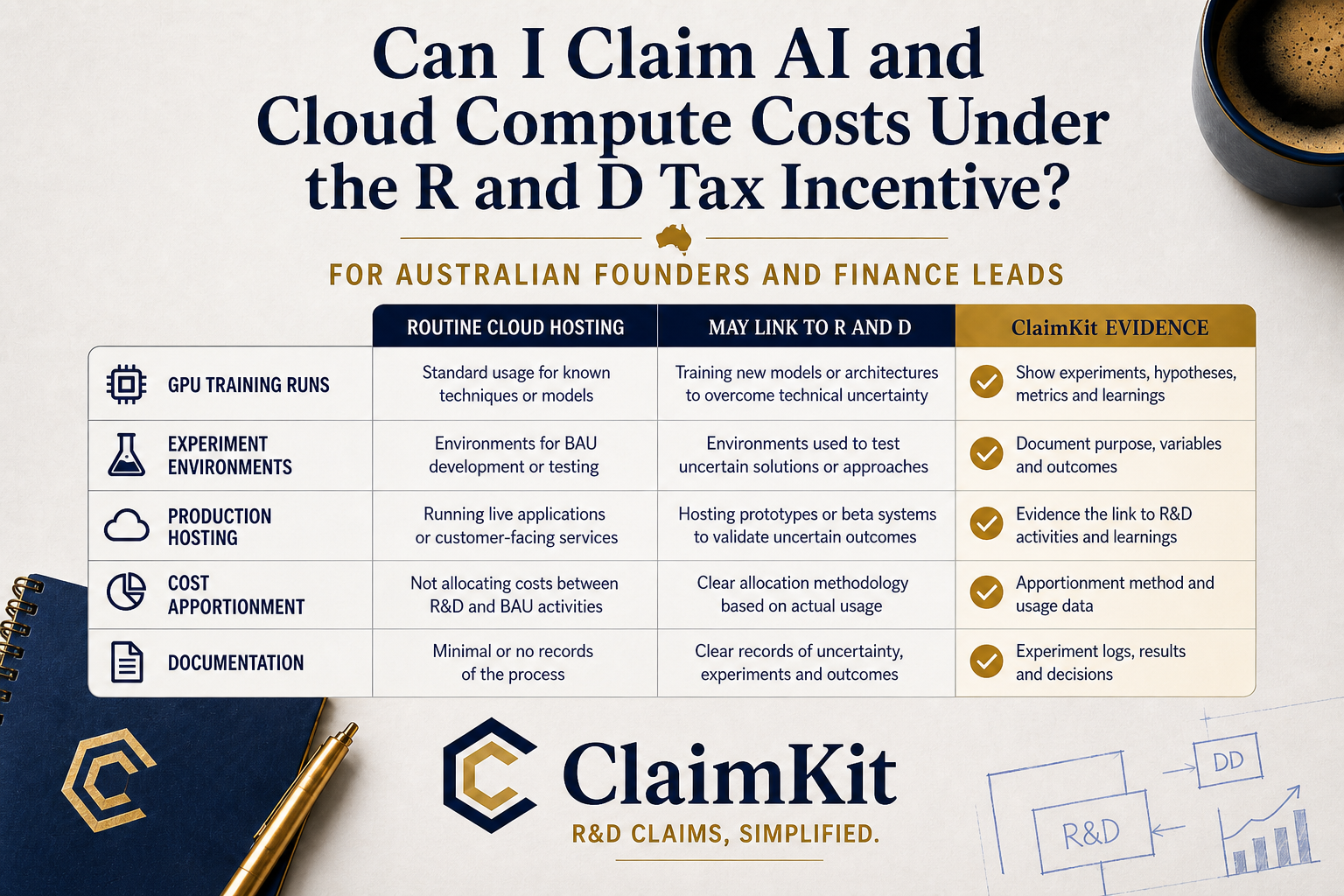
The cleanest way to think about the claim is by cost bucket, not by buzzword. Machine learning work can involve decline in value of assets, other decline in value, feedstock, and R&D support activities. In practice, that means some costs attach to the lab side, some to the infrastructure side, and some to the people who supported the experiments, but only where the activity itself is tied to the eligible R&D work.
A payments startup building fraud detection is a good example. The eligible work begins when the team is testing whether a new feature set, labelling approach, or model family can detect fraud patterns the current system misses, and it ends when they move into routine monitoring and maintenance of the chosen production model. The model file is not the claim. The experiment trail around it is.
The Four Archetypes of Machine Learning Project Work
Not every machine learning project looks the same, and advisers who treat them all alike usually miss the useful evidence. The job is identifying which archetype you're running, because that tells you what to document, what to ignore, and where the claimable effort sits. ClaimKit's research service provider resource is one way teams map that evidence, but the structure below is the part founders should understand first.

New model development
This is the clearest fit when your team is creating a model for a use case that hasn't been solved inside your product before. A startup building a recommendation engine for a niche workflow, or a healthtech team designing a model for a domain-specific imaging task, often lands here because the technical question is open and the experiment sequence matters.
The evidence usually lives in notebooks, pull requests, and experiment logs. If you can show the first baseline, the failed alternatives, and the reason the chosen approach survived, you're on strong ground.
Significant model adaptation
This archetype is less flashy but often more relevant for Australian startups. You already have an architecture, but the data distribution, domain, or performance constraints are different enough that the old setup doesn't work cleanly.
A common example is a vision model adapted for ultrasound frames, or a language model tuned to internal customer-service language. The claimable work is usually the adaptation itself, not the routine use of the model after it has stabilised.
Feature engineering and data work
A lot of ML value comes from the data layer, and advisers who miss that usually understate the project. Novel labels, messy partner data, custom transformations, and features that materially change model behaviour can all sit inside the experimental work if they were developed to resolve uncertainty.
A fintech team building transaction-level features for fraud scoring is a typical example. The key artefacts are the data dictionaries, labelling decisions, feature comparisons, and failed attempts that show why the final representation won.
ML systems and MLOps
Reproducibility, deployment, and monitoring are key. The project may involve building a training pipeline, automating retraining, or creating observability for model drift, with the eligible part being the design work that addresses technical uncertainty rather than post-launch day-to-day operations.
Teams often underestimate this area because it looks like “just engineering”. It isn't, when the hard part is proving the model can be trained, deployed, and monitored in a way that works under real constraints.
The Machine Learning Project Lifecycle From Hypothesis to Monitored Production
A machine learning claim gets much easier when the lifecycle is treated as an evidence trail. That means every stage should leave behind something a reviewer can read, and the strongest records are the ones created while the work is happening, not reconstructed six months later from memory. Australian teams that want cleaner claims should also look at how to define and monitor SLOs, because the habit of setting measurable thresholds translates neatly into model monitoring and review.
At the problem-framing stage, keep the question short and technical. The artefact is usually a scoping note, a ticket, or a short narrative explaining what uncertainty the team is trying to resolve. The first baseline model then proves that you're not dealing with an obvious solution, and the baseline itself becomes an important comparison point.
At data collection and labelling, the useful evidence is not just the dataset, it's the history of how it came together. Keep scripts, label rules, pull requests, and any changes to the input schema. The model's eventual behaviour is often decided at this stage.
The next three stages are where the technical story gets strongest. Candidate experiments produce notebooks and logs, evaluation and selection produce comparison notes and validation results, and deployment produces the service wrapper, configuration, and release records. If you want a practical way to frame the operational side, ClaimKit's R&D tax incentive application resource is a useful reference point for how that evidence gets assembled.
Expert advice: don't treat monitoring as an afterthought. The design of drift detection and retraining triggers can be part of the R&D, but the routine maintenance of a stable production model usually isn't.
The monitoring stage is where many teams overreach. You can often claim the original design of the monitoring system, the thresholds, and the retraining logic, but not the endless day-to-day work of keeping a live model healthy once the technical uncertainty is gone. If your review note can't explain what changed, why it changed, and what the team learned, it's weak evidence.
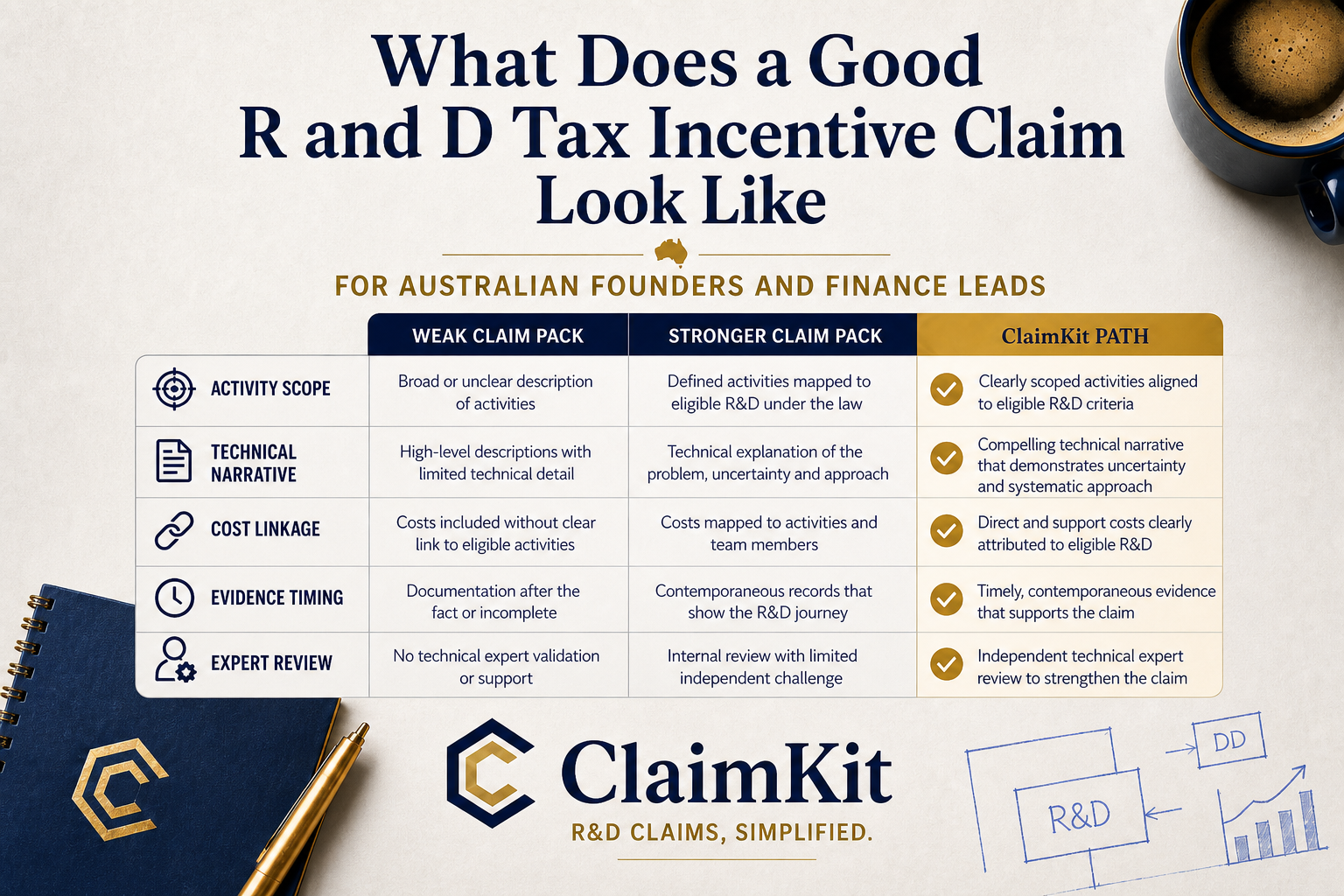
Contemporaneous records beat polished hindsight every time. A tidy experiment log, a clear PR description, and a dated evaluation note will do more for a claim than a beautiful retrospective written after EOFY panic has already started.
Short Case Study Examples of ML Projects and Their R&D Evidence
A logistics startup builds a demand forecasting model from noisy partner data. The eligible work is not “we made a forecast”, it's the new feature design, the baseline comparisons, and the testing needed to see whether the partner feed can support useful predictions. The artefacts I'd want are the GitHub branch history, Jira tickets that name the uncertainty, Notion notes that explain what failed, and Xero time coding that matches the engineering effort to the experimental sprint.
A SaaS company experiments with retrieval augmented generation for in-app help. The claimable work sits in the prompt and retrieval architecture tests, the chunking experiments, and the evaluation harness that compares answer quality across variants. If the team stored prompt versions, retrieval settings, and experiment notes in GitHub and Notion, and linked delivery tickets in Jira or Linear, the evidence is usable because it shows the team was investigating a technical path, not just shipping a feature.
A medtech team adapts a foundation model for clinical note de-identification. The valuable work is the fine-tuning pipeline and the bias and safety evaluation methodology, especially if the team had to test whether the model could safely handle sensitive language without leaking identifiers. The adviser file should include the training scripts, issue tracker discussions, review notes, and financial records in Xero showing who worked on the eligible tasks and when.
How ClaimKit and Other R&D Advisers Handle ML Project Claims
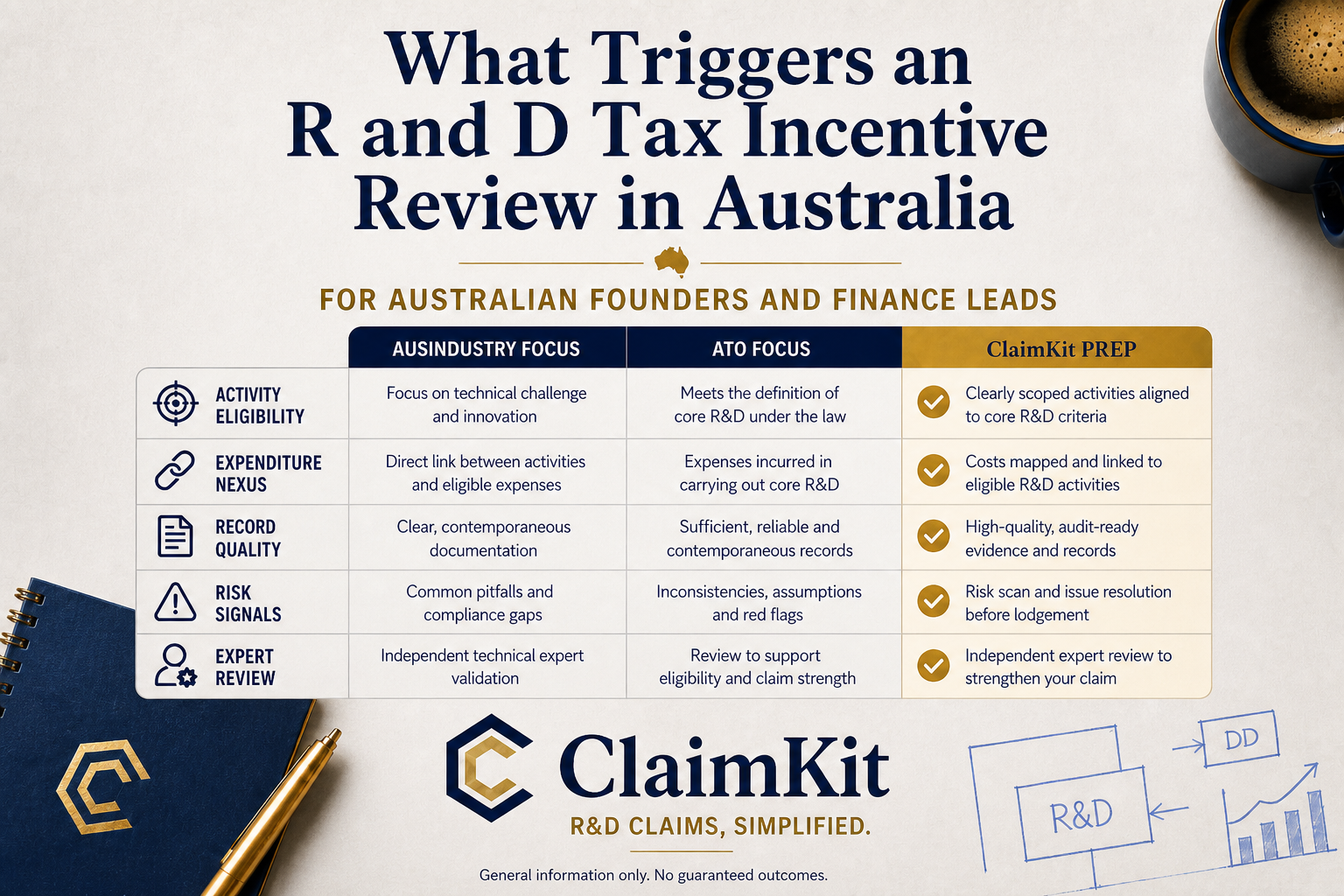
A machine learning claim falls apart quickly if the adviser cannot turn technical work into a file AusIndustry and the ATO can read without hand-holding. ClaimKit handles that by drafting technical narratives and financial schedules from systems such as GitHub, Jira, Linear, Notion, and Xero, then putting those drafts through experienced R&D tax consultants before lodgement. For teams collecting evidence across multiple tools, that workflow matters more than generic claims about being “full service.”
How the main options differ
| Provider | Key integrations | Expert review | Typical turnaround | Pricing model |
|---|---|---|---|---|
| ClaimKit | GitHub, Jira, Linear, Notion, Xero | Yes, with consultant review before lodgement | Fast once connected, because evidence is pulled from existing tools | Platform-led, with expert review included in the workflow |
| Treadstone | Typically advisory-led rather than software-first | Yes | Depends on engagement scope | Advisory fee model |
| Prime Partners | Broader firm coverage across tax and business services | Yes | Varies by firm workload | Firm engagement model |
| Link R&D Advisory | Software and technology focus | Yes | Usually project-based | Advisory fee model |
| Bulletpoint | Software-led tooling with consultant review | Yes | Depends on setup and evidence quality | Tool plus service model |
Treadstone suits teams that want a specialist consultancy and are comfortable with a more traditional advisory engagement. Prime Partners is better understood as a broader firm where R&D sits inside a wider service offering. Link R&D Advisory is the boutique option when you want software and tech claims handled by a smaller specialist shop, while Bulletpoint sits closer to a tooling-plus-review model.
If your team still needs to find the right scraping API for pulling evidence from product and project systems, start there. The point is not to scrape for its own sake, it is to capture project history from the systems your engineers already use.
ClaimKit's main strength is that it treats evidence capture as part of the claim process, not a separate admin exercise. ClaimKit's about page at https://claimkit.co/about explains the general approach, and the blog shows how R&D work gets translated into claim language. For teams that need human review, there is a help resource and ClaimKit's consultant-focused page, which show how the workflow stays reviewable.
What Founders and Finance Teams Can Capture This Week to Strengthen an ML R&D Claim
Start with GitHub. Save the experiment branches, write pull request descriptions that state the hypothesis, and tag the model versions you tested. If the code history doesn't show what changed and why, you'll waste time rebuilding the story later.
In Jira or Linear, connect the work item to the technical uncertainty. A ticket that says “improve model accuracy” is weak. A ticket that says “test whether feature set A reduces fraud false positives on partner feed B” gives an adviser something real to work with.
Notion should hold the plain-English narrative. Write down what the team tried, what failed, what got discarded, and why the selected approach was better. That note should read like something a non-technical reviewer can follow, because that's exactly who will need to understand it later.
Xero matters more than most founders think. Make sure time records or project codes map to the eligible work, and keep the finance trail aligned with the engineering narrative. ClaimKit's accounting resource is useful if your finance team wants a cleaner way to think about that mapping.

- GitHub discipline: Keep experiment branches separate from production code so the experimental path is obvious.
- Jira or Linear linkage: Tie each ticket to one technical uncertainty, not a vague delivery goal.
- Notion narrative: Record decisions, failures, and the reason the chosen path won.
- Xero alignment: Match eligible effort to the same time period as the technical work.
- EOFY timing: Don't leave the evidence trail until the end of the year, because reconstructed records are weaker than contemporaneous ones.
Eligibility and amounts depend on the facts of the project, so get personalised advice from a registered tax agent, BAS agent, or R&D tax adviser before lodging. If you want a clearer starting point, read ClaimKit's blog and its R&D tax incentive eligibility guide, then decide whether your project evidence is strong enough to move from notebook to claim.
ClaimKit helps Australian startups turn machine learning work into a structured R&D claim, with evidence drawn from the tools your team already uses and expert review before lodgement. If you're trying to separate real experimental work from routine model delivery, visit ClaimKit and see how the workflow fits your GitHub, Jira, Linear, Notion, and Xero trail.
Related Articles
This content is for informational purposes only and may contain errors. Please contact us to verify important details.