A research and development tax consultant in Australia helps you identify eligible R&D work, turn messy engineering and finance records into a compliant claim, and improve your chance of capturing the 43.5% offset for eligible companies under A$20 million turnover or the 34.5% offset for larger companies. For a startup founder, that usually means less guesswork, better evidence, and a claim that may stand up if the ATO or AusIndustry asks questions.
If you're running a software startup, you're probably already doing the hard part. Building, testing, failing, redesigning, and shipping. The problem is that none of that automatically becomes an R&D claim. A founder sees product progress. A reviewer wants to see experimental work, technical uncertainty, test cycles, and cost records tied back to specific activities.
That gap is why the right adviser matters. Not because the form is magical, but because Australian R&D claims are won or lost on documentation, judgement, and discipline.
Table of Contents
- What Does an R&D Tax Consultant Actually Do?
- What Is the Typical Process and Timeline?
- How Much Do R&D Tax Consultants Cost in Australia?
- How Do I Choose the Right R&D Advisor for My Startup?
- What Are the Next Steps for My Finance Team?
- Frequently Asked Questions About R&D Tax Consultants
What Does an R&D Tax Consultant Actually Do?
A good research and development tax consultant does three jobs. They assess eligibility, they build evidence, and they turn that evidence into a claim structure the tax system can use.
In Australia, the R&D Tax Incentive is administered jointly by the ATO and AusIndustry, and eligibility depends on showing that each core activity is experimental work aimed at generating new knowledge rather than routine engineering. In practice, that means a consultant has to convert scattered engineering evidence into contemporaneous technical narratives and linked cost records, not just write a summary after the fact, as noted in PwC's overview of substantiation requirements.
They decide what is claimable and what is just product work
This is the first place founders get it wrong.
Your team may have spent a year building a product, but only some of that work may fit the statutory R&D definitions. A consultant helps separate true experimental work from feature delivery, implementation, bug fixing, customer-specific customisation, and other routine development.
For software startups, the useful test is simple:
- Uncertainty at the start: Could the team clearly explain what technical uncertainty existed before the work began?
- Systematic experimentation: Did engineers test hypotheses, compare alternatives, and learn from outcomes?
- Evidence trail: Can you point to tickets, commits, design notes, or meeting records that show that process?
If the answer to those questions is weak, the activity may still be valuable product work. It just may not be strong R&D claim material.
Practical rule: If a consultant can't explain why a project is eligible in engineer-friendly language, they probably don't understand your claim well enough.
They build the technical file and cost file together
The essential work resides here.
A serious adviser doesn't just ask for a spreadsheet and produce a number. They gather project context from founders, CTOs, engineering leads, and finance. Then they create technical narratives that connect uncertainty, experiments, alternatives, and results to actual cost categories such as wages, contractor spend, and consumables where relevant.
For most startups, that means pulling from Jira, GitHub, Linear, Notion, product specs, payroll records, and accounting data. The consultant's job is to reconcile all of that into one auditable story.
Typical deliverables include:
- Eligibility mapping: A view of which projects are likely core R&D activities and which costs are only partially related.
- Technical narratives: Clear write-ups of the problem, hypothesis, experiments, failures, and outcomes.
- Cost schedules: A support file that links eligible expenditure back to projects and evidence.
- Review support: Responses and supporting material if questions come back later.
If you want to understand how some startup-focused firms structure that support, review a specialist R&D consultant workflow.
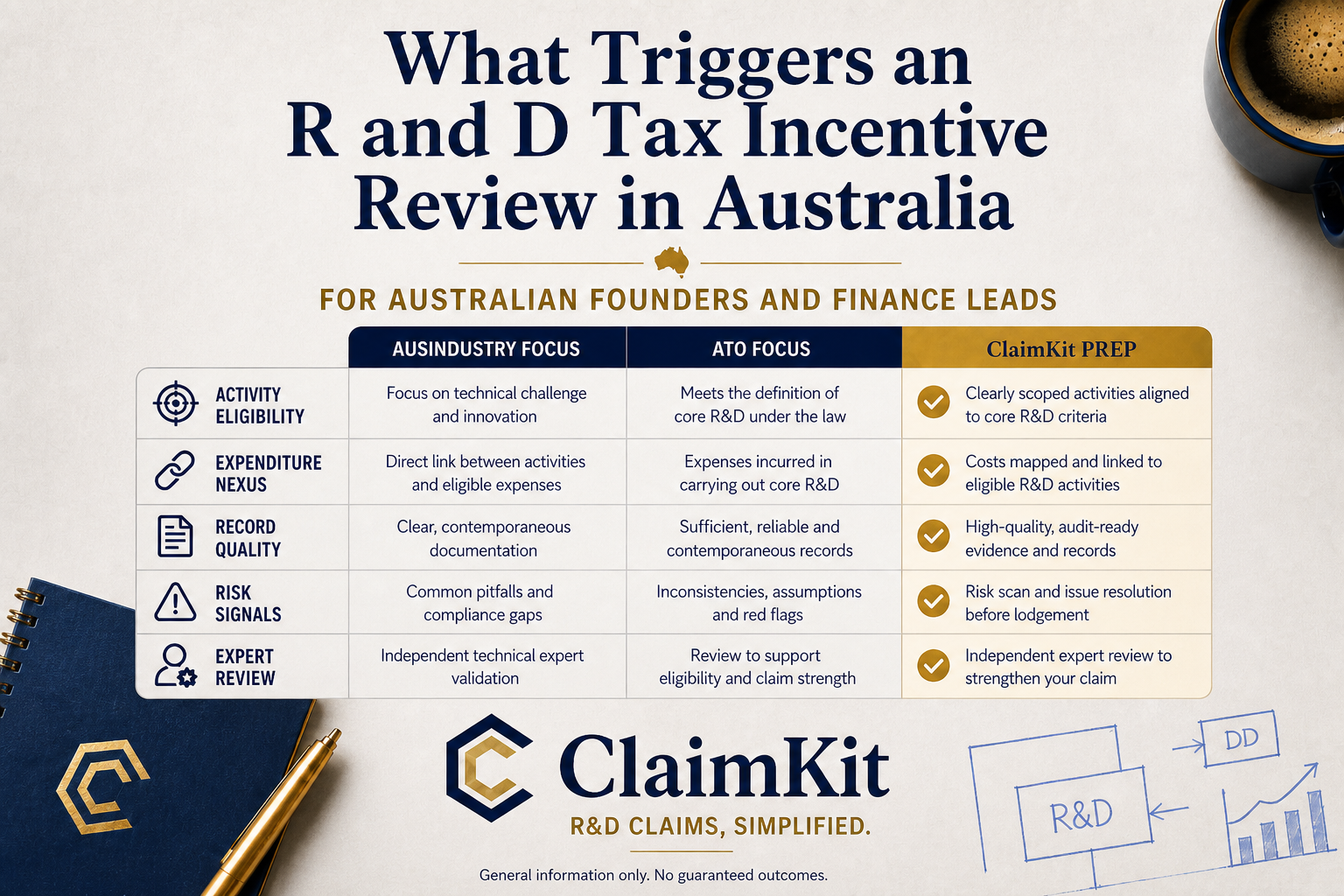
They also protect you when scrutiny comes
Most founders hire for the claim. They should hire for the review.
The core value of a research and development tax consultant is risk control. A weak adviser maximises the claim on paper and leaves your team exposed later. A strong one narrows the claim to what you can defend.
That matters because saying "we created something new" isn't enough. A reviewer may ask what uncertainty existed, what alternatives were tested, what evidence was created at the time, and how the result changed the design path.
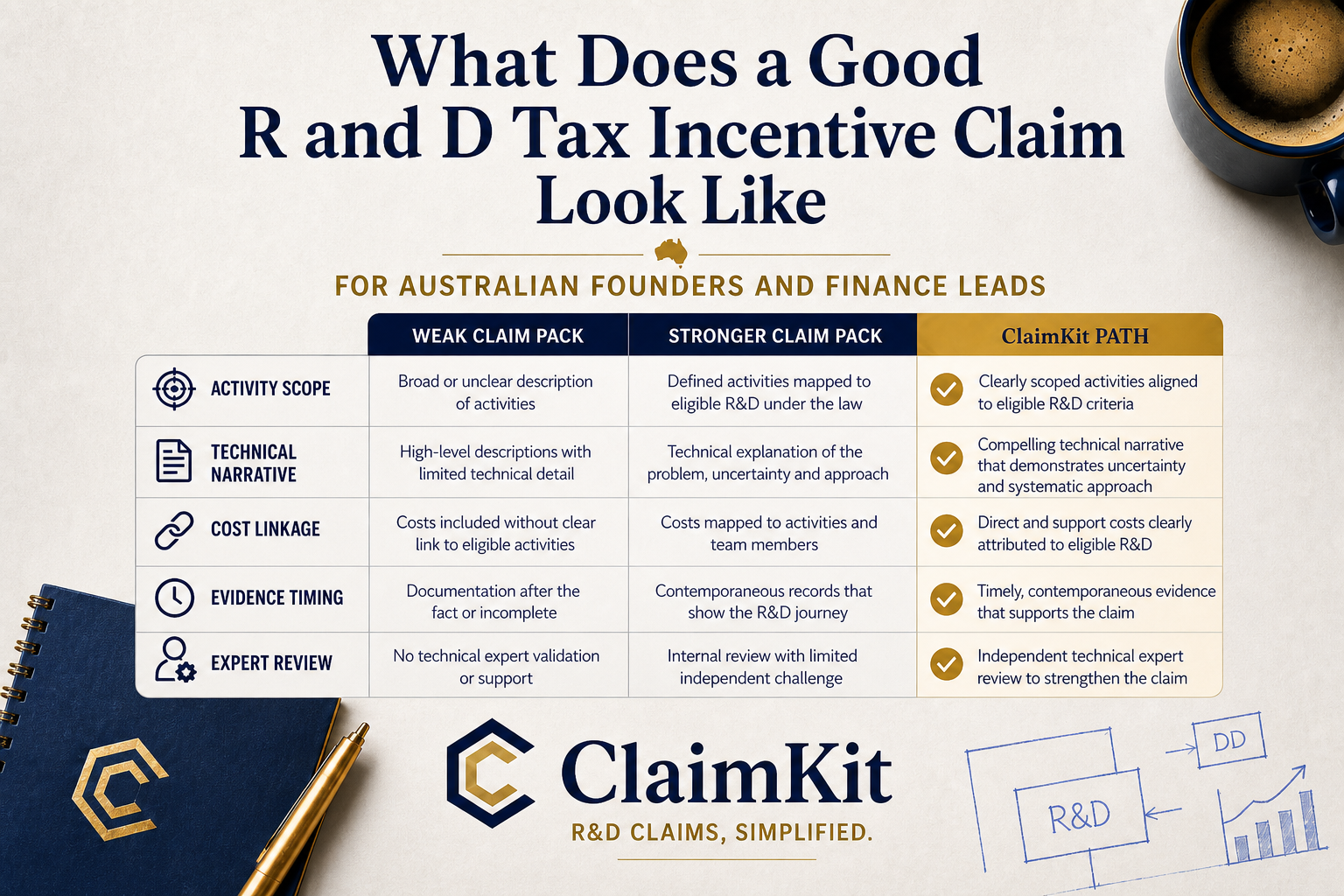
A smaller claim with strong evidence is often more valuable than a larger one built from memory and optimism.
If your adviser isn't asking awkward questions about engineering process, they aren't doing their job.
What Is the Typical Process and Timeline?
Most startup founders assume the process is a single EOFY task. It isn't. The best claims start before year-end and finish with far less drama.

Australia's system is built around the R&D Tax Incentive, which provides a tax offset of up to 43.5% for eligible companies with aggregated turnover under A$20 million, and it is jointly administered by the ATO and AusIndustry according to the Australian Government's R&D Tax Incentive guidance.
The process in plain English
A normal engagement runs through a few distinct phases.
-
Scoping
You meet with the adviser, explain the product, and walk through major projects. This step should feel like a technical conversation, not a sales script. -
Technical assessment
The adviser identifies where genuine experimentation happened. They should ask about failed approaches, constraints, unknowns, and how the team tested alternatives. -
Evidence collection
Most delays occur here. The team gathers project notes, issue history, commit records, architecture docs, payroll data, contractor details, and ledger exports. -
Narrative drafting
The adviser turns that material into project descriptions and supporting explanations that fit the claim framework. -
Financial quantification
Finance and the adviser align eligible labour and other costs with the projects being claimed. -
Registration and tax return coordination
The registration piece and tax return piece need to line up properly. If they don't, you're creating rework for yourself and your accountant.
For ongoing updates and practical startup examples, the ClaimKit blog is useful reading.
What founders should do around EOFY
EOFY is when the panic starts, but that's too late to start from zero.
The smarter approach is to treat R&D documentation as a monthly operating habit. Founders who leave everything until year-end usually force engineers and finance into retroactive reconstruction. That's slow, expensive, and messy.
A simple timeline looks like this:
| Stage | What should happen |
|---|---|
| During the year | Track experimental projects, technical decisions, and linked costs |
| Near EOFY | Confirm project scope, gather missing records, align finance and engineering |
| After EOFY | Draft technical narratives and expenditure schedules |
| Before registration deadline | Finalise the registration with AusIndustry |
| Tax return stage | Coordinate the claim position with the company tax process |
Don't wait until your accountant asks for the claim. By then, your engineers have forgotten the failed tests, and your finance team is guessing at cost allocation.
If you're pre-seed or seed, assign one owner now. Usually that's the finance lead or founder, with direct input from your CTO. Without a single owner, claims drift.
How Much Do R&D Tax Consultants Cost in Australia?
Pricing in this market is all over the place, and many founders compare quotes badly.
The headline fee matters less than the method, the effort required from your team, and whether the adviser leaves you with a defendable file. Cheap can become expensive if your staff spend weeks reconstructing evidence or cleaning up a weak draft.
The three pricing models you'll actually see
Success fee is still common. The adviser charges a share of the eventual benefit. Founders like it because it feels low-risk upfront. The downside is obvious. If your records are already clean and your claim is straightforward, you may pay more than the work justifies.
Fixed fee is cleaner. You know the number, the scope is clearer, and procurement is easier. This often suits companies with a stable process, predictable claim profile, or internal finance capability that can do part of the work.
Platform or hybrid pricing has become more relevant for software startups. The platform does much of the evidence gathering and drafting, and a human expert reviews and finalises the claim. That can reduce manual admin if your team already works in tools like GitHub, Jira, Linear, Notion, and Xero.
What a sensible founder should compare
Don't just ask, "What's your fee?" Ask these instead:
- What work does my team still need to do? Some firms quote attractively, then push most of the evidence assembly back onto you.
- How do you gather documentation? Manual questionnaires are slower and usually weaker than a process tied to your operating systems.
- Who writes the technical narrative? A tax generalist often misses the technical logic. An engineer-only draft often misses the statutory framing.
- What happens if there is a review? You want a clear answer on support, scope, and response process.
A founder at an early-stage SaaS business usually wants predictable cost, low team disruption, and a clear audit trail. A later-stage company with a bigger finance function may prefer a fixed-fee specialist if internal documentation is already strong.
The wrong way to buy this service is to optimise for the lowest fee. The right way is to optimise for evidence quality and founder time.
How Do I Choose the Right R&D Advisor for My Startup?
You don't need the biggest name. You need the adviser whose process matches how your team works.
If your engineers live in GitHub, Jira, Linear, and Notion, and your finance team lives in Xero, then an adviser who still runs everything through static questionnaires and a few interviews is already behind. That model can work, but it creates friction and usually relies too heavily on memory.

Traditional firms versus startup-focused models
Here's the practical comparison.
| Advisor type | Best fit | Typical strengths | Typical trade-offs |
|---|---|---|---|
| Large consulting firms | Later-stage companies with complex governance | Broad tax capability, process discipline, wider advisory bench | Higher cost, slower pace, less startup-specific workflow |
| Boutique R&D specialists | Startups and SMEs wanting hands-on support | Deeper focus on R&D claims, more tailored engagement | Quality varies by team, evidence collection may still be manual |
| Independent consultants | Founder-led businesses wanting direct access | Flexible communication, lean process | Capacity risk, less bench depth |
| Hybrid platform with expert review | Software teams with modern tooling | Faster evidence capture, better transparency, structured workflows | Still needs founder and engineering input to validate nuances |
Treadstone, Prime Partners, Link R&D Advisory, and Bulletpoint each sit in parts of that specialist market and may suit different startup profiles. Some founders want high-touch advisory. Others want a leaner process with more system-driven evidence capture. The right choice depends less on brand and more on fit.
If you want to understand the team and operating model behind one hybrid option, see how ClaimKit describes its company and approach.
Questions to ask before you sign anything
Use this list in your first call.
- How many software claims do you handle? You want specifics about software experimentation, not generic manufacturing examples.
- How do you distinguish R&D from normal sprint work? If they answer with buzzwords, move on.
- What evidence do you expect from Jira, GitHub, Notion, and Xero? Strong advisers can name the artefacts they care about.
- Who drafts the narratives and cost schedules? Sales-led firms often hide this.
- How do you handle edge cases and partial eligibility? Every real claim has grey areas.
- What support do you provide if the ATO or AusIndustry asks questions? This should be clear before engagement, not after.
Ask one uncomfortable question early: "What parts of our current process make our claim weaker?" The right adviser will answer quickly.
Red flags that should make you walk away
Some warning signs are obvious. Others are subtle.
- Guaranteed outcomes: Nobody credible should promise approval, refunds, or a specific result.
- Pressure to maximise at all costs: That's often code for weak judgement.
- No technical curiosity: If they don't ask about hypotheses, alternatives, and failed attempts, they're not testing eligibility properly.
- Black-box pricing: If you can't tell what work is included, expect change requests later.
- Little interest in records created during the year: That usually means they're planning a retroactive narrative.
There is one startup-friendly middle ground worth considering. A hybrid platform like ClaimKit can draft claims from connected tools such as GitHub, Jira, Linear, Notion, and Xero, then route those drafts through expert review and ATO lodgement. That model won't remove founder responsibility, but it can reduce manual chasing if your systems are already reasonably organised.
What Are the Next Steps for My Finance Team?
If your finance team wants a better claim this year, the answer isn't more spreadsheets. It's better operating hygiene.

Australian claimants increasingly need contemporaneous evidence across tools like Jira, GitHub, Notion, and finance systems, and a smaller, tightly evidenced claim is often lower-risk than a larger one rebuilt from memory after year-end, as explained in this discussion of documentation quality and substantiation.
Do these five things this week
-
Tag experimental work in your delivery tools
Create labels in Jira, Linear, or your issue tracker for work that involves technical uncertainty and testing. Don't tag every ticket. Tag the work where engineers are actively trying to prove something. -
Mirror that structure in finance
Set up tracking categories, cost centres, or project codes in Xero so salary and contractor costs can be traced back cleanly. -
Run a monthly finance and engineering check-in
Twenty minutes is enough. Confirm what experiments ran, what changed, and what evidence exists. -
Store short decision records
A brief Notion page or engineering memo is often enough if it records the uncertainty, the options considered, and the outcome. -
Nominate one claim owner
Usually this is the finance lead. Sometimes it's the founder. It should never be "everyone".
Set up a workflow that doesn't rely on memory
Most weak claims fail long before the claim is written. They fail when nobody captured the technical reasoning at the time.
A simple operating rhythm helps:
- Weekly: Engineers tag relevant tickets and keep commit history clean.
- Monthly: Finance checks wage mapping and contractor allocation.
- Quarterly: Founder, CTO, and finance review which projects still look claim-worthy.
- Pre-lodgement: Gather only what's missing, not the whole year from scratch.
If you want a visual overview of what that kind of system-driven process looks like, this walkthrough is a decent starting point:
If your current process depends on one stressed engineer remembering six months of technical decisions in June, fix that now.
Frequently Asked Questions About R&D Tax Consultants
Some questions come up in every founder conversation. Here are the ones that matter most.

Can I do an R&D claim myself?
Yes, you can. Whether you should is a different question.
If your work is simple, your records are clean, and your team already understands the eligibility framework, a DIY approach may be workable. But most software startups struggle with the same issue. They can describe product progress, but they can't easily translate that into a compliant experimental narrative tied to costs.
If you're unsure about software eligibility, this R&D tax incentive eligibility guide is a useful place to start.
What software work is usually worth assessing?
Work is usually worth assessing when the team faced real technical uncertainty and had to test alternatives to resolve it.
Examples might include difficult architecture problems, performance constraints, novel data handling challenges, or implementation approaches where the outcome wasn't known at the start. Routine feature builds, standard integrations, UI polish, and straightforward bug fixes are usually weaker candidates.
The key question isn't whether the product is new to your market. It's whether your team carried out systematic experimentation.
When do I need to register?
You need to manage the registration process on time with AusIndustry and coordinate it with the company tax return process. Don't leave that until the last minute.
If you're already close to deadline, get help quickly. The work isn't just submission. It's pulling together records that should support what you're submitting. The ClaimKit help centre is useful if you want to understand the mechanics before speaking with an adviser.
The deadline risk usually isn't the form. It's the scramble to invent a coherent evidence pack after the year has ended.
How is a platform different from a traditional consultant?
A traditional consultant usually relies more on interviews, spreadsheets, and document requests. A platform-led model usually starts by collecting information from the tools your team already uses, then drafting the claim materials from that data before expert review.
The practical difference is transparency. Founders can often see where the information came from and correct gaps earlier. Traditional consultants may offer more bespoke handling for unusual cases. Platform models may suit software startups better when the underlying records already live in structured systems.
The right choice depends on your team, your budget, and how disciplined your records are.
If you want a faster way to organise evidence and prepare a claim with expert review, ClaimKit is worth a look for software-focused Australian teams using GitHub, Jira, Linear, Notion, and Xero.
Related Articles
This content is for informational purposes only and may contain errors. Please contact us to verify important details.