The Australian Digital Solutions Program is a subsidised government service for small businesses, offering up to 5 hours of one-on-one digital mentoring for a $110 co-contribution, with support valued at $1,995 per business. It's useful if you need help with online selling, digital marketing, or cyber security, but for many tech startups it isn't the growth lever that matters most.
If you're building software, hiring engineers, and trying to get through EOFY cleanly, the bigger question isn't whether you can get a few hours of digital advice. It's whether you're capturing the evidence needed for an R&D Tax Incentive claim that may be worth far more than the mentoring itself.
Table of Contents
- What Is the Australian Digital Solutions Program?
- Is the Digital Solutions Program Enough for a Tech Startup?
- What Is the R&D Tax Incentive for Australian Startups?
- How Do You Create Audit-Proof R&D Documentation?
- How Should You Choose an R&D Tax Advisor?
- Your Digital Solutions and R&D Tax Questions Answered
What Is the Australian Digital Solutions Program?
Could a $110 advisory program help your business improve its digital operations? Yes. Is it the government program a software startup should build its finance process around? Usually not.
The Australian Digital Solutions Program is a federal small business support program that gives eligible businesses access to low-cost digital advice. It is designed for practical capability building rather than direct funding. In plain terms, you are buying structured guidance, not getting cash into the company.
For many small businesses, that is a sensible offer. A local services firm, ecommerce operator, or established SME can use it to improve online sales processes, tighten cyber security habits, or get clearer on streamlining operations digitally. Those are worthwhile outcomes if the business is still building basic digital maturity.
Who is it for
The program is aimed at eligible small businesses with an active ABN, generally those with fewer than 20 full-time equivalent employees. It is also intended to be accessible across metropolitan and regional Australia, so it is broader than the usual workshop model many founders expect.
That point matters because the program is built for wide small-business usefulness, not for the narrow evidence requirements of a tech company claiming R&D.
What the Program Delivers
The structure is simple. You receive access to qualified advisers and a limited amount of guided support across common digital business topics. You do not receive a grant to spend on product development, engineering, or specialist tax documentation.
Typical areas of support include:
- Online selling advice to improve ecommerce setup or digital channels
- Digital marketing guidance around visibility, campaigns, and acquisition basics
- Cyber security support to improve day-to-day operating habits
- General digital capability advice for businesses trying to run more efficiently
That has value. It is just a different kind of value than many startup founders assume.
I see the confusion often. A founder searches for government support, finds the Digital Solutions Program, and treats it as if it sits in the same category as the R&D Tax Incentive. It does not. One gives you a few hours of business advisory support. The other can materially change cash flow if you are doing eligible technical work and can prove it properly.
That is the gap traditional Digital Solutions advice rarely addresses. For a tech startup, an essential digital solution is often a system for capturing hypotheses, experiments, technical decisions, and developer evidence as the work happens. Tools built for R&D documentation workflows for startups sit much closer to that problem than a general small business mentoring program.
Use the Digital Solutions Program if your business needs help with digital basics. Do not confuse it with the process required to support a serious R&D claim.
Is the Digital Solutions Program Enough for a Tech Startup?
If you are building software that could generate a serious R&D Tax Incentive claim, should a small digital advisory program be your main focus? Usually, no.

Where the program helps
Founders still get value from broad business advice. Early teams often need better operating rhythm, clearer systems, and more discipline around sales and delivery. Advice on streamlining operations digitally can be useful if the business is still patching together basic workflows.
That support has a place. It just sits in a different category from the work that protects a large R&D claim.
Why it falls short for a tech startup
The core question isn't whether the business is becoming more digital. It's whether the company can prove eligible technical experimentation in a way that survives review.
That is where founders lose ground.
A software startup can be doing genuine experimental work and still end up with a weak claim because the evidence was captured late, scattered across tools, or written at too high a level. By the time EOFY arrives, engineers remember the outcome but not always the hypothesis, the technical uncertainty, the failed approaches, or why one path was abandoned for another.
I see this trade-off all the time. A founder spends energy chasing a modest advisory benefit while ignoring the internal process that supports a far bigger financing outcome. For a venture-backed or venture-scale team, that is usually the wrong order of operations.
Teams rarely struggle to describe the product they shipped. They struggle to reconstruct the technical decisions, experiments, and dead ends that made the work eligible.
The practical question is simple. If you had to defend your R&D position six or twelve months from now, would your evidence already exist in a usable form?
For many startups, the answer is no. GitHub commits exist. Jira or Linear tickets exist. Sprint notes exist. Slack discussions exist. What is missing is the system that connects those records into a clear R&D narrative tied to specific hypotheses, uncertainties, testing, and outcomes.
Here is the difference in practical terms:
| Focus area | Useful support | What a tech startup still needs |
|---|---|---|
| General digital operations | Advisory input | Internal adoption and follow-through |
| Marketing and online presence | Advisory input | Commercial execution |
| Basic cyber security habits | Advisory input | Ongoing controls and owner accountability |
| Technical uncertainty mapping | Limited help | Clear R&D methodology and evidence capture |
| Audit-ready R&D records | Limited help | Contemporaneous documentation tied to the work |
That is why I treat R&D documentation as a core digital solution for a software company. If the business is already investing heavily in engineers, product experiments, and unresolved technical problems, the priority is to capture evidence while the work is happening.
Founders comparing options should review specialised R&D documentation platform background and team information alongside any general advisory program. The better path is usually to use broad mentoring for operational basics, while putting serious attention into documentation systems that support the claim worth far more.
What Is the R&D Tax Incentive for Australian Startups?
The R&D Tax Incentive is the government program most software founders should study before they worry too much about a small advisory subsidy. It exists to support eligible experimental work, and for the right startup it can have a much larger financial impact than a short mentoring package.

Why founders pay attention to this program
For Australian tech startups with aggregated annual turnover under $20 million, the R&D Tax Incentive provides a 43.5% refundable tax offset on eligible R&D expenditure, with the application needing to be lodged within 10 months of the end of the financial year, as outlined in this R&D Tax Incentive guide for Australian companies.
That's the core reason finance leads care. If you're loss-making and investing in genuine product or technical experimentation, this isn't a side issue. It may materially affect cash flow planning.
A second source states the same headline benefit in more concrete terms: a startup under the turnover threshold may receive a $435,000 cash refund for every $1 million spent on eligible R&D while in a loss position, according to this startup R&D Tax Incentive overview.
There's also a minimum spend threshold. A company must spend at least $20,000 on eligible R&D activities in the financial year to qualify, based on this R&D eligibility explainer for Australian businesses.
What software work may qualify
Founders need to be careful. Not all software work is R&D.
Eligible claims generally turn on technical uncertainty, a hypothesis-led process, and systematic experimentation aimed at generating new knowledge. Routine software development, ordinary feature delivery, standard debugging, beta testing, or building internal admin tools with known methods may fall outside that line.
That distinction matters because many startups overestimate how much of their engineering spend is claimable. Building product is not the same thing as conducting eligible R&D.
Founder shortcut: Ask a simple question. Was the team trying to resolve a genuine technical unknown, or were they implementing a known solution with normal engineering effort?
If you want the formal program framework, the Australian Government R&D Tax Incentive guidance is the starting point. It won't tell you everything about your specific claim, but it does anchor the rules.
For more practical reading on startup-specific qualification issues, the ClaimKit blog has useful material on how software teams think about eligibility and evidence in practical application.
How Do You Create Audit-Proof R&D Documentation?
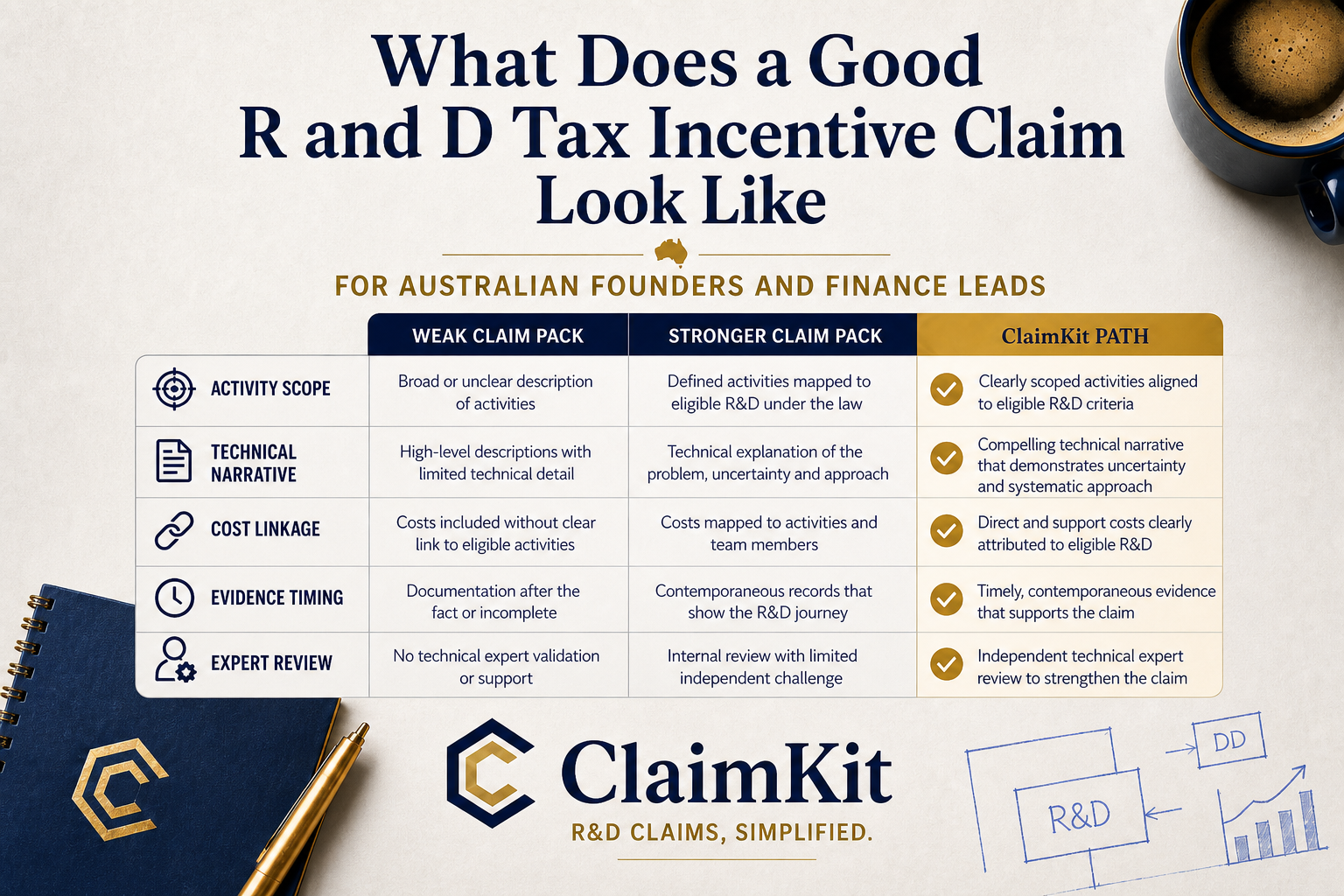
The outcome of good claims hinges not on a glossy summary prepared months later, but on the ordinary records your team creates while building.

The software development guidance for the R&D Tax Incentive is direct on this point. Failing to maintain real-time records such as weekly test reports, daily labour tracking by Core and Supporting activity, and code repository logs directly increases audit risk and claim rejection, according to the software sector guide for the R&D Tax Incentive.
What contemporaneous documentation looks like
Founders hear “documentation” and think it means writing a long report in April. That's too late.
Contemporaneous documentation means your evidence exists as the work happens. In practice, that usually includes development history, issue tracking, experiment notes, technical decisions, failed attempts, and time or cost allocation that can be explained later without guesswork.
A decent evidence set often draws from tools like GitHub, Jira, Linear, Notion, and Xero. The hard part isn't collecting raw data. It's translating that data into a technical narrative that shows a real problem, a systematic approach, and an outcome that can be evaluated.
Manual spreadsheets can work, but they often break under pressure. The team gets busy. Engineers stop tagging work cleanly. Product and finance interpret projects differently. By EOFY, someone is trying to reconstruct months of decisions from patchy ticket titles and half-remembered stand-ups.
That's also why teams working with internal AI tooling should pay attention to version control and evidence discipline more broadly. A practical piece on documentation for AI agents is useful because it reinforces the same operating principle: if you can't trace what changed, why it changed, and who decided it, your documentation quality drops fast.
What founders can do this week
You don't need to overhaul the company in one go. Start with a tighter operating rhythm.
- Define the experimental projects: Separate routine feature work from the projects where the team faced a genuine technical unknown.
- Lock the source systems: Confirm which tools hold the evidence. For most software startups, that's GitHub, Jira or Linear, Notion, and Xero.
- Create a recurring review cadence: Finance, engineering, and product should review candidate R&D work during the year, not after it.
- Track labour and contractor effort cleanly: If people split time across workstreams, record that as you go.
- Capture failures as well as successes: Failed experiments may still matter if the underlying work was eligible.
A practical demo helps make this more concrete:
If you're unsure whether your current records are good enough, don't start by asking whether the claim can be “made to work”. Start by asking whether an independent reviewer could follow the story from problem to experiment to conclusion using records your team created at the time.
For more operational guidance on evidence gathering and process questions, the ClaimKit help centre is a practical resource.
How Should You Choose an R&D Tax Advisor?
Most founders end up choosing between two broad models. A traditional R&D advisory firm, or a more tech-enabled platform with expert review built into the workflow.
Neither is automatically right. The choice depends on your team, data quality, internal finance maturity, and how much transparency you want during the claim process.

Traditional firms versus modern platforms
Traditional advisers such as Treadstone, Prime Partners, Link R&D Advisory, and Bulletpoint can be a reasonable fit if you want a highly hands-on engagement and you're comfortable with a consultant-led process. Some founders prefer that because they want direct access to an experienced adviser who can manage the claim from end to end.
The trade-off is usually process. Traditional firms often rely on interviews, document requests, spreadsheets, and retrospective narrative drafting. That can work, but it may feel slow and opaque to a software team that already has most of its evidence sitting inside engineering and finance tools.
A modern platform approach is different. Instead of starting with a blank document and a few interviews, it starts with the operating data your company already generates. For tech startups, that's often a better match.
Here's a fair comparison:
| Decision factor | Traditional adviser | Tech-enabled platform with expert review |
|---|---|---|
| Workflow style | Consultant-led | System-led, then reviewed by experts |
| Evidence capture | Often manual | Often integrated with existing tools |
| Visibility for founders | Can feel black-box | Usually more transparent |
| Speed to draft | Often slower | Often faster |
| Best fit | Complex advisory preference | Data-rich software teams |
Questions to ask before you sign
Don't pick an adviser based only on brand familiarity. Ask operational questions.
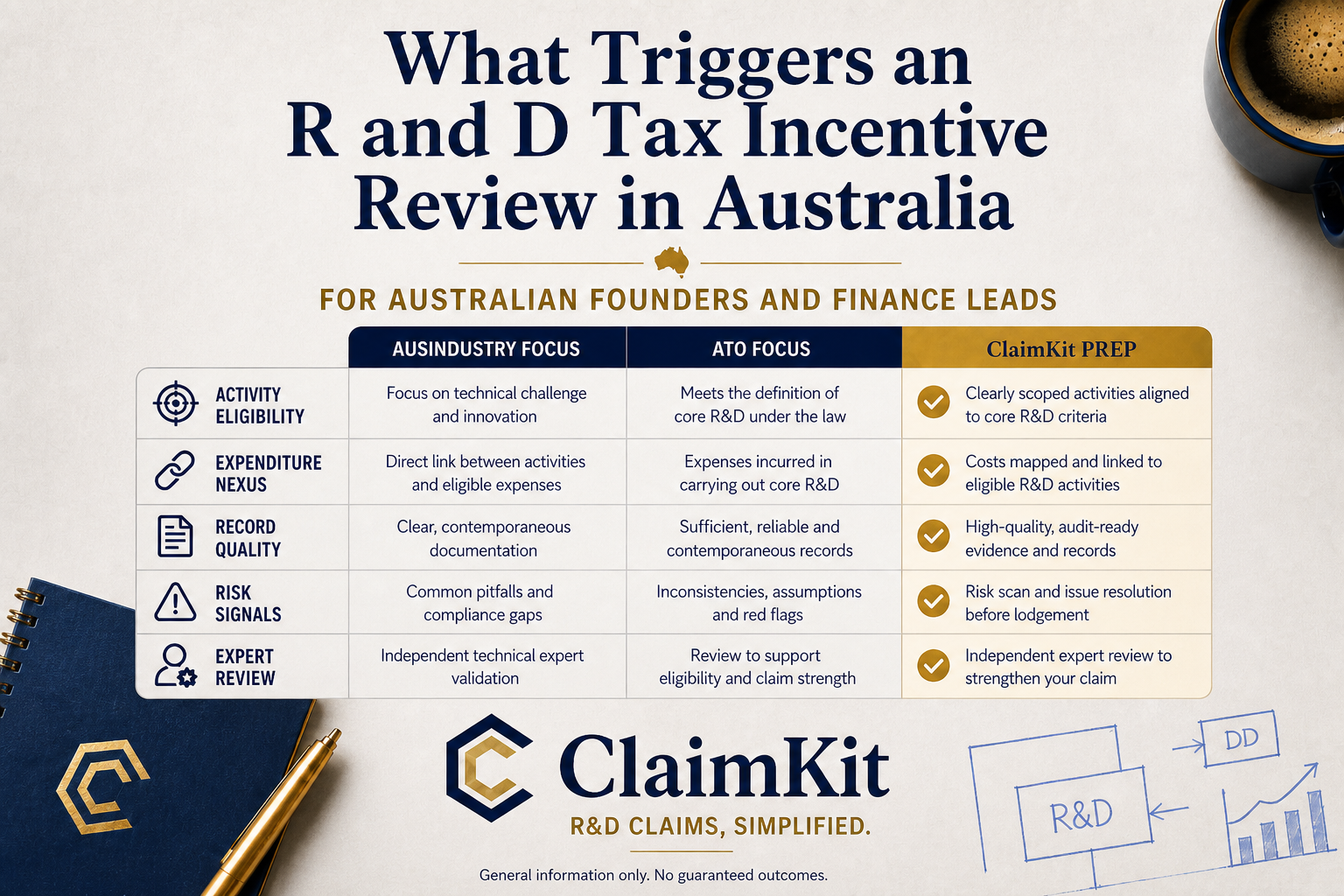
- How do you determine eligibility? You want a clear process for separating routine software development from genuine experimental work.
- How do you gather evidence? If the answer is mostly interviews and spreadsheets, expect more founder time.
- Who reviews the technical narrative? Claims should be prepared with expert review, not generated blindly.
- How do you handle EOFY timing? The right adviser should have a plan for documentation and lodgement windows.
- How transparent is the fee model? Percentage fees, fixed fees, and hybrid arrangements all create different incentives.
Ask to see the workflow, not just the pitch deck. A strong adviser should show you how evidence moves from source systems into a reviewable claim file.
Practical steps founders can take this week:
- Pull a project list from engineering and product. Mark which items involved technical uncertainty.
- Check data quality in GitHub, Jira, Linear, Notion, and Xero.
- Set an EOFY meeting with finance and engineering before records get colder.
- Shortlist two or three options across both traditional firms and software-first providers.
- Book a working session where the adviser reviews actual project data, not just a verbal summary.
If you want to compare support models that include specialist consultants, the ClaimKit consultants page is one place to benchmark what expert-reviewed, software-enabled claim preparation looks like.
Your Digital Solutions and R&D Tax Questions Answered
Can the $110 Digital Solutions Program fee be claimed under the R&D Tax Incentive?
Short answer. Do not assume it does.
The fee for Digital Solutions mentoring is a small operating cost. Whether any part of it can be included in an R&D claim depends on what the service covered and whether it relates closely enough to eligible R&D activities under the program rules. General business advice, marketing help, or broad digital capability support usually sits outside the claim.
If you want to confirm what the Digital Solutions Program covers, use the official business.gov.au Digital Solutions Program information. Then assess the fee in the same way you would assess any other startup cost. Ask what work was done, who used it, and whether it supported eligible experimental activity or general business improvement.
For most tech startups, this is the wrong optimisation target anyway. The real value sits in getting your R&D evidence, project mapping, and expenditure treatment right.
What's the minimum R&D spend for a startup to qualify?
There is a minimum expenditure threshold, but founders get into trouble when they focus on the dollar figure before they test eligibility.
A company can spend enough money and still have a weak claim if the work was routine implementation, feature delivery, or standard engineering. The threshold matters. The activity classification matters more.
That is why the practical question is not "did we spend enough?" It is "can we prove which part of that spend relates to eligible R&D?"
What if our R&D project failed?
Failure does not kill an R&D claim.
In software, some of the best evidence comes from work that did not produce the expected result. An abandoned model, a failed scaling approach, or an architecture decision that had to be reversed can all support a claim if the team was addressing technical uncertainty and kept records of the hypothesis, tests, results, and conclusions.
Founders often underclaim here because they only document shipped features. Auditors care about the experimental process, not whether the release made it into production.
Should we still use the Digital Solutions Program at all?
Yes, if you need basic business support at a low cost.
It can help with general digital capability, advisory sessions, and practical small-business guidance. For a SaaS or deep tech startup, though, it should sit well below the R&D Tax Incentive on your priority list. One is a modest support program. The other can materially change cash flow if your claim is well prepared.
Use the program if it solves a real operational problem. Just do not confuse it with the documentation system your R&D claim requires.
How do we reduce risk before EOFY?
Start before EOFY, not after it.
Pull together your engineering records, financial data, and project history while people still remember what happened. Check whether your source systems can show a clear link between technical work, staff time, contractor costs, and the experiments you may want to claim. If a provider will handle sensitive project and financial records, review their data handling standards first. The ClaimKit privacy policy for startup claim data is one example of the kind of information you should inspect before sharing source material.
The safest path is boring. Good records, consistent project descriptions, and clear technical narratives beat retrospective storytelling every time.
If your startup is doing real engineering work and you want a cleaner path from evidence gathering to expert-reviewed claim preparation, ClaimKit is worth a look. It connects with tools like GitHub, Jira, Linear, Notion, and Xero, helps draft the technical narrative and financial schedules, and combines that with expert review and ATO lodgement support so your team can move faster with better documentation.
Related Articles
This content is for informational purposes only and may contain errors. Please contact us to verify important details.